Meet The Rock: Small 3D Printed Speakers Promise Big Sound


 Music fans know the thrill of opening a long-anticipated album and popping it into the CD player, or iPod dock, or turntable, depending on your generation or preferences. It’s sometimes a tense moment; this could be your new album of the year, or it could be a terrible letdown. I always feel a little bit betrayed when one of my favorite artists comes out with a dud, but it happens. I’ve learned not to judge a record by first listen, though; what initially seems like a disappointment sometimes grows into a masterpiece after giving it a few playthroughs. The transformation seems miraculous, but a lot of it depends on the quality of the speakers you’re using. There’s a big difference between listening to something on your quiet, outdated laptop and blasting it on your car stereo, letting it surround you as you breeze down the road. I never make any judgement on a record until I’ve given it a proper “car listen.”
The creators of The Rock know the importance of well-crafted speakers. Austrian companies MOSTLIKELY and mo° sound have teamed up to create a set of 3D printed speakers whose multi-sided, quasi-spherical design allows for sound quality way beyond what you’d expect from such a compact device. The design was based on three principles of sound:
- Ideal Stereo Imaging: As described by the creators, the ball-shaped speakers were designed like “an imaginary sound space, like a three-dimensional stage, on which the location of each performer can be clearly located.” This allows for a surround-sound, concert-like experience.
- Chaos Inside: It may sound like the title of an emo album, but it actually describes the sound quality produced by The Rock’s odd shape. Because the speaker is made up of many walls of differing shapes, angles, and sizes, sounds waves are less likely to crash into each other, allowing for a clearer sound.
- The Point Source: While other speakers have several sources of sound, The Rock transmits a full sound frequency from one single chassis, creating improved spatial sound.
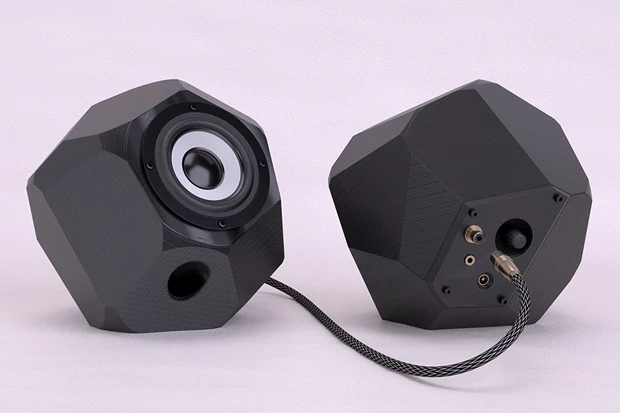
The Rock is one of the first 3D printed products developed by MOSTLIKELY, an agency that creates everything from buildings to art installations to music videos. The spherical speakers are a variation on the porcelain ball-shaped speakers that mo° sound has been producing since 2011. 3D printing allowed the designers to have more control over the shape and density of both the inside and the outside of the speakers. With a weight of only 1kg per speaker, the size of The Rock speakers should come as a relief to anyone who remembers having to haul massive box speakers up and down the stairs for the sake of a decent sound system.
 Right now The Rock is being marketed through an Indiegogo campaign with a flexible goal of €500. A contribution of €350 will get you a set of active speakers, or speakers that include an amplifier. €280 gets you a pair of passive speakers, amplifier not included.
A wide range of colors are available, and delivery is expected to be in February 2016. The speakers, which were printed in PLA, have been fully designed and tested and are made on order. Have you tried out these speakers? Let us know in the Rock 3D Printed Speaker Forum on 3DPB.com.
Here’s a time-lapse video of one of the speakers being printed:
Subscribe to Our Email Newsletter
Stay up-to-date on all the latest news from the 3D printing industry and receive information and offers from third party vendors.
Print Services
Upload your 3D Models and get them printed quickly and efficiently.













You May Also Like
Bambu Lab 3D Printers Bring a 166-Million-Year-Old Dinosaur Back to Life
Fourteen desktop 3D printers spent seven weeks producing the bones of a dinosaur that lived roughly 166 million years ago. The result is now on display at Blenheim Palace in...
3D Printing Financials: Creality Warns of H1 Loss Ahead of Earnings Report
Creality (HKG: 3388) is expecting to report a loss for the first half of 2026, just months after the 3D printer maker went public in Hong Kong. In a profit...
Kupros Launches Cu29 V2, Announces Process for Embedded Electronics from Desktop FFF & FDM
In addition to its more traditional uses, the centrality of copper to an unusually large number of high-growth industries has led more than a few observers to argue that it...
Bambu Lab and Insta360 Invite Makers to Build Custom Camera Gear
Bambu Lab is expanding the role of MakerWorld, its community platform for 3D printable models. The company has partnered with camera maker Insta360 to launch the Luna Ultra Design Challenge,...