3Doodler EDU Team Uses LEGOs to Teach STEM Lessons


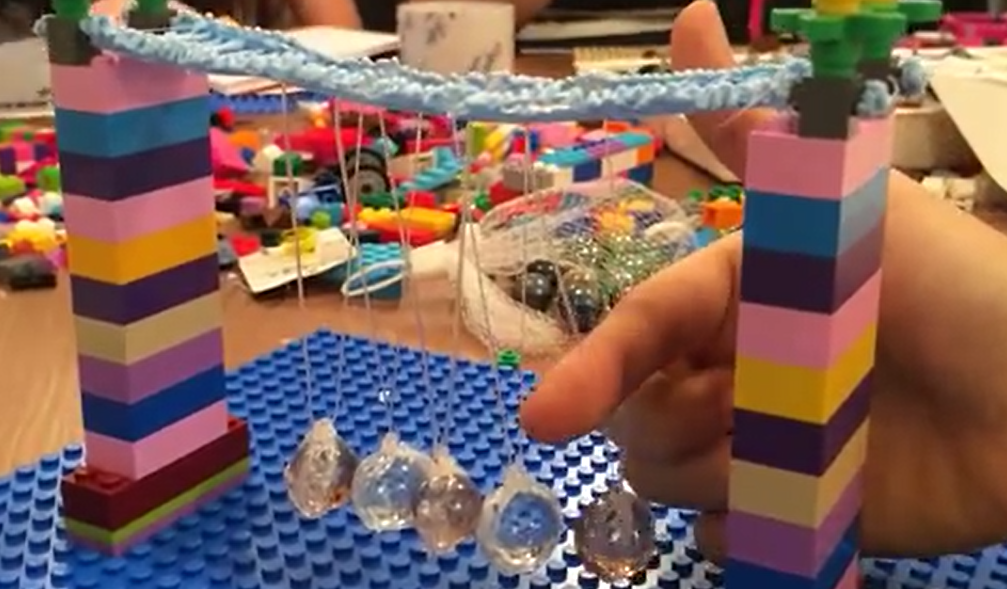
If you are American and were stopped on the street and randomly asked, “What do you think the most popular educational toy is of all time?” there’s a high likelihood you’d answer “LEGOs.” These brightly colored building blocks have evolved into much more complex toys that can be put together (in fact, the word “lego” is Latin for “put together”). LEGOs were first manufactured in 1947 in Denmark, although they are so synonymous with American childhood that one would think they were started here. Here we have seen the LEGO manifest in many guises, as 3D designers have expressed their ongoing appreciation for LEGOs and their educational value. Now 3Doodler, maker of the 3D printing pen, is getting in on the LEGO action too with their “5 Inventive Challenges Integrating 3Doodler and LEGO.”
The ideas behind these Challenges is that you will use LEGOs to form the larger structures and then use the 3Doodler to fill on the extra flexible parts. These Challenges are designed to teach basic scientific principles that are also compatible with the Science, Technology, Engineering, and Mathematics (STEM) curriculum that is being used more and more in classrooms.
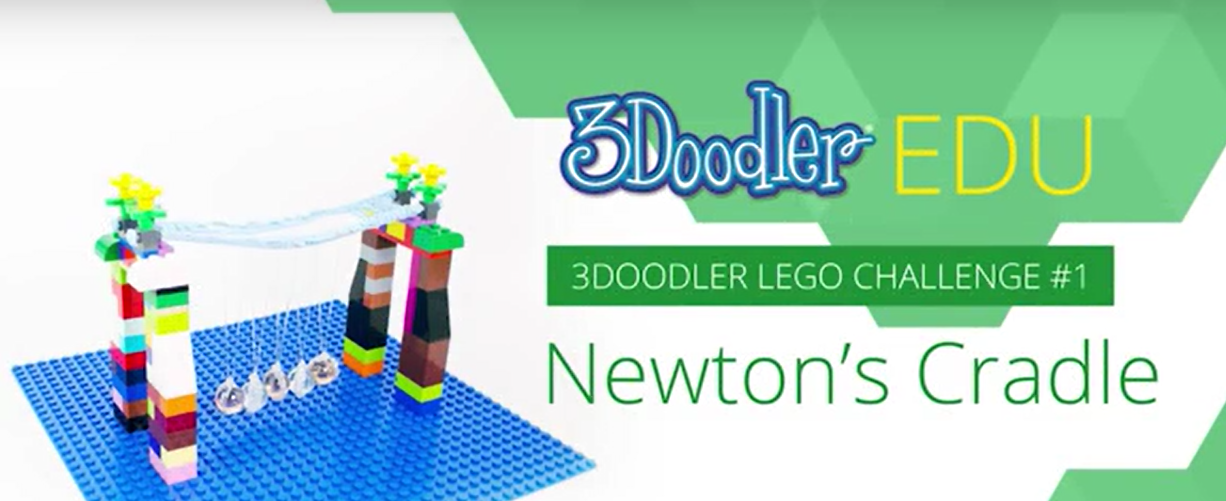
Take as one example the first Challenge, Newton’s Cradle, which is designed to teach students about Newton’s Laws of Motion and the transfer of energy (“For every action there is an equal and opposite reaction”). With this project, you can also see how the speed or direction of the spheres is changed by the design; compare how pushing and pulling the spheres creates different effects; and measure the spheres to show that patterns can predict future motion.
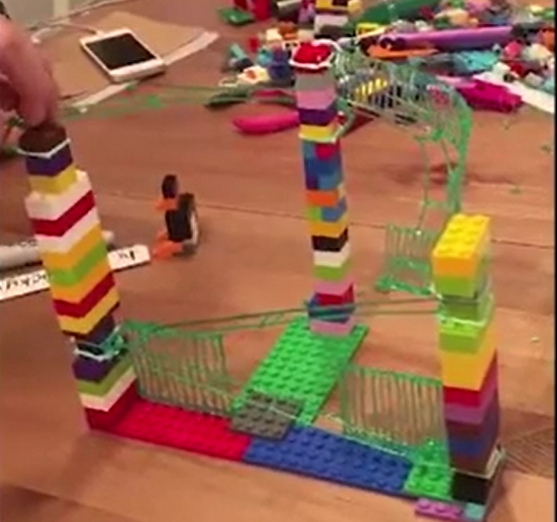
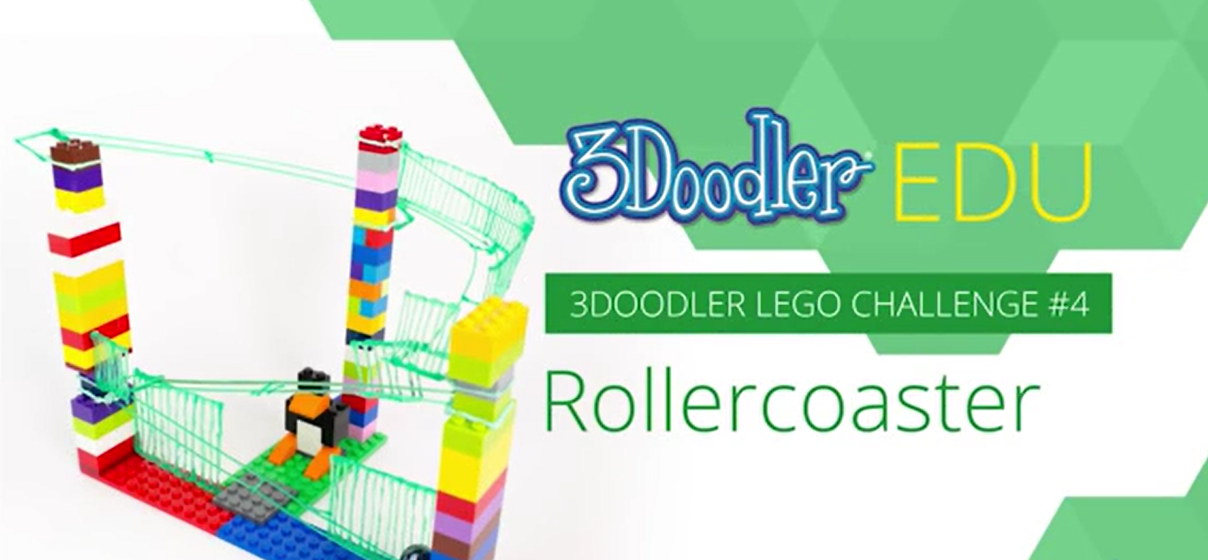
Another example of a 3Doodler LEGO Challenge is #4: Rollercoaster. This challenge is designed to teach the lesson that “It is a slippery slope from potential to kinetic energy.” This unique rollercoaster also shows how design choices control the rollercoaster’s speed and control; how you problem solve to keep your marble on your course; and how rollercoaster banks and curves can be managed to control your marble.
The other three Challenges are just as compelling as the two described here: a catapult; a pulley; and a trampoline. Each Challenge comes with a link to a YouTube video showing the structure in action, Advanced Challenges for the real LEGO experts, Reference Materials, and a list of materials needed to complete each individual Challenge.
 These lessons also seem well-designed for various ages. Some students can focus on the basic intended lesson, while the additional materials of the Advanced Challenges and Reference Materials, can make the lessons more complex, too. What a great way to learn Science and Engineering principles, and have fun with LEGOS and a 3Doodler, too!
The 3Doodler EDU Team wants to see your creations if you complete any of the Challenges (#WhatWillYouCreate) by sending them photos of your completed Challenges. And they are also taking suggestions for their next five Challenges, so if you get any new ideas, send them their way and you might just see your idea used to teach STEM lessons! Let’s hear your thoughts on this initiative in the 3Doodler & LEGO forum thread on 3DPB.com.
Subscribe to Our Email Newsletter
Stay up-to-date on all the latest news from the 3D printing industry and receive information and offers from third party vendors.
Print Services
Upload your 3D Models and get them printed quickly and efficiently.












You May Also Like
Conexeu Sciences Wishes to Make a Regenerative Breast Matrix Solution (and sell shares)
Conexeu Sciences wants to commercialize a regenerative breast matrix solution. For years, Australian firm BellaSeno and Lattice Medical have been working on similar solutions. In 2018, Lattice came out with...
3D Printing News Briefs, August 23, 2025: Facial Implants, Tibial Fractures, Lamps, & More
It’s all about medical in this weekend’s 3D Printing News Briefs. BellaSeno established a clinical advisory board. MedCad is donating 3D printed facial implants to war-injured Ukrainians, and researchers in...
BellaSeno’s 3D Printed Breast Implants Keep Shape with 87% Fat Volume, Avoids Silicone Risks
At a medical conference in Austin this week, a new kind of breast implant took center stage. It is not made from silicone but from a 3D printed, fully resorbable...
BellaSeno Completes Two Clinical Trials on 3D Printed Resorbable Breast Implants
German firm BellaSeno, which is focused on 3D-printed resorbable breast implants for both augmentation and lumpectomy, has completed two clinical trials for resorbable breast implants. These trials represent the first-ever...