Optical Transient Liquid Molding: UCLA Bioengineers are 3D Printing on the Microscale

 Versatile is a term we hear bandied about as a necessary feature for many items and processes, but often we aren’t quite sure how it applies specifically–to anything, anymore. With 3D printing, versatility is plain as day, and it is truly what makes the technology so attractive to people with ideas–whether they are planning on going really big or really, really small.
Bioengineers at the UCLA Henry Samueli School of Engineering and Applied Science have some ideas all right. Looking toward applications which could prove powerful in biomedicine but also other industries, these researchers aren’t just going small with their project–they are going microscopic–using software to design objects as small as 100-500 micrometers in size, and features as small as 10-15 micrometers. The first question is, as one shakes the head, how in the world do they do something like this? And two, why do they want–or need–particles as small as the width of a human hair?

Henry Samueli School of Engineering and Applied Science, Engineering VI
Chueh-Yu Wu, Keegan Owsley, and Dino Di Carlo have outlined exactly why–and far more–in their paper recently published in Advanced Materials, called “Rapid Software-Based Design and Optical Transient Liquid Molding of Microparticles.” With a completely new technique that would not be possible without 3D printing, the team is able to use UV light patterns to manipulate objects shaped by a photopolymer precursor stream. Optical transient liquid molding (TLM) is the name of the process which employs the 2D light patterns to create objects researchers have found elusive up until this point, even with 3D printing.
“…mass production of microscale features or objects is difficult to achieve. Optical lithography approaches that leverage microfluidic delivery of precursor photopolymer streams such as stop-flow lithography, possess many of the advantages of 3D printing technologies and have expanded fabrication to microscale objects (i.e. particles) with a relatively high manufacturing rate that is on an upward trajectory,” states the research team in their paper.
Rather than accepting limitations in this area, the bioengineers kept working for a solution, and found one through the shaping of the polymer precursor stream before extrusion. With these streams they can create 3D fibers and particles, but challenge remained in ‘shrinking’ them to the microscale. Using TLM, they are able to achieve smaller channel flow as well as using the unique ‘stopping flow.’
“TLM is a universal strategy to rapidly refresh and control high-speed flow inside microchannels enabling 3D design of particle shape and layered structures in silico, fabrication of the design in reality, and finally application to advanced microparticle systems,” states the team in their paper.
The two fluids used are combined in pillars which in turn control the shape of the liquids coming together. These fluids are the liquid polymer and the liquid mold. Using this technique means that the shape is dependent on the arrangement of the pillars, which the researchers can vary using their previously developed software, uFlow, available for free download to anyone.
“It’s like we squeeze dough through a mold, which is the liquid mold, to make a noodle and then cut the noodle into pieces using another mold — the patterned UV light,” said Chueh-Yu “Jerry” Wu, lead author and graduate student of Di Carlo.
![UCLA bioengineers develop a way to make objects smaller than a human hair [Photo Credit: UCLA Henry UCLA Samueli School of Engineering and Applied Science]](https://3dprint.com/wp-content/uploads/2015/11/micro-object_mid-520px.jpg)
UCLA bioengineers develop a way to 3D print on the microscale [Photo Credit: Chueh-Yu Wu/ UCLA]
“We know that shape often determines material function, so while we have a few ideas of what this could lead to, this fundamental capability to produce made-to-order 3-D microparticles could be applied in ways we have not contemplated,” said Dino Di Carlo, the principal investigator on the research and a professor of bioengineering at UCLA. “There are so many potential applications — in that sense, it’s really exciting.”
The researchers are now able to 3D print one of these objects every five seconds. Let’s hear your thoughts on this method of printing in the Microparticle 3D Printing forum thread on 3DPB.com.
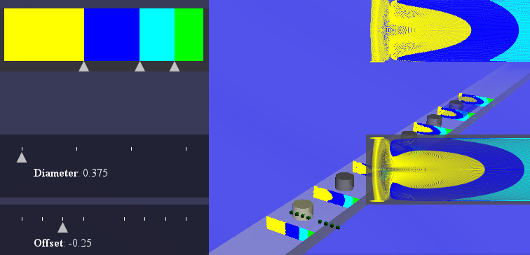
uFlow is a computer-aided design (CAD) tool for the rational design of inertial flows.
Subscribe to Our Email Newsletter
Stay up-to-date on all the latest news from the 3D printing industry and receive information and offers from third party vendors.
Print Services
Upload your 3D Models and get them printed quickly and efficiently.













You May Also Like
AI Design and Point-of-Care Integration Headline ADDITIV Medical 2026
Medical additive manufacturing is expanding rapidly inside major healthcare institutions. In 2026 alone, hospital systems including Indiana University Health and Sheffield Teaching Hospitals launched dedicated point-of-care 3D printing facilities to...
GKN Aerospace’s UAV Demonstrator with 3D Printed Engine Avoids ITAR Regulations
The US CIA director recently made an unannounced visit to Moscow that has naturally raised much speculation, while the EU and NATO have now officially accused Russia of being behind...
The Business Case for 3D Printed Stents
A new 3D printed stent developed at New York University (NYU) does not look like the devices doctors typically use today. Instead of a simple tube, the prototype resembles a...
3D Printing Financials: 3D Systems, Prodways, and Align Build on Positive Momentum
The latest earnings from 3D Systems (NYSE: DDD), Prodways (EPA: ALPWG), and Align Technology (Nasdaq: ALGN) show that the 3D printing market continues to move forward. Some businesses are growing...