Modified Bees Could Be the 3D Concrete Printers of the Future

In the past we have seen where bees have been put to use in an art project where they 3D print shapes via honeycombs. Now a man named Geoff Manaugh, former editor-in-chief of tech website Gizmodo and designer John Becker have come up with a bioengineering scenario in which bees would replace 3D printers. In an interview with Dezeen Magazine, the duo lay out a scenario in which the bees of the future would be genetically modified and trained to print and repair buildings and other structures by producing a concrete-like material from their glands, instead of producing honey.

Concrete patterns could be “printed” onto buildings by bees. Photo courtesy Dezeen.
According to Manaugh, the bees would be able to repair structures after being housed inside a mold that is in the shape of the area needing repair. Though Manaugh said in his scenario that bees would eventually be able to create free-standing structures from scratch, but he hasn’t laid out exactly how that would be accomplished.
Manaugh and Becker came up with the idea of “construction worker” bees after reading about entities such as the U.S. military and the Massachusetts Institute of Technology using genetically modified animals to create things such as weapons-grade silk and enclosures. The duo think that bees and other genetically modified animals make better “factories” than the ones people currently use.
“The notion that we could abandon industrial dyes, fossil fuels, artificial adhesives, and other toxic, carcinogenic, or environmentally damaging materials and, instead, work humanely with the bodies of animals to produce viable alternatives is actually an enormously exciting possibility,” said Manaugh. “It combines synthetic biology with biomimetics, and suggests that the future of industrial production might someday be visually indistinguishable from a rain forest, coral reef, or garden.”
Also, the process to convert worker bees into actual construction workers wouldn’t be that much of a leap from what nature intended as some bees already produce natural products that are similar to those created in labs.

“There is already a species of bee native to New England that naturally produces a cellophane-like polymer that could, in theory, be used as an industrial alternative to plastic, one that does not require the use of fossil fuels; and something as simple as a special dietary regime for silkworms resulted in naturally dyed silk, free from industrial inks or coloring,” said Manaugh. “It was examples like these — and there are dozens — that inspired us and kept the idea moving forward.”
Though Manaugh and Becker think their idea is a viable alternative to the way things are currently done, they made it clear that their idea is speculative and not a blueprint for a brave, new, bee-built world.
“Living creatures are not just an industrial resource for humans to use and exploit, turning them into 3D printheads on a whim,” said Manaugh. “This is another reason why our idea of printing architecture using genetically modified bees is presented as the plot of a fictional story, not as an actual biological design proposal for 3M or BASF to consider investing in.”
Regardless, such a possibility certainly is intriguing. Imagine bees that are able to be placed on certain damaged areas of buildings, which can then 3D print a concrete-like substance from their glands, similar to they way in which they produce honey. Certainly animal rights groups may not a green with such a manipulation of the natural abilities of these creatures, however, the benefits could outweigh the harm done, if any to the bees. What do you think? Is such a concept a future possibility? Let us know your thoughts in the Bee 3D printer forum thread on 3DPB.com.
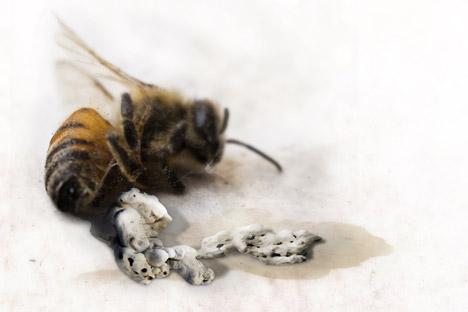
Dead bee with “concrete honey” excretions. Photo courtesy Dezeen.
Subscribe to Our Email Newsletter
Stay up-to-date on all the latest news from the 3D printing industry and receive information and offers from third party vendors.
Print Services
Upload your 3D Models and get them printed quickly and efficiently.











You May Also Like
Fabric8Labs & University of Illinois Collaborate on 3D Printed Copper Cold Plates for Data Centers
Collaboration between emerging technology enterprises and research universities is one of the most consistently winning tactics for any nation building (or rebuilding) an industrial ecosystem. It’s an especially constructive approach...
Medical, Electronics, & Semiconductors: Detailed 3D Prints at RAPID 2026 with Boston Micro Fabrication & Lithoz
They say that good things come in small packages, and that’s certainly the case when it comes to Boston Micro Fabrication (BMF). A leader in micro-precision additive manufacturing, the company...
3D Printing News Briefs, April 18, 2026: Educational Grants, Bambu X1, & More
In today’s 3D Printing News Briefs, SPE announced a collaboration to expand 3D printing education through its equipment grant program. Bambu Lab has retired its X1 Series of FFF 3D...
Alloy Enterprises Is Being Acquired as AM Consolidation Continues
Johnson Controls has agreed to acquire Alloy Enterprises in a deal expected to close in the third quarter of the year. The move brings Alloy’s advanced manufacturing and thermal management...