Shapeways’ Pendant and Keychain Creators Make 3D Design Simple

 When I mention to people that I write about 3D printing, I often get impressed looks and comments like, “Wow, that’s really high-tech!” or “I have no idea how that stuff works.” They’re often surprised when I tell them how accessible it is, especially through sites like Shapeways. Even a quick browse through the user-friendly Shapeways site can be a bit intimidating for someone completely unfamiliar with 3D printing, however. It’s easy to look at the complexity of some of the jewelry, art and housewares and think, “I’d never even know where to start with something like that.” Well, rest easy – Shapeways is now offering an application to help even the greenest 3D printing novices create their own, personalized 3D printed accessories.
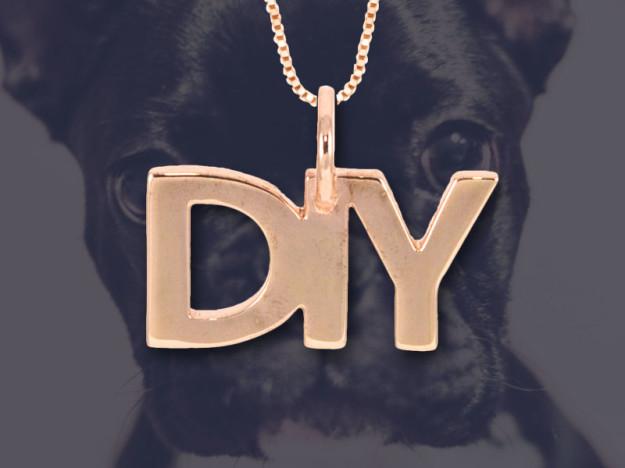
The Shapeways Pendant Creator and Keychain Creator are exactly what they sound like – step-by-step tutorials that lead you through the process of creating your own 3D printed pendant or keychain. On a whim, I decided to try it myself.
 For all the writing I’ve done about Shapeways, I’ve never actually ordered anything from them, so I figured it was time to change that. I decided to create a pendant using the beginners’ tutorial. First I needed to upload a design. Shapeways suggests you keep it simple, like a black and white shape or pattern; I went with a simple hummingbird silhouette. The site allows you to customize the size and thickness of your pendant, but for the sake of simplicity I decided to stick with the default settings: 30mm, with a 2mm thickness. You can also alter the sharpness of the image, softening the edges if you like, or add a backing, if your piece contains bits that are detached from the main design. Finally, I added a loop for a chain, clicked “create my pendant,” and, within ten seconds, my pendant was ready to order. I selected red polished strong and flexible plastic, placed my order, and was done. The whole thing probably took five minutes, once I settled on a design.
 In short, the Pendant Creator and Keychain Creator are pretty nice applications for 3D printing novices. It’s incredibly simple to use, as long as you keep in mind that you’ll need to stick to relatively simple designs. A grayscale option is available for more advanced users, but for the most part it’s very straightforward. It’s inexpensive; my red hummingbird pendant cost me a whopping $2.81 before shipping. I can see it being a great way to introduce kids to 3D printing for the first time, or to allow them to make their own personalized but inexpensive Christmas presents. I may try it again sometime, with a bit more planning ahead, and use something I drew myself instead of Google-image clip art. It’s a fun way to experiment with turning your own art into jewelry without a major commitment of time and money.
Discuss this story here.
Subscribe to Our Email Newsletter
Stay up-to-date on all the latest news from the 3D printing industry and receive information and offers from third party vendors.
Print Services
Upload your 3D Models and get them printed quickly and efficiently.












You May Also Like
Bambu Launches A2L: What the New Printer Reveals About Its Strategy
Bambu Lab continues its relentless march for 3D printing domination with the launch of the A2L. The 330 × 320 × 325 mm printer will have a nozzle temperature of...
3D Printing News Briefs, May 30, 2026: RIMPAC 2026, Acquisition, Ceramic Implants, & More
We’re kicking things off with materials news in this weekend’s 3D Printing News Briefs. Then it’s on to a hybrid manufacturing system for a maritime exercise, an expansion of industrial...
3D Printing News Briefs, May 28, 2026: Continuous Fiber Reinforcement, Bioprinted Trachea, & More
In today’s 3D Printing News Briefs, America Makes announced the winners of its JAQS-SQ Project Call. Axtra3D is partnering with Keystone Industries to expand its dental material ecosystem, while BigRep...
Peopoly Unveils $15,000 Giga 800 FGF 3D Printer for Large Pellet Prints
Peopoly is known for its Magneto X, a printer that eschews belts and uses linear motors instead. The company also has a vat polymerization system, and now is moving into FGF...