Replicas of 6th and 7th Century English “Staffordshire Hoard” Artifacts Are 3D Printed

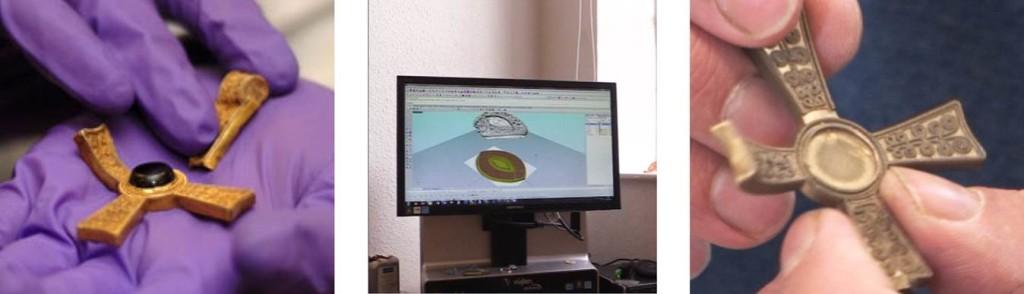
In 2009, a remarkable stash of over 3,500 objects was found in an English field. These artifacts were dated back to the “Kingdom of Mercian Era” — roughly the 6th and 7th centuries — and this huge silver and gold metalworks collection became known as “The Staffordshire Hoard.” The Staffordshire Hoard is jointly owned by the Birmingham and Stoke-on-Trent City Councils, and the collection is held by Birmingham Museums Trust and the Potteries Museum and Art Gallery. These groups approached Birmingham City University’s Jewellery Industry Innovation Center (JIIC) because they wanted to reproduce some artifacts from the Hoard for public handling and wider public access. Enter 3D printing with the JIIC.
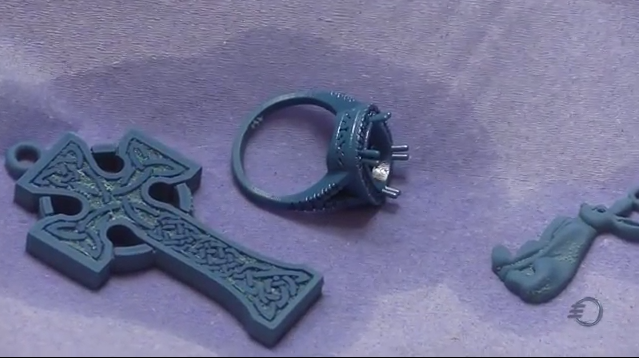
The JIIC is part of the Birmingham School of Jewellery, and it is recognized for “highly complex CAD/CAM and laser technologies” used by companies for product development. JIIC was a good fit for The Staffordshire Hoard museum project since it facilitates access to high-end technologies for businesses that don’t normally have access to them. So, the idea of 3D printing some collection pieces was born, which would let people handle the pieces and learn more about the people and culture of the Mercian Era. And there’s plenty to learn. For example, did you know that Mercia was originally a pagan kingdom that eventually adopted Christianity through the influence of King Peada around 656?
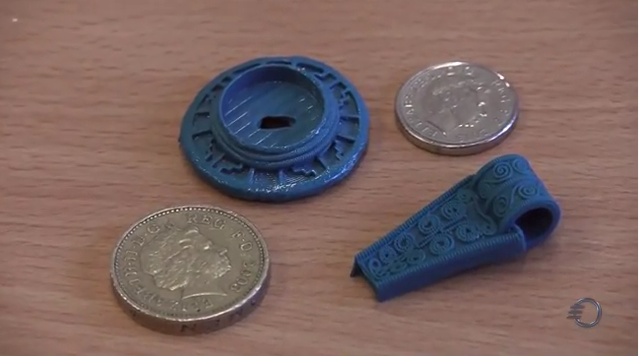
When JIIC’s Frank Cooper heard about the project, he knew which type of printer they’d be using:
“If we need some casting prototype produced that we are 99.9 percent certain will work in the casting process, then we will go to the Solidscape machines… The [Solidscape] build quality is fine, the repeatability is excellent and it’s pretty much ‘press go and leave.’ Our favorite process is to switch it on at night … and then take the stuff off the next morning and do all the final finishing. It’s never failed us.”
The other beneficial aspect to the prototyping process in this project is not only the creation of replicas intended to be handled, but model designers could speculate about the appearance of the original artifacts too. Just a brief look at the artifact collection reveals objects ranging from seahorses to crosses, helmet cheek pieces, studs, plates and pyramids. Some artifacts are engraved with intricate designs such as animals or abstract patterns, and almost all of the pieces are somehow related to Mercian warfare.
Since there is so much to be discovered still about the time period, it is clear that the artifacts that make up the Staffordshire Hoard are an important key to unlocking this history. This collaboration between those who care for The Staffordshire Hoard artifact collection and those who are on the cutting edge of new 3D printing technology is a testament to the educational value of blending old (medieval, in this case) and new (technologies.) It certainly makes me want to learn more about this time period, and if you feel the same way, you can get started by watching the video below:
Discuss this story in the Artifacts 3D Printing forum thread on 3DPB.com.
Subscribe to Our Email Newsletter
Stay up-to-date on all the latest news from the 3D printing industry and receive information and offers from third party vendors.
Print Services
Upload your 3D Models and get them printed quickly and efficiently.











You May Also Like
3D Printing Predictions 2026: Industrial Production & Polymer Additive Manufacturing
Polymer additive manufacturing is seeing less investment, attention, and disruption than metal additive manufacturing currently. Less crucial for defense needs, it has of late had far fewer new entrants. But,...
EPFL Is Growing Metal
Over the years, researchers in additive manufacturing have been working on different hydrogel systems for scaffolds, supports, and parts. Others have worked on different forms of growing 3D prints, while...
Boston Micro Fabrication Secures U.S. Patent for Dual-Resolution microArch D1025 3D Printer
The growth of reshoring has catalyzed interest in leveraging additive manufacturing (AM) for very large parts, most notably those used in U.S. maritime applications. As the momentum behind reshoring continues to...
SEOULTECH Researchers Make Auxetic 3D Printed Pressure Sensors for Wearables
In a recent paper, Seoul National University of Science and Technology (SEOULTECH) researchers look at “Additively Manufactured 3D Auxetic Metamaterials for Structurally Guided Capacitive and Resistive Tactile Sensing.” Mingyu Kang, Hong-Gap...