SEOULTECH Researchers Make Auxetic 3D Printed Pressure Sensors for Wearables


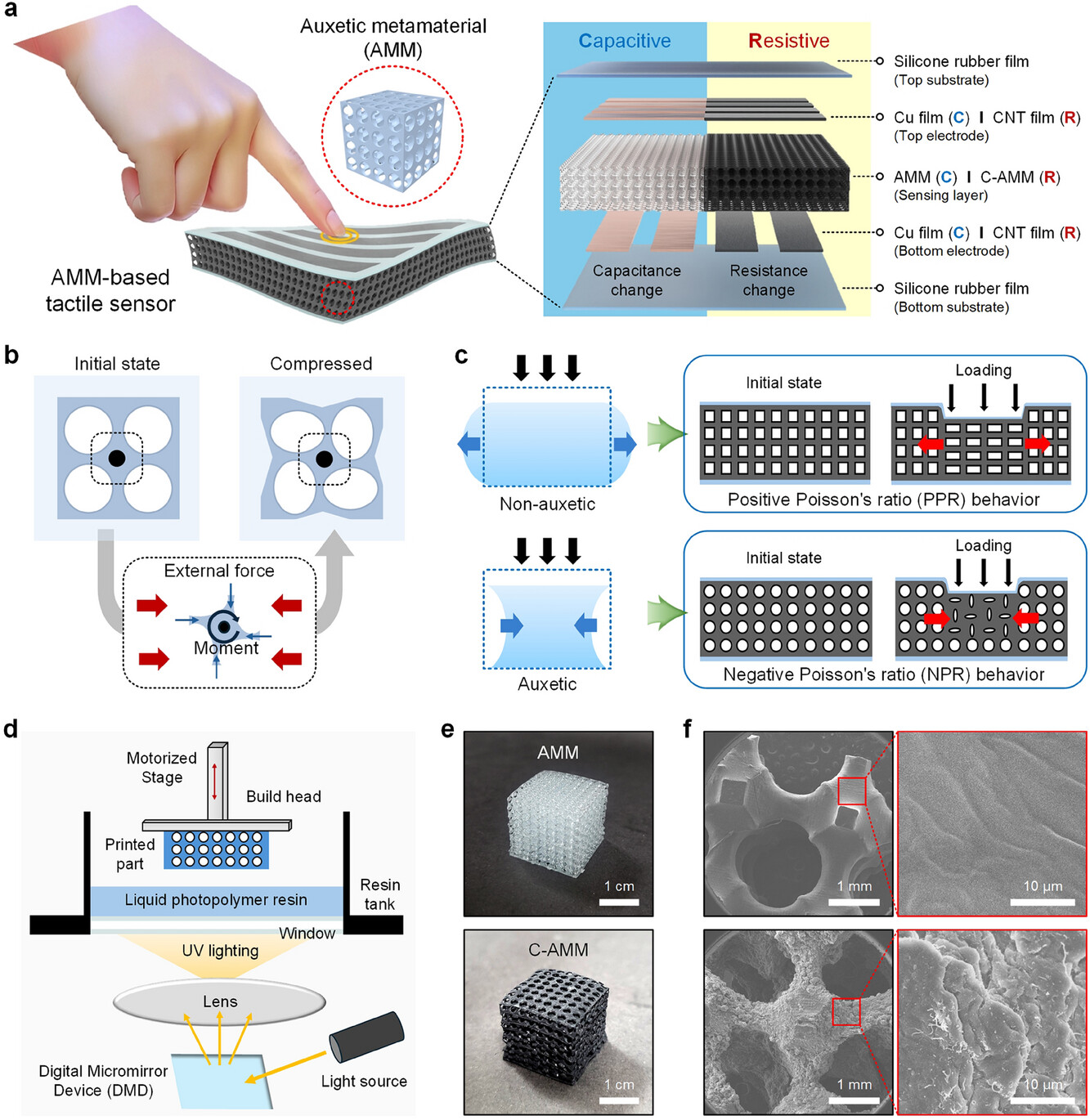
In a recent paper, Seoul National University of Science and Technology (SEOULTECH) researchers look at “Additively Manufactured 3D Auxetic Metamaterials for Structurally Guided Capacitive and Resistive Tactile Sensing.” Mingyu Kang, Hong-Gap Choi, Keun Park, and Soonjae Pyo used vat polymerization (DLP) printing of elastomeric materials to make better sensors. The resulting strain sensors can be used to measure gait or map pressure more generally, for example. The team thinks that their research could have applications in prosthetics, wearables, and medical monitoring.
The 3D printed sensors have a negative Poisson’s ratio, meaning that they behave opposite to what we expect and actually compress when pushed. In their research, the team found that these auxetic shapes were actually more sensitive than alternatives. The researchers printed lattice structures that resemble a tic tac toe board. They then made it so that a component could use capacitive and resistive properties when being used as a sensor. In between layers of copper film, the capacitive property is used, while if they coat the sensor with carbon nanotubes, resistance can be measured.
Researcher Kang said that,
“The unique negative Poisson’s ratio behavior utilized by our technology induces inward contraction under compression, concentrating strain in the sensing region and enhancing sensitivity. Beyond this fundamental mechanism, our auxetic design further strengthens sensor performance in three critical aspects: sensitivity enhancement through localized strain concentration, exceptional performance stability when embedded within confined structures, and crosstalk minimization between adjacent sensing units. Unlike conventional porous structures, this design minimizes lateral expansion, improving wearability and reducing interference when integrated into devices such as smart insoles or robotic grippers. Furthermore, the use of digital light processing-based 3D printing enables precise structural programming of sensor performance, allowing geometry-based customization without changing the base material.”
I really like the idea of using one sensor material kind of like a GORE-TEX for sensors, which can then be optimized for a particular scenario with piezo or another sensing capability. That same material can then also be shaped to be conformal, fit in a particular housing, or be made to measure for a use case. One interesting thing that the team showcased was using their system in a gait monitoring sensor. This kind of thing could be very valuable for making better shoes, treating limb loss, or improving prosthetics and orthoses generally. But, accurate things that are low-cost are difficult to make. Several research teams and companies have tried to make such sensors for years, but have not made them precise or inexpensive enough.

Researcher Pyo said,
“The proposed sensor platform can be integrated into smart insoles for gait monitoring and pronation analysis, robotic hands for precise object manipulation, and wearable health monitoring systems that require comfortable sensing without disrupting daily life. Importantly, the auxetic structure preserves its sensitivity and stability even when confined within rigid housings, such as insole layers, where conventional porous lattices typically lose performance. Its scalability and compatibility with various transduction modes also make it suitable for pressure mapping surfaces, rehabilitation devices, and human-robot interaction interfaces that require high sensitivity and mechanical robustness.”
This could help make shoe soles smarter, or improve the way that a lot of prosthetic devices work. Our shoes, even 3D printed ones, are rather dumb and made with uniform foams on old data. By knowing what you walk on, how you walk, where you walk, what kind of foot roll you have, how you walk differently when tired, how you run, and more, we could make better soles for everyone. In prosthetics, better sensors would lead to more comfort and help those who have to feel pain every day due to incorrectly fitted prosthetics. But, broader use in sensing for input devices or end effectors for all manner of robots could also be made with the same technology. Sensors and 3D printers are a match made in heaven. Maybe we could increasingly blanket our world with 3D printed sensors fit for purpose.
Subscribe to Our Email Newsletter
Stay up-to-date on all the latest news from the 3D printing industry and receive information and offers from third party vendors.
Print Services
Upload your 3D Models and get them printed quickly and efficiently.












You May Also Like
Desktop UV Printers & 3D Printing: Collision Course
UV printing has been around for ages, of course. But, since a few years ago, desktop UV printers have made their way into households, small businesses, and enterprises. These machines...
3D Printing News Briefs, June 24, 2026: Name Change, Digital Foundry, & Yeast
In today’s 3D Printing News Briefs, we’re starting with a formal name change for an African industrial technology company that’s a major user of additive manufacturing (AM) in the oil...
Fabri Raises $13.5 Million to Create Digital Foundry
Fabri is a startup that wants to create a “digital foundry,” and just raised some funds to help it reach this goal. There are far too few foundries in America....
Flashforge Unleashes Wax 3D Printer
Flashforge has released a wax 3D printer. Wax printing was pioneered by Solidscape, a company acquired by Stratasys and later sold to Prodways before being shuttered in 2024. That firm’s wax jetting...