Aleph Objects’ LulzBot 3D Printers to be Featured on ‘How It’s Made’ TV Show

The average individual has no clue how every day items such as toothbrushes, deodorant, hot dogs, or bubblegum are made. To fill this void and give us all an understanding of the world we interact with each day, the  Montreal, Canada based company, Productions MAJ, Inc. has been been producing a television show since 2001, called ‘How It’s Made’. The show which airs on the Discovery Channel in Canada, and the Science Channel in the U.S, is an amazing learning tool, but also incredibly interesting.
Aleph Objects the producer of popular LulzBot 3D Printers announced recently that the filming crew for the popular television showed was at the company’s headquarters in Loveland, Colorado last month, to film a segment for an upcoming episode, which will air sometime next season. The episode will, at least in part, explore the emerging technology of 3D printers and how they are built. What makes Aleph Objects a very interesting company to choose to film, is that unlike the majority of 3D printer manufacturers out there, many of the main structural components of their LulzBot 3D printers are actually 3D printed themselves.
The crew began filming in the room where Aleph Obects has a cluster of 130 3D printers churning out a variety of parts in a special LulzBot green color. They used green, instead of the typical black, because the finished product made for the end of the television segment will be a special limited edition, ‘How It’s Made’ Lulzbot 3D printer.
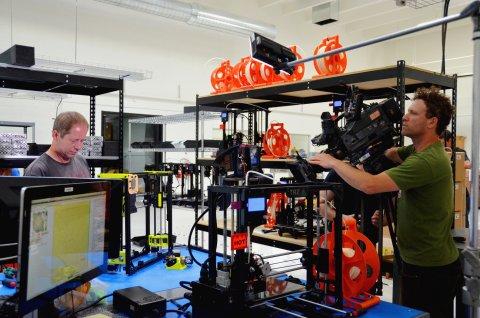
From there the crew went on to watch all the parts of a typical LulzBot TAZ 4 printer come together. From drilling holes into the pieces, to placing special thermal insets onto the machine, they got to film it all. The segment will end with the final calibration and testing which Aleph Objects does with all their machines, prior to shipping them out.
“Everyone here at Aleph Objects is excited to see the final, edited segment which will air on The Discovery Channel in 2015,” stated the company’s blog. “It was a pleasure showing their crew, and eventually their global audience, how 3D printers are made! Make sure to stay updated on the LulzBot blog and our Facebook and Twitter pages for more information on when the episode is set to air.”
The LulzBot TAZ 4 3D printer, which was documented for this show is Aleph Objects’ latest machine, a machine which is constructed on an open source framework, and has one of the larger build volumes (11.7in x 10.8in x 9.8in) in its class. The printer can be purchased for $2,194.95 from the LulzBot website. We will be sure to update this article when news breaks of an exact airing date for this segment. Let us know what you think about this story in the ‘How It’s Made’ LulzBot 3D printer forum thread on 3DPB.com. Check out a sample segment of a ‘How It’s Made’ episode below…. about hot dogs!
Subscribe to Our Email Newsletter
Stay up-to-date on all the latest news from the 3D printing industry and receive information and offers from third party vendors.
Print Services
Upload your 3D Models and get them printed quickly and efficiently.











You May Also Like
Intergalactic Turns to Velo3D to Accelerate Aircraft Heat Exchanger Development
A new aviation project shows how metal 3D printing can dramatically shorten the time it takes to turn a design into a working aircraft component. Velo3D announced that aerospace supplier...
DyeMansion Buys ASM in Smart Move Into Entry-Level Post-Processing
Post processing leader DyeMansion has bought ASM. ASM’s VX1 is a compact, entry-level vapor-smoothing system that could work on or next to your desk. The unit was designed to be...
3D Systems Sells Oqton and 3DXpert to Hubb Global Holdings
3D Systems (NYSE: DDD) is narrowing its software strategy, choosing to concentrate on polymer production and artificial intelligence (AI), while divesting two major platforms to Hubb Global Holdings. The company...
Boston’s Additive Edge: How Alloy Enterprises Turns Sheets of Metal into Cooling for the AI Era
When I walked into Alloy Enterprises’ headquarters just outside Boston, I didn’t expect to be handed a piece of metal as light as a feather or to learn that it...