3D Printed Baroque Recorder is Music to the Maker’s Ears

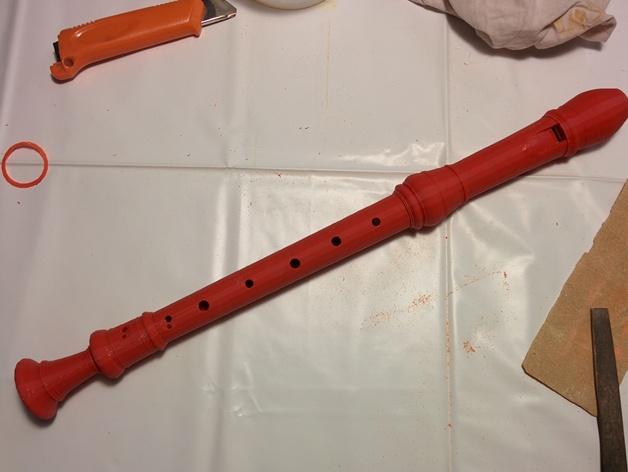 A number of makers have turned their attentions to the art of crafting instruments through 3D printing. At first, these instruments were mostly interesting for their novelty. However, as more and more instruments are produced with 3D printing, the understanding of what is possible, and what is practical, is making this method more mainstream.
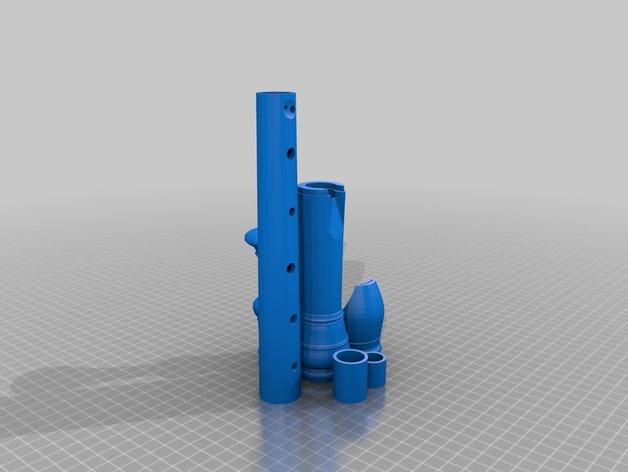 Some instruments lend themselves more easily to 3D printing than others and one that seems a particularly obvious candidate for exploration is the recorder. Just because it is clearly an excellent opportunity for exploring the contribution that 3D printing can make to music doesn’t mean that it was simple to produce. Software programmer Aito Esteve Alvarado had quite the task ahead of him when he, and his Prusa i3, set out to make an alto recorder.
In an interview with 3DPrint.com, he explained his desire to create a recorder:
“I am fascinated by the idea of printing your own instruments since [I] watched a video on youtube some years ago featuring a completely 3D printed flute. The flute came out the printer completely assembled and functional, with parts printed in different materials. Obviously it needed an expensive industrial 3D printer to print. So this summer I decided to go ahead and try to print the best recorder I could achieve using my RepRap printer.”
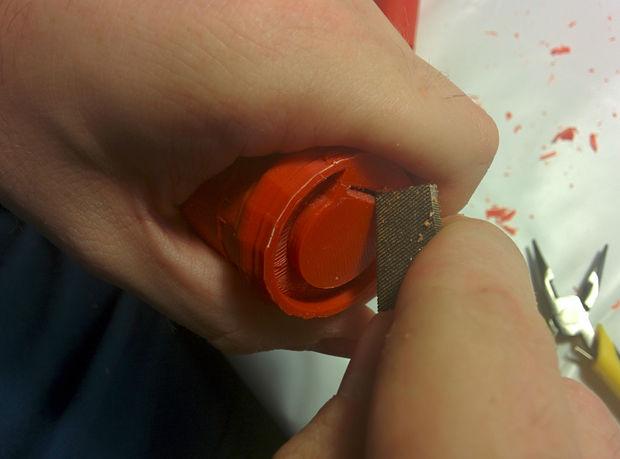
 While many envision 3D printing as something that smoothly and simply produces a finished product, Alvarado quickly realized that the magic of 3D printing also requires a great deal of old fashioned ‘elbow grease.’ Luckily, he has shared the files for his creation on Thingiverse thereby making this a much more accessible printing project even for those who are nearer to the beginning of their printing practice. Alvarado described the process for creating the files:
“I first attempted to copy a historical recorder but the recorder was tuned to A=415Hz (typical of the baroque era) and the fingering was different from modern recorders, so I decided to keep just the aesthetic design and make all the measurements to tune it to 440Hz. I’ve used OpenSCAD to model the recorder, Inscape to draw the outline of the design and a small script of python to model the windway, as it was a bit tricky.”
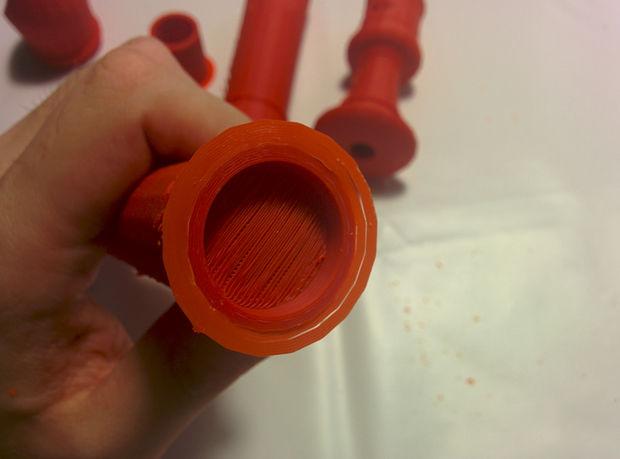 Once he had the files prepped and ready to go, it took approximately 13 hours for the final print to be completed. After the print, the recorder still required some attention in order to bring it to a finished state. In another sign of his commitment to sharing his knowledge, Alvarado has also written a complete Instructables tutorial that details the production from print to finishing.
As the old saying goes, “the proof of the pudding is in the eating” so the ‘proof’ of the instrument is in the playing. As such, there is still some distance to travel before Alvarado’s instrument is ready for a world class, traveling, recorder ensemble.
“It sounds pretty good,” he says. “I own a Yamaha alto plastic recorder so I can only compare with that. The Yamaha sounds brighter and louder than the printed recorder, but this is in fact a feature I like because I can play it quieter and I can control the volume better. The tune isn’t quite perfect, it’s off as much as 30 cents for some notes, while others are really accurate.”
 Advances are made when we don’t let the perfect be the enemy of the good. In other words, just because it can’t be made as if Stradivarius had turned his hand to 3D printing, hasn’t prevented someone from making an effort and thereby advancing the collective effort. I remember being in middle school and being handed a recorder, the sole purpose of which I believed was to irritate my parents. Now, students can be handed a website and asked to create their own recorders.
Now that sounds like progress.
Discuss your thoughts on this musical creation in the 3D Printed Baroque Alto Recorder forum thread over at 3DPB.com.
Subscribe to Our Email Newsletter
Stay up-to-date on all the latest news from the 3D printing industry and receive information and offers from third party vendors.
Print Services
Upload your 3D Models and get them printed quickly and efficiently.













You May Also Like
3D Printing Financials: XTPL Adds New Semiconductor and Defense Customers in Q1 2026
Polish microprinting company XTPL (WSE: XTP) reported first-quarter 2026 revenue of PLN 1.6 million (roughly $441,000) as the company expands into the semiconductor and advanced electronics markets, while also launching...
3D Printing News Briefs, May 30, 2026: RIMPAC 2026, Acquisition, Ceramic Implants, & More
We’re kicking things off with materials news in this weekend’s 3D Printing News Briefs. Then it’s on to a hybrid manufacturing system for a maritime exercise, an expansion of industrial...
The University of Utrecht: “3D Printing Could Change Who Gets to Become a Manufacturing Power”
For decades, manufacturing has mostly been controlled by countries with huge factories, lower labor costs, and industrial systems that took years, sometimes decades, to build. But Utrecht University human geographers...
3D Printing News Briefs, May 28, 2026: Continuous Fiber Reinforcement, Bioprinted Trachea, & More
In today’s 3D Printing News Briefs, America Makes announced the winners of its JAQS-SQ Project Call. Axtra3D is partnering with Keystone Industries to expand its dental material ecosystem, while BigRep...