3D-Fuel Takes PLA to Next Level with Higher Heat Resistance Filament & Algae-Fuel

 ABS is about to take another hit on the pros and cons list for 3D printing as companies like 3D-Fuel work not only to make more durable filaments, but also those that are even more environmentally friendly and capable of producing superior 3D models.
Reigning supreme almost since the inception of 3D printing despite some drawbacks, ABS has been a go-to material mainly because of its strength, minor flexibility, and resistance to temperature. Now though, 3D-Fuel is pumping out two new PLA filaments which should be of great interest to their users who enjoy the sweet-smelling material and like to know they are using thermoplastics with greater recycling qualities.
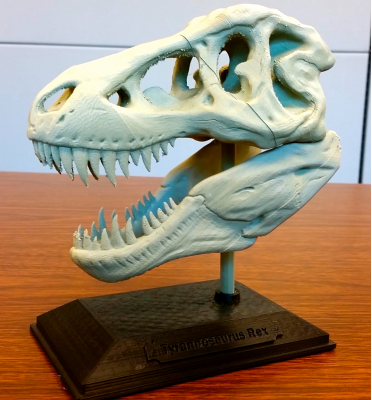
3D printed with Algae-Fuel filament
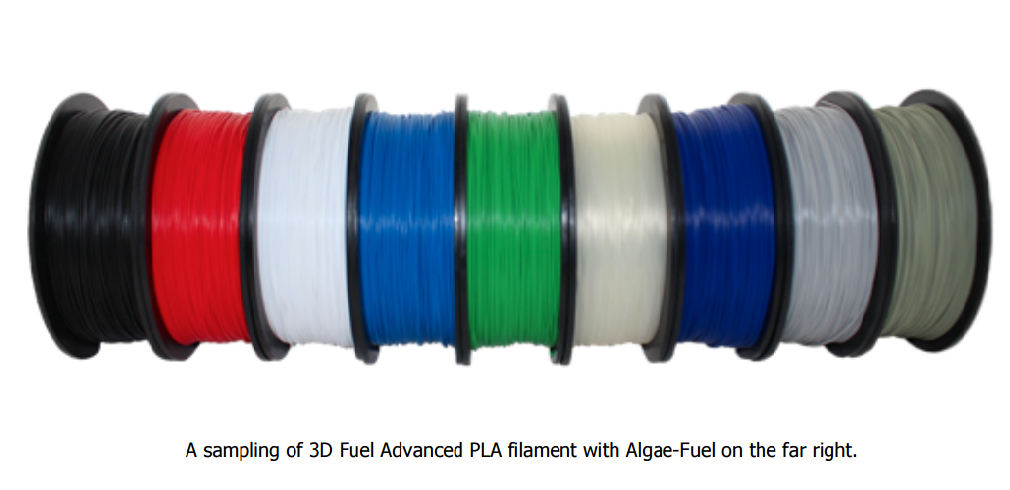
Imbuing the vegetable-based material with greater strength, 3D-Fuel is now releasing a High Heat Grade Advanced PLA filament as an answer to the material’s historically low heat-resistance qualities. Using a high heat grade material, 3D-Fuel has also created a PLA that offers more rapid crystallization. Available in 1.75 mm and retailing at $49.99, you can expect:
- Low odor
- Higher print detail/resolution
- Excellent first layer adhesion
- Improved adhesion between layers
- Reduced warping, curling, and failed 3D prints
Also from 3D-Fuel comes another most interesting new filament called Algae-Fuel, available in 1.75 mm and retailing at $75.00. It’s inspiring to see not only the usual vegetable base for PLA but a new product using wild algae that is GMO-free and doesn’t take up valuable and vast areas of crop lands for production.
”We are extremely excited to be bringing these revolutionary new filaments to the 3D printing market,” states Matt Stegall, co-founder of 3D-Fuel. “We believe that these products can truly disrupt the filament market and greatly increase the adoption of more sustainable filaments because the user doesn’t have to compromise on performance or quality.”
With Algae-Fuel, users are able to look forward to all the qualities that PLA is able to offer but it offers a more sustainable option and is also very high in protein, a desirable quality when working with plastics, and especially for 3D printing. In collaborating with ALGIX, known as a “clean technology company,” the team at 3D-Fuel works closely with Solaplast which is known as the sustainable polymer innovation center and bioplastics division of ALGIX.
“3D Fuel is in a great position within the 3D filament market because we are able to rapidly innovate and take ideas to end products in a short period of time,” states Ryan Hunt, COO of 3D-Fuel. “By being vertically integrated under one roof with Solaplast, we have in house: polymer science expertise, biomass processing, bioplastics compounding, filament extrusion, a quality control and 3D printing test lab, logistics and many strategic partnerships. This enables us to ensure high quality and consistent products for our customers.”
 While the 3D printing community is certainly one that is progressive and focuses on global vision, sharing, and innovation, the environmental issues presented by working with thermoplastics are becoming nearly as a large a conversation as that of how they pertain to what’s actually being made. With that in mind, the companies that are focused on an eco-friendly bend are getting a leg up not only in helping the planet, but also in the marketplace, as users find their products more appealing–and rightly so.
“There is often the thought that more sustainable plastics will not perform as well as traditional petroleum-based plastics. As more and more 3D printers try 3D Fuel products, that myth will be debunked,” says Barbara Zeller, Marketing and Communications Manager of ALGIX and 3D-Fuel.
It’s a reasonable parallel to draw that with the best fuel and nutrition you put in your body, the better you feel and the better your health is. If you are planning to run a marathon this weekend, you have to fill up on the best food first. And with 3D printing, if you are embarking on an important new project, putting the best material possible into your machine is an obvious goal.
“This is our mission at 3D Fuel, to provide the highest quality materials to our customers. We want to help them fuel their creativity today, without compromising our needs of tomorrow,” said Mike Van Drunen, CEO of 3D-Fuel.
It’s also crucial to purchase your materials from a proven manufacturer who knows what they are doing from the packaging of your materials to the testing and manufacturing. 3D-Fuel is offering a way to build on all the strengths already offered by PLA, as well as experiencing the bonus of added durability and a greater nod toward mother nature as well.
Along with the release of these two new filaments, 3D-Fuel is also offering a “Fuel Your Creativity” competition. Users are encourages to post and tweet the video below in posts to be entered to win a free spool of 3D-Fuel filament every month for an entire year! Using #3dfuel and #fuelyourcreativity, you just need the most likes or re-tweets to win. See the following video for more information.
Are you a fan of PLA over ABS, or do you enjoy using both materials for varying projects? Discuss in the Higher Heat Resistance Filament & Algae-Fuel forum thread over at 3DPB.com.
Subscribe to Our Email Newsletter
Stay up-to-date on all the latest news from the 3D printing industry and receive information and offers from third party vendors.
Print Services
Upload your 3D Models and get them printed quickly and efficiently.











You May Also Like
Scaling AM Suppressor Production: Oerlikon AM & ATLIX Rise to the Challenge
End-of-barrel suppressors, oftentimes referred to as silencers, function by capturing and redirecting high-pressure propellant gases through carefully engineered internal structures and channels. By disrupting the gas flow before it exits...
Unlocking Big Part Manufacturing for the Energy Sector: How EPRI’s Convergent Approach Proves the Potential of Large-Area DED 3D Printing
The U.S. hydropower fleet, more than 2,200 plants averaging 65 years of age, relies on large, bespoke components that are increasingly difficult to source. Long lead times, disappearing suppliers, and...
In-Situ Automated Toolpath Generation and Auto-Alignment for Performance-Driven Directed Energy Deposition (DED)
The evolution of Directed Energy Deposition (DED) systems has increasingly focused on improving process adaptability, geometric fidelity, and integration into automated manufacturing environments. FormAlloy has advanced this progression through the...
From Material Maturity to Fleet Execution: What Comes Next for Additive Manufacturing in the U.S. Navy
Additive manufacturing is steadily moving from experimental use toward routine application in U.S. Navy shipbuilding, sustainment, and much more. In recent years, the Navy, working through its Maritime Industrial Base...