Revolutionary Dar3D Printing Technology Used by Startup ‘Relief Art’ Shows the Texture of Art

 Mauro Panettieri is one of the co-founders of Relief Art, and the company says they’ve just rolled out a new technology which promises great strides in high-speed, low-cost 3D printing.
A startup based in Pisa, Italy, the company says their Dar3D Printing Technology an innovative method which can transform any sort of digital image into a “tactile 3D print.”
Artists call the technique ‘Impasto,’ and paint is laid on an area of a surface so thickly that the strokes of a brush or painter’s knife become a visible element of the design. The paint can be mixed as it’s applied to the surface, and when dry, impasto results in textures which appear to leap from the canvas. The word itself means “dough” or “mixture,” and it’s generally executed with oil paints.
The technique has long been prized by painters for its ability to control the reflection of surrounding light, the addition of a depth of expressiveness and for the three-dimensional, sculptural rendering of brush or knife technique it leaves behind.
It has been employed by masters such as Titian, Rembrandt, Vermeer, Hans Hofmann, Willem de Kooning, and, perhaps most famously, by Vincent van Gogh.
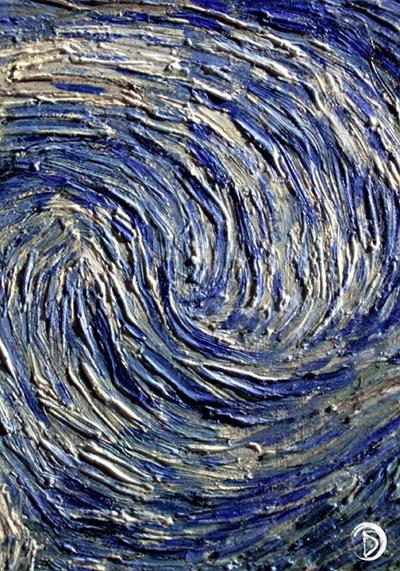 According to Panettieri, the process began years ago – the aim? To develop a technology that was capable of faithfully reproducing a painting, but not just just in form and color, but also in brushstrokes, color and texture as accurately as possible. He says the initial results, done on canvas and wood, were nothing less than thrilling, and that the final products of those efforts were destined to take their place among the best examples in the fine art reproduction market.
He adds that, as research and development has advanced this entirely new category of high-quality graphic products, the process is now ready for introduction to a larger market and audience.
Relief Art says a full range of stiff and flexible support materials for the paintings now includes paper, faux leather and even plastic film.
Dar3D Printing Technology, with its patent-pending process, now means any sort of digital image or artwork, in any medium and on any support, can be transformed into a 3D print with a startlingly accurate surface relief. The company says applications for it range from book covers to faux leather diaries to luxury packaging such as wine bottle labels to stunning fine art replicas.
“Not only does the way the image looks change, there is also the added dimension of touch. This means that a photograph of a landscape, for example, can be in relief, giving the owners the added pleasure of running their fingers over the details of the surface,” Panettieri says. “Three features set Dar3D Printing Technology apart from any other printing technology: its high-speed production, low manufacturing costs, and the range of supports.”
He adds that Relief Art is intent on establishing business partnerships with investors, companies and industries poised to exploit the commercial opportunities offered by this Dar3D Printing Technology.
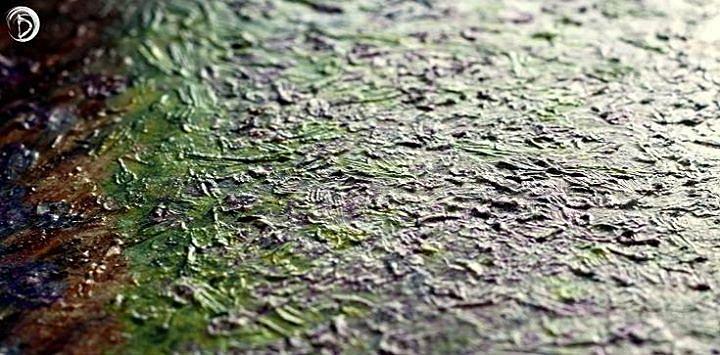
Claude Monet – detail of the Artist’s Garden At Giverny
Have you ever seen the results of Relief Art’s method? Let us know in the Dar3D Printing Technology forum thread on 3DPB.com.
Subscribe to Our Email Newsletter
Stay up-to-date on all the latest news from the 3D printing industry and receive information and offers from third party vendors.
Print Services
Upload your 3D Models and get them printed quickly and efficiently.











You May Also Like
Singapore 3D Prints Childcare Center Walls in Two Days
The exterior walls of a childcare center were 3D printed in two days in Singapore. The first story was made with additive while the second was made with conventional methods....
ICON Opens Sales of Its Titan Construction 3D Printer, Promises Walls for $20 per Square Foot
Construction 3D printing company ICON has taken a major step toward commercializing its technology. The Austin-based firm announced the launch of the Titan program, which will allow builders to directly...
Australian Researchers Develop Accelerator-Free Underwater 3D Concrete Printing System
Infrastructure projects are just as important as housing to the additive construction (AC) market segment, and structures used for underwater applications like coastal resilience have steadily become one of the...
3D Printing at the 2026 Milano Cortina Winter Olympics
For the summer Olympics, we are well aware of the extensive 3D printing that goes on in service of track cyclists, road cyclists, and runners. In athletics, custom 3D printed...