German Student 3D Prints an Amazing RC Hovercraft That Can Travel on Land & Water


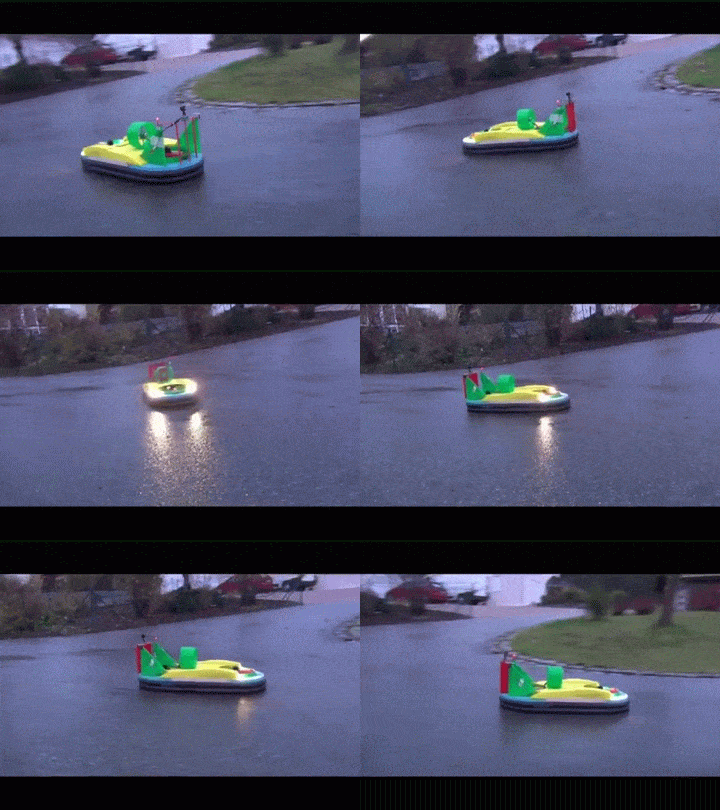 Functionality continues to be one of the more common themes for popular 3D printed designs as of late. Most people are no longer excited by the mere fact that they can simply print an object, so they are now turning to printing unique, fascinating and functional designs. For one German student, named Jan Buerstner, 3D printing provided him a means of fabricating a working RC hovercraft unlike anything we have seen before.
“I got the idea last year when I read an article about Hovercrafts. From there I studied the topic and wanted to build one for myself,” Buerstner tells 3DPrint.com.
Buerstner has recently completed his third iteration of his incredible design, and is now working on the fourth generation. The first two vehicles had some issues that Buerstner ultimately needed to overcome, including the fact that the they could not hold their own weight, and were very difficult to control. Even the smallest of stones would destroy the propeller on the lifting motor, thus he was not all that happy with his original designs. This latest design, however, seems to work quite well.
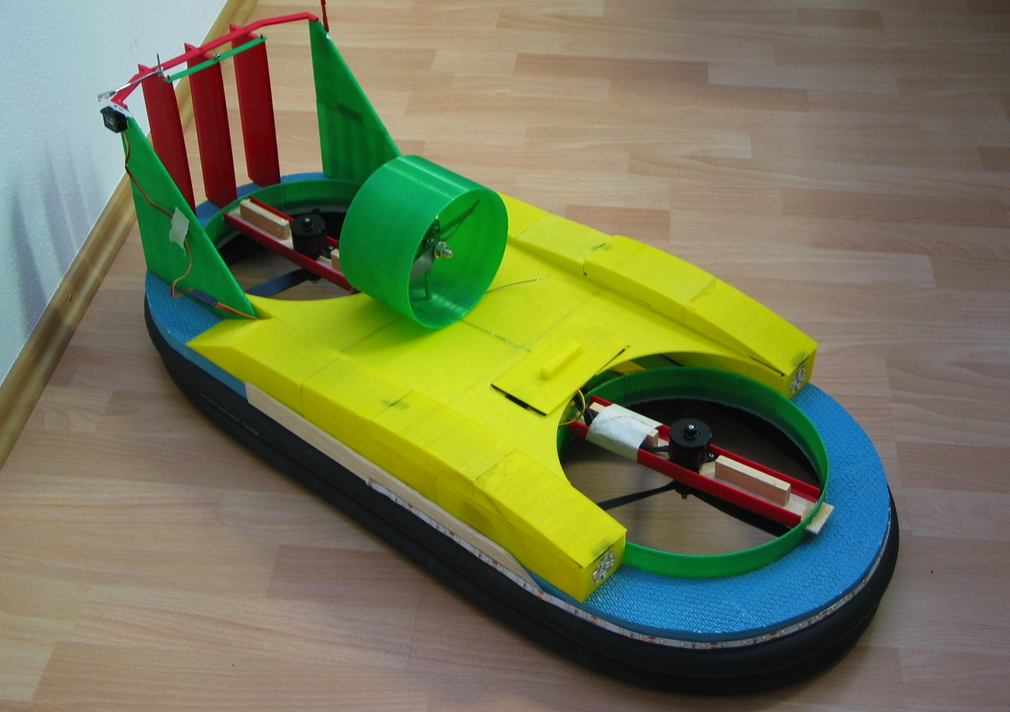
The 3D printed hovercraft, which Buerstner has made available to download on Thingiverse, was designed using Autodesk Inventor 2013. It was then 3D printed on his MakerBot Replicator, a process which took 3-4 days to complete. While the majority of the vehicle is 3D printed, obviously the entire thing is not.
“I did not print the base because it would take way too long, and Styrofoam has the advantage that it swims when the engines fail,” Buerstner tells us. “I also did not print the bicycle tubes because they have to be flexible and they must be one piece so that no air flows out to the sides.”
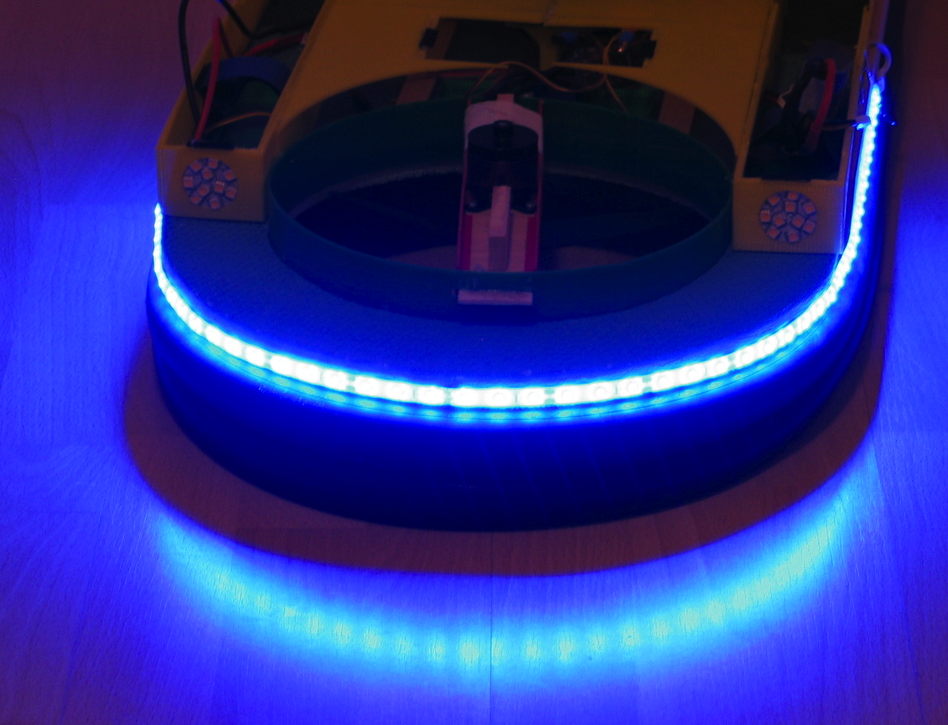 The bicycle tubes are glued under the base in order to prevent small stones from being sucked into the propeller of the lifting motor. It seemed to solve a big issue, thus he stuck with this method for his latest version of the hovercraft as well.
“The Hoveraft is lifted by two motors and it has one thrust motor,” Buerstner explains. “The power for the motors comes from three 2800 mAh Lipo batteries. My plans with the Hovercraft are to develop a cheap mobile research station for the arctic. The advantages are that it has no CO2 emissions and you can control it from another place like a drone.”
Are 3D printable “hover-drones” the next big thing? It is quite possible.
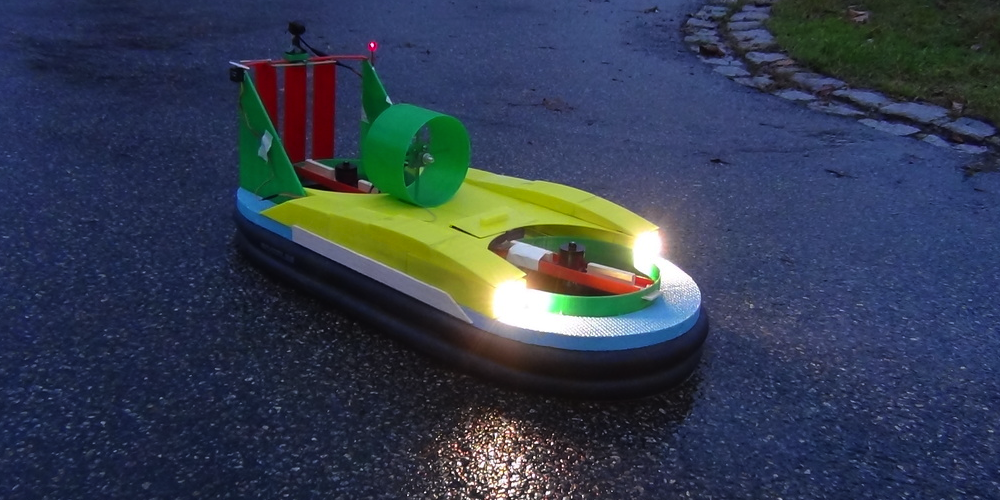
Buerstner’s craft has the ability to hover on both land and water without any problem, and it can carry up to 500 grams of payload. With its current configuration, it can run for 8-9 minutes at a time.
What do you think about this awesome creation? Have you 3D printed your own hovercraft yet? Discuss in the 3D Printed Hovercraft forum thread on 3DPB.com. Check out the video of the hovercraft in action below.
Subscribe to Our Email Newsletter
Stay up-to-date on all the latest news from the 3D printing industry and receive information and offers from third party vendors.
Print Services
Upload your 3D Models and get them printed quickly and efficiently.













You May Also Like
The Drone Industry is Showing Where 3D Printing Delivers Real Value, AM Research Report Finds
The rapid rise of drones is creating one of the biggest opportunities for additive manufacturing (AM). Whether they’re used on battlefields, inspecting bridges or crops, or delivering supplies, drones need...
3D Printing News Briefs, June 27, 2026: Nanoscale 3D Printing, Defense Readiness, & More
We’re starting with a story about a grant for advanced nanoscale 3D printing in this weekend’s 3D Printing News Briefs, and then on to metal additive manufacturing (AM) for defense...
US Army Awards Continuous Composites 3D Printed Missile Component Contract
Despite the very loud, indignant claims from American defense officials that the US hasn’t depleted a significant portion of its munitions stockpiles, the US has depleted a significant portion of...
Rheinmetall Uses Ducting Made with Minifactory for Challenger 3 Tanks
Rheinmetall UK is using Minifactory Material Extusion as the primary production method for tank ducting on the Challenger 3 Main Battle Tank program. The Challenger 3 is the UK’s formidable...