3D Printing Allows Researchers to Control a Smartphone with Sound Waves

 It’s no secret that Disney Research is incredibly interested in all aspects of 3D printing. We’ve seen what seems like a laundry list of innovative applications for the technology, coming from the talent at Disney.
This week a research paper surfaced, authored by Gierad Laput, Scott E Hudson and Chris Harrison of both Disney Research and Carnegie Mellon University’s HCI Institute, and Eric Brokmeyer of only Disney Research. In the report, titled ‘Acoustruments: Passive, Acoustically-Driven, Interactive Controls for Handheld Devices,’ researchers detail a method in which they are able to make tactile controls that can direct a smartphone’s actions via sound, without the need for any form of additional electronic devices. And best of all, a large portion of these devices are able to be 3D printed as prototypes.
When I was a child, my grandfather gave me his old TV. Although the picture wasn’t all that clear, as it dated back to 1976, I had a television set unlike anyone else I knew. It had a remote control that required no batteries. It was a passive remote which gave off a sound that the TV was able to recognized as one of five directions; volume up, volume down, channel up, channel down, and finally if you clicked the volume button three times the TV would shut off. The research presented in this recent paper brought back memories of both my grandfather and that TV.
Like with my old TV, researchers were able to utilize ultrasonic waves to control a device., only this time the sounds were coming from the speaker of a smartphone and were diverted through a series of tiny 3D printed pipes no larger then a centimeter in any direction. The pipes were designed in Rhino, and its Grasshopper visual language, and fabricated using a Stratasys Objet260 Connex 3D Printer. They were all printed out of a material known as VeroClear-RGD810 UV-cured photopolymer. Dependent on the size, shape, and bends within each pipe, the output from the smartphone speaker would transform as it shoots through various pipe types. At the other end of these pipes is the smartphone’s microphone. Researchers were able to program the phone, allowing it to recognize various sounds as commands for a specific function. All these pipes were intricately placed within different devices based on whatever passive tool the researchers were creating. They called these devices Acoustruments, ‘Low-cost, passive, and powerless mechanisms, made from plastic, that can bring rich, tangible functionality to handheld devices.’
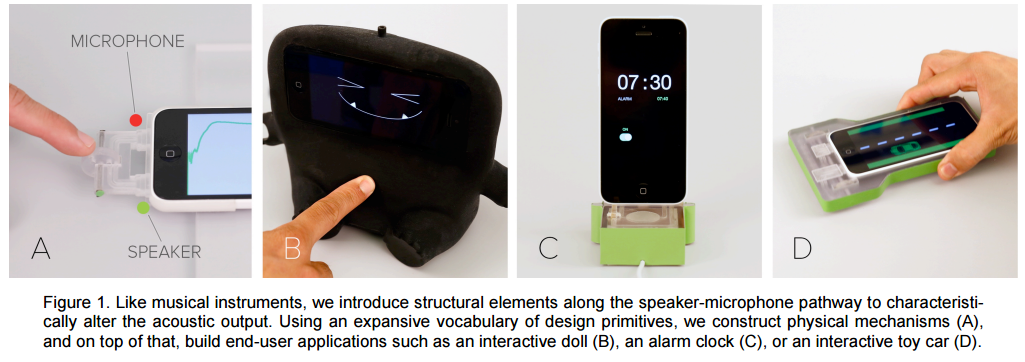
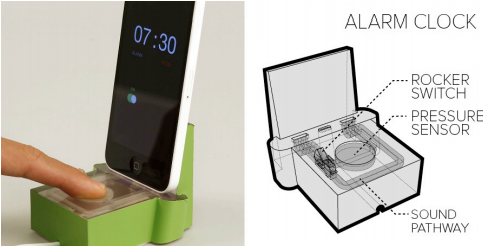
The researchers presented several applicable examples of what these passive systems could be used for, including an alarm clock, smartcase, interactive doll and an interactive toy car.
“Our experiments show that Acoustruments can achieve 99% accuracy with minimal training, is robust to noise, and can be rapidly prototyped,” wrote the researchers.

The most impressive aspects of these methods is the fact that no battery power, no wired connections or other complicated setups are required. The plastic 3D printed pieces are able to control a smartphone, using only sounds. What this does is exploit the phone’s powerful internal computer and integrate it with these external devices.
Disney Research has noted that most of the tubing could in fact be manufactured on a mass scale using traditional techniques such as injection molding, but the 3D printed parts they prototyped seem to work just as well.
It will be interesting to see where this research leads us, and if we may begin seeing games, tools and other applications which passively utilize our smartphone’s computational capacity in a whole new way. Let us know your thoughts on this research in the 3D Printed Passive Smartphone Control forum thread on 3DPB.com.
Subscribe to Our Email Newsletter
Stay up-to-date on all the latest news from the 3D printing industry and receive information and offers from third party vendors.
Print Services
Upload your 3D Models and get them printed quickly and efficiently.











You May Also Like
Advancing Workforce Development for Industrial Additive Manufacturing
As additive manufacturing (AM) continues its transition from a niche technology to a core element of industrial production, workforce development has emerged as one of the industry’s most pressing issues....
Scaling DLP: How Visitech Moves Production Beyond the “Printer Farm”
With hundreds of light engines shipped in 2025, Visitech is leveraging its new Texas facility and scrolling DLP architecture to redefine industrial throughput. By achieving up to 20 times the...
Reuniting ExOne and voxeljet: An Investor’s View on Building a Global Industrial Sand Printing Leader
Authored by Whitney Haring-Smith, Chair of the Board, ExOne Global Holdings & Managing Partner, Anzu Partners At Anzu Partners, we invest with conviction in industrial technologies that create categories—and then...
Adoption of Advanced Powder Metal Manufacturing in the Global Small Arms Space – SHOT Show 2026 Additive Manufacturing Analysis
Back in 2013, I remember being completely blown away when a company called Solid Concepts reportedly additively manufactured nearly a complete firearm as a proof of concept. Although desktop polymer...