Naval Postgraduate School Trains Non-Specialist Operators in Deployable 3D Printing with XSPEE3D


Aside from enabling uniquely complex geometries, I think that the two truly differentiating advantages of additive manufacturing (AM) are the potential for deployability and the potential for simplifying the process of training new manufacturing workers. If you’re an industry stakeholder pitching policymakers on making AM a critical element in a national manufacturing mobilization effort, those are the strengths I think you should lean into.
At the same time, I think it’s important to keep in mind that those advantages are still very much in their “potential” phase: manufacturing at the point-of-need and training new industrial 3D printing operators are far from being plug-and-play solutions. Nevertheless, the number of case studies where both of those advantages are being accentuated are gradually accumulating, and one company that’s a standout in this context is SPEE3D.
Back in November, Vanesa Listek wrote about how almost a dozen AM companies participated in the U.S. Navy’s annual Trident Warrior exercises, SPEE3D among them. Now, against the backdrop of this week’s Military AM Summit 2026 (February 3-5), the company has revealed how it worked with a frequent collaborator, the Consortium for Advanced Manufacturing Research and Education at the Naval Postgraduate School (CAMRE NPS), to demonstrate how the company’s technology enables front-line production of critical parts.
At Trident Warrior ‘25, CAMRE trained service members from across the U.S. armed forces on the XSPEE3D, the containerized cold spray AM (CSAM) system that SPEE3D released in the fall of 2022. Specifically, the service members tested the XSPEE3D’s capacity to support the repair of U.S. Navy aviation parts in combat scenarios.
According to the company, the trials validated that the XSPEE3D is an increasingly viable option for executing maintenance, repair, and overhaul (MRO) duties in contested logistics environments. SPEE3D’s combination of an Australian headquarters and a heavy U.S. presence gives the company an edge in a world where the U.S.’s counterparts in the Australia-UK-U.S. (AUKUS) partnership are signaling a shared interest in enhanced front-line MRO.
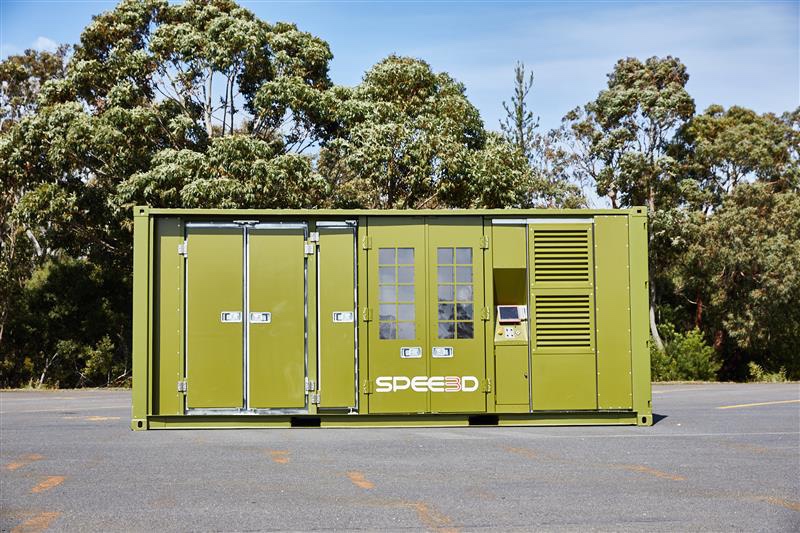
In a press release about SPEE3D’s demonstration of training non-specialists to repair aviation parts at Trident Warrior ‘25, SPEE3D’s US VP of Defense, Mark Menninger, said, “Military readiness is critically important to all branches, and they need technologies that provide them the ability to get assets back into service. The Trident Warrior exercises demonstrated how SPEE3D offered the warfighters and maintainers the fastest and most efficient solution to get their systems back up and running, giving them the best chance to complete their missions quickly and effectively.”
Chris Curran, Lt.Col., USMC (Ret.), the Program Manager at CAMRE, said, “I think perhaps the biggest win for SPEE3D during the event was showing how you can use the machine to precisely add material to a damaged part and not have to manufacture a new part, saving material labor while improving readiness.”
While this type of activity is certainly nothing new for SPEE3D, the angle about “training non-specialist operators” illustrates the significance of the operational trials. That’s not a peripheral detail: it’s the foreshadowing of a quantum leap.
There is no reality in which the West addresses its long-term shortage of manufacturing workers without non-specialists being rapidly trained on new equipment. This means that unless AM OEMs ensure that non-specialists can learn how to use their hardware in unprecedentedly compressed timelines, then the AM industry has nothing to offer the broader manufacturing sector in terms of AM’s usefulness as a workforce development tool.
The synergy between rapid workforce development and frontline production capacity is precisely what makes the defense sector so integral to accelerating the rate of 3D printing adoption. This is why I think that the U.S. military should be helping other critical industries standardize a formula for the development of a new generation of advanced manufacturing workers.
Steven Camilleri, the CTO of SPEE3D, once told me in an interview about how he subscribes to Clayton Christensen’s idea of disruptive innovation, especially the belief that, “The problem of any disruptive technology is not a technological one, but a marketing one.” If companies like SPEE3D can continue to lower the barrier-to-entry for training new workers on their hardware, the AM industry will go a long way towards solving its marketing problems.
Images courtesy of SPEE3D
Subscribe to Our Email Newsletter
Stay up-to-date on all the latest news from the 3D printing industry and receive information and offers from third party vendors.
Print Services
Upload your 3D Models and get them printed quickly and efficiently.













You May Also Like
The Two Paths to AM Print Services Market Growth
AM Research New market research: AM Research is building its new Additive Manufacturing Services Market 2.0 model. Learn more about the report and preorder here → Things continue to heat...
Additive Manufacturing Has a Major Growth Opportunity; Trust Will Decide Who Captures It
After years of overpromising, the next phase of AM growth will be won by companies that consistently deliver what they say. When I entered additive manufacturing in 2014, after 15...
10 Years of Multi Jet Fusion: Onsite at HP’s Vancouver, Washington Facility
At this year’s RAPID event in Boston, HP Additive Manufacturing Solutions celebrated ten years in the additive manufacturing (AM) market. The company ushered in the milestone with several innovations, including...
ADDMAN to Buy Up to $10.8M in Nickel 718 Powder from 6K Additive Over 30 Months
After years of buildup, we’re finally starting to see what the US metal additive manufacturing (AM) market could look like at scale. To be sure, it’s still not quite there,...