Made In Space to Send 3D Printer to Space Station Ahead of Schedule

A little over fifty years ago, the world was amazed as human beings began trekking into outer space. Here we are in 2014 and the fascination of space has not fizzled out. In fact, we as humans continue to break barrier after  barrier outside of the Earth’s atmosphere. The latest barrier is one which could eventually allow NASA to save millions of dollars in fuel costs, as well as increase the safety of astronauts, both stationed at the International Space Station (ISS), as well as traveling on other expeditions.
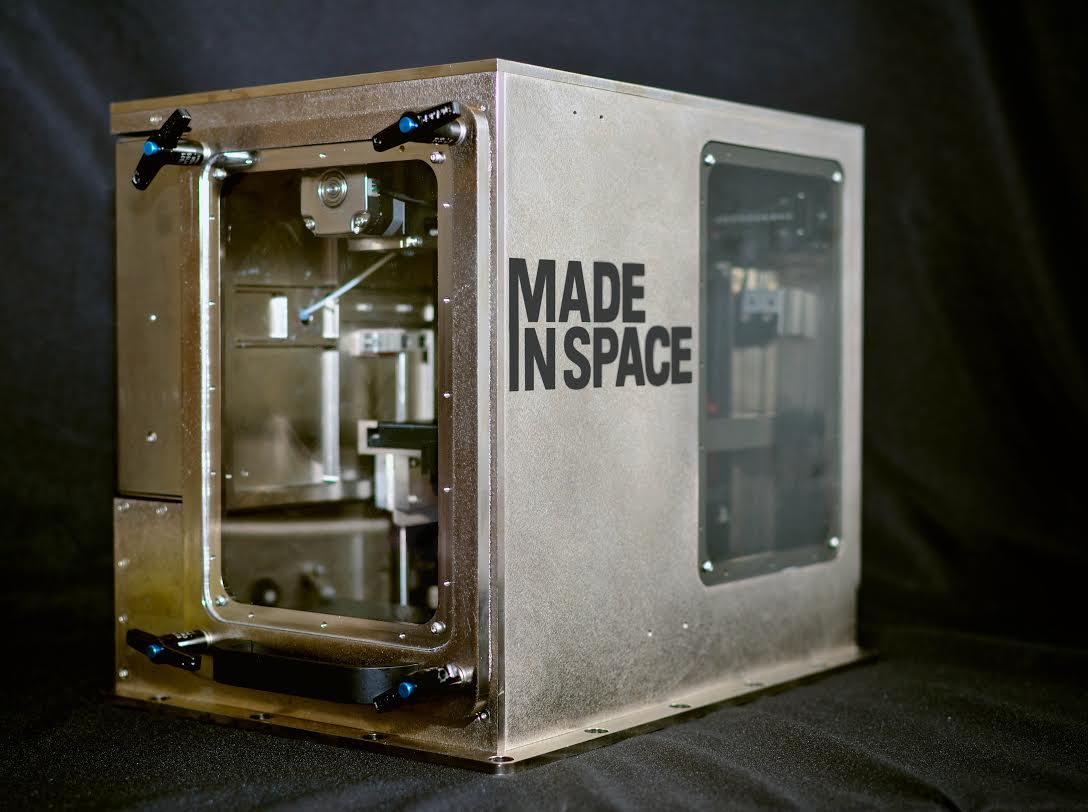
A privately held company, Made In Space, has recently teamed with NASA to develop a 3D printer capable of being transported and used by astronauts on the International Space Station. After over 20,000 print hours of testing out various 3D printing technologies, Made in Space announced today that their 3D printer has passed final NASA certifications and testing, ahead of schedule.

Made In Space CEO Aaron Kemmer during 2013 microgravity
tests of the space-bound printer aboard Zero-G Corporation’s modified Boeing 727
Originally the printer was set to travel to the ISS in November of this year, on board the SpaceX CRS-5 mission, but because of the project meeting all the key milestones, and passing NASA’s safety and operational requirements ahead of schedule, the Made In Space 3D printer will reach the ISS in August, aboard the SpaceX CRS-4 cargo resupply mission.
“NASA was able to provide key guidance on how to best comply with strenuous space certification, safety and operational requirements and Made In Space excelled at incorporating that insight into the design,” said Niki Werkheiser, the NASA 3D Print Project Manager. “As a result, the hardware passed testing with flying colors. Made In Space now has first-hand experience of the full ‘A-to-Z’ process for designing, building, and testing hardware for spaceflight.”
Once the printer makes its way to the ISS, it will be immediately installed in the Microgravity Science Glovebox (MSG) on the station. Upon installation, the printer will begin printing a series of 21 different demonstration objects, which include an array of parts, tools and test coupons. High-definition video will allow researchers at NASA, as well as Made In Space, to assess the output while eventually the printed objects will be sent back to Earth for further detailed analysis.
When all the testing is completed, Made In Space plans to launch and install an Additive Manufacturing Facility on the ISS. This facility will build on the lessons learned from the initial demonstration, and permit additional materials to be printed, as well as a larger build volume.
“When we started Made In Space in 2010, we laid out a large, audacious vision for changing space exploration by bringing manufacturing to space,” said Jason Dunn, Chief Technology Officer for Made In Space. “We’ve systematically pursued that vision by testing 3D printing in microgravity on parabolic flights, designing a printer for those conditions, and, now, flying our 3D printer to the ISS. Passing these tests means that we’ve achieved another milestone. We’re nearing the culmination of the first stage of our larger vision.”
Just what is that bigger vision? Made In Space plans to offer 3D printing from space to companies and individuals. This could really open up the possibilities for companies, instead of only Government agencies like NASA.
This project shows how government and small businesses can work together in an extremely efficient manner to innovate, in ways we have never seen before. The culmination of extremely hard work, a drive to succeed, and a desire to go further than anyone has ever been before, is what has driven NASA, and now Made In Space to these heights. It will be interesting to see what both NASA and Made In Space plan for this technology in the coming years. Let us know what you think about this incredible story at the Made In Space 3D printing forum thread at 3DPB.com.
Subscribe to Our Email Newsletter
Stay up-to-date on all the latest news from the 3D printing industry and receive information and offers from third party vendors.
Print Services
Upload your 3D Models and get them printed quickly and efficiently.











You May Also Like
Controlled Powder Production for Advanced Research Applications
Modern physics experiments and high-value industrial applications increasingly depend on custom, high-performance materials. These often require strict constraints such as radiopurity, controlled microstructure, and repeatable powder behavior in metal additive...
Creative Destruction in AM: What the Nobel Prize Winners Got Right
When the Nobel Prize in Economic Sciences was awarded in 2025 for work explaining innovation-driven economic growth, many readers outside economics likely skimmed past it. Inside manufacturing and technology circles,...
Titomic Lands First Order for 3D Printed Semiconductor Capital Equipment Components
One of the markets that should be a reliable source of growth well into the future for the additive manufacturing (AM) industry is semiconductor capital equipment (semicap). When Additive Manufacturing...
Applied Acoustics Uses Additive for Subsea Gear
Subsea equipment has to be rugged, temperature-resistant, and able to cope with the long-term effects of saltwater. Extreme pressure and pressure changes are also problems endemic to this industry. Subsea...