3D Printed Headset/Handset Kit Lends Artist Emily Biondo’s Interactive Exhibition a Professional Polish

In the work of Washington, D.C.-based multimedia artist Emily Biondo, old and new technology meet and sometimes clash, the senses compete and contradict, and language itself is subjected to the filter of time and the high-tech influence of the web. Biondo, who blends contemporary technology via electrical sensors, LEDs, RFID, and more, also incorporates 3D printing in works that draw from traditional artistic methods such as needlework and collage. Much of her work is interactive and Biondo cleverly draws her viewers in and they become actors in her high-tech-low-tech experiments.
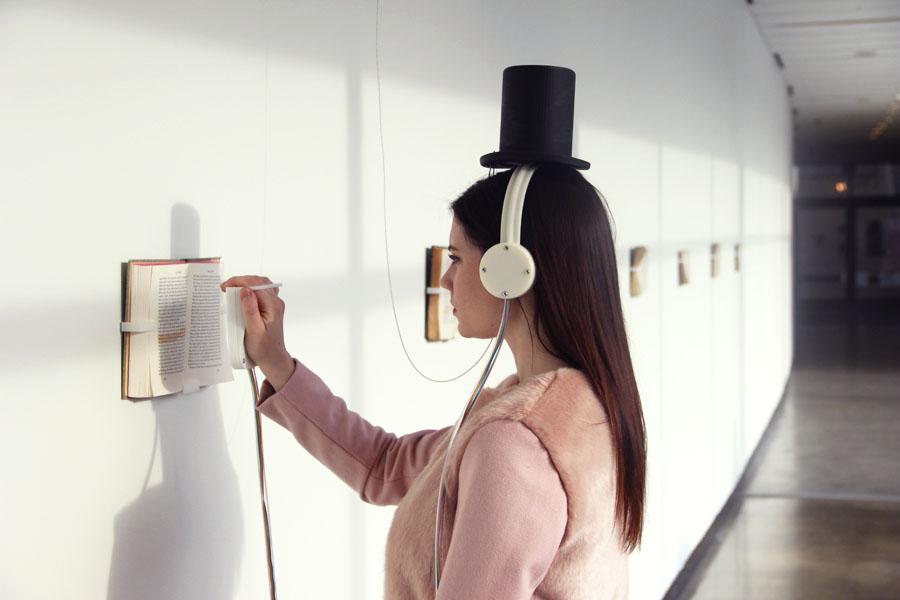
Biondo’s latest installation features 3D printed accouterments that visitors use to listen to audio snippets of 18th- and 19th-century books like Sir Walter Scott’s Ivanhoe, Jonathon Swift’s Gulliver’s Travels and Rafael Sabatini’s Scaramouche. The books–13 total–are displayed in 3D printed mounts and portions of text are highlighted. The highlighted snippets are textual companions to audio translations to which visitors to the installation can listen using headsets with 3D printed components.
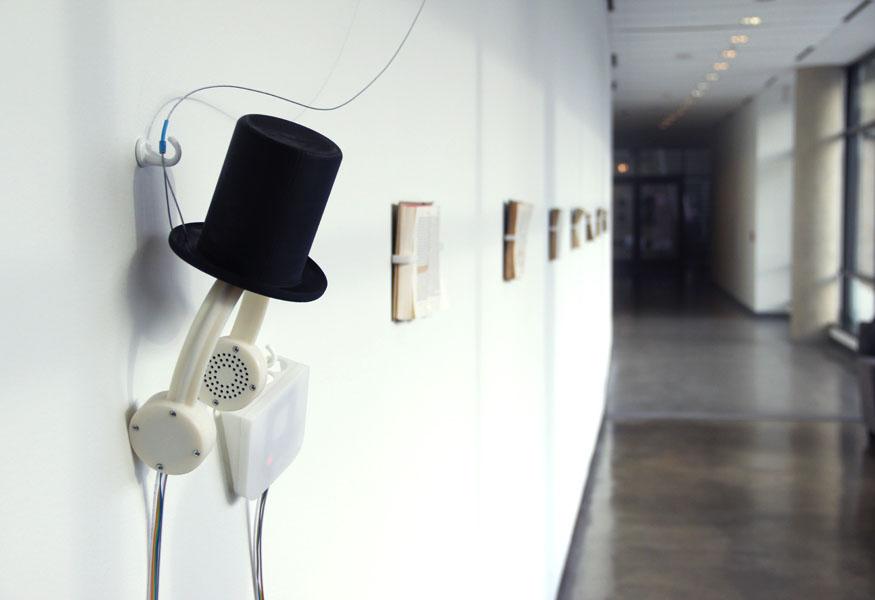
In a nod to the headwear of that bygone era in which books like Gulliver’s Travels and Ivanhoe also transported viewers to times past, a 3D printed top hat houses the electrical components of each headset. What issues from the audio recordings via an RFID reader is not a direct translation, however. Instead, a monotone male voice interprets the 18th- or 19th-century text into 21st-century slang, which includes vernacular popularized during the internet age or “millennial speak,” like “JK” (“just kidding”), “YOLO” (“you only live once”), and “hash tag.”
Biondo, who earned her MFA at the American University in Washington, D.C., also works as a designer and teaches graphic design at McDaniel College in Westminster, Maryland. She titled her interactive installation “Headspace.” It was exhibited at the Katzen Arts Center Alumni Exhibition in D.C. from February 14 to March 22.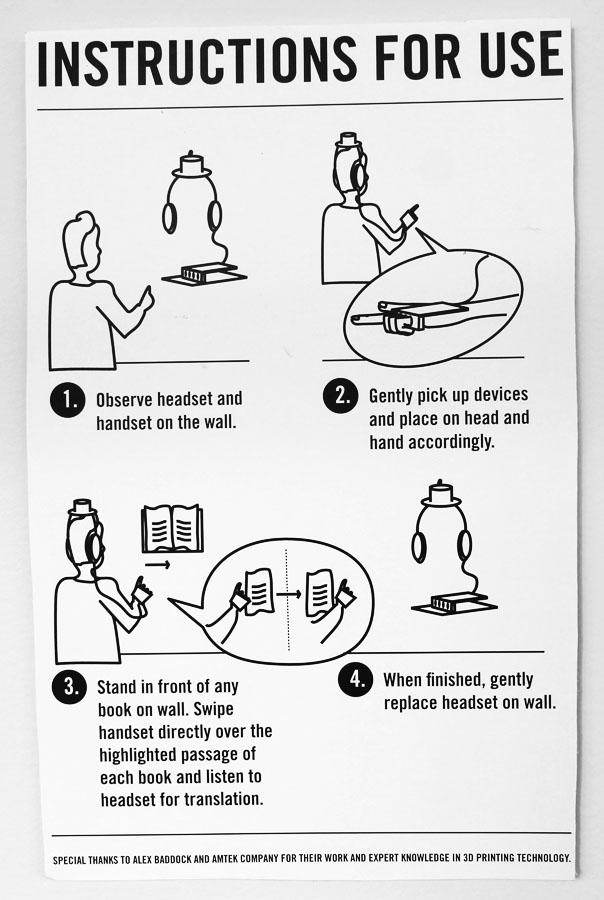
The “kits” that visitors to Headspace use were created using 3D printed parts and electrical components like the RFID reader, tags, and styluses that allow a listener-viewer to select the highlighted text and receive the translation. Biondo had originally encased the electronics in polyester fabric and a visitor to the installation would interact with the books by donning a headset and a glove. Thanks to Amtek Company, Inc. and consultant Alex Baddock, Biondo was able to redesign the interactive kit to be mostly 3D printed, making it far more durable and thus capable of being handled by many visitors to the installation.
“This type of project is perfect for 3D printing because we were creating low volume parts that were relatively intricate,” said Baddock. “If we only had access to CNC equipment, we would have spent at least twice as long on the design and infinitely more time producing the parts. Additionally, we would have had to sacrifice some of the details we were able to achieve with 3D printing, because it would have been too difficult to machine.”
Producing the objects using a traditional method of manufacturing would have been prohibitively expensive for the artist. Additionally, Biondo’s incorporation of 3D modeling and printing technology seems to suit her dexterous blending of low-tech and high-tech artistic techniques.
The pieces were created using ABSplus material for durability, made on a uPrint SE Plus 3D printer. In all, 13 mounts were created, with 3D printing used to craft the headset, ear phones, handset, mounts, and even the top hat. More than just a whimsical touch, the top hats actually contain the headsets’ electrical components. The use of technology from Stratasys encouraged the artist, who plans to make 3D printing a more integral part of her artistic production in the future.
“3D printing is a wonderful tool for artists,” Biondo explained, “especially for those without well-equipped fab studios or access to costly manufacturing processes. It provides a streamlined approach, which allows me to create perfectly fitted elements of my work without occupying an extensive amount of time.”
By using 3D printing, Biondo was able to save both money and time and the revised interactive kits for Headspace gave the show a polish it might previously have lacked.
What do you think of this use of 3D printing? Would Stratasys’ technologies be useful in more art exhibits you know of? Let us know in the 3D Printed Headspace Headsets forum thread over at 3DPB.com.
Subscribe to Our Email Newsletter
Stay up-to-date on all the latest news from the 3D printing industry and receive information and offers from third party vendors.
Print Services
Upload your 3D Models and get them printed quickly and efficiently.











You May Also Like
What the 2026 Post-Processing Survey Reveals About the Future of AM
As additive manufacturing (AM) continues its transition from prototyping to production, industry attention is shifting toward one of the most demanding but often overlooked parts of the workflow: post-processing. The...
At RAPID + TCT 2026, Executive Keynotes Break Down What’s Next for AM
While AI is expected to be a major focus at RAPID + TCT 2026, the event is also putting the spotlight on something just as important: leadership. This year’s Executive...
Sintavia Taps NVIDIA Blackwell for AI-Driven Additive Manufacturing Pipeline
Investors have become increasingly anxious about the sustainability of NVIDIA‘s growth trajectory, which is a rather natural outcome when a stock goes up infinity percent or so over the course...
Please Localize Your Supply Chains
Resilience is starting to feel like the only economic metric that matters, which is noteworthy, for one, because there is no defined metric that I know of that actually measures...