Dutch Engineer Jasper Menger Presents Incredible Robotic Arm 3D Printer With 26 Foot Reach

 Two technologies which could transform society, manufacturing and business more than any others over the coming decade are 3D printing and robotics. While skeptics claim that both these technologies will eventually lead to massive job losses, those techno-optimists like myself believe that ultimately such technologies will lead to more affordable goods and services, as well as an economy which rewards the do-it-yourself mentality. It’s quite possible that the largest gains from an innovation standpoint will be made at the intersection of where 3D printing and robotics converge.
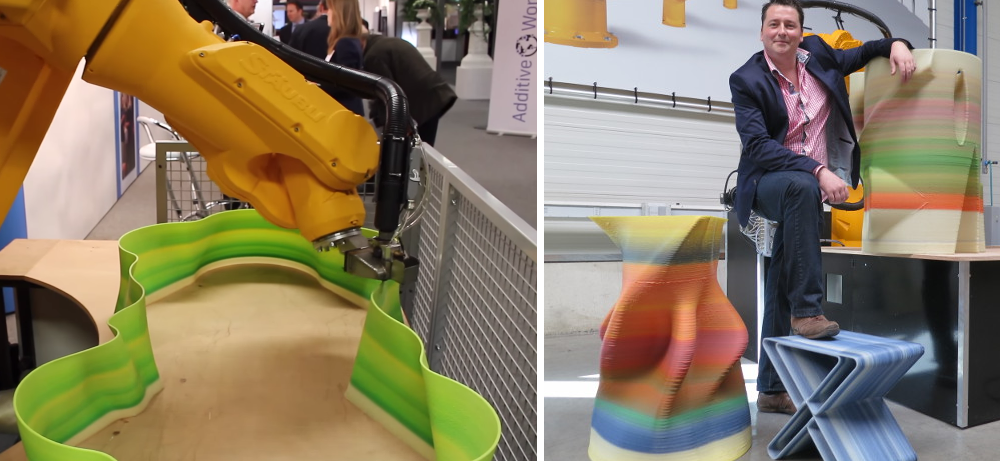
For one Dutch, 28-year-old man named Jasper Menger, both these technologies play an integral part in a new 3D printer which he unveiled at RapidPro 2015 in Veldhoven earlier this month. Menger who runs a company called 3D Robot Printing has create a 3D printer which is tethered to a traditional robotic arm, similar to one seen within a typical manufacturing facility.
Working on the project for over two years now, Menger only recently got the technology to the point where it could reliably print out very large objects using a process that’s similar to fused 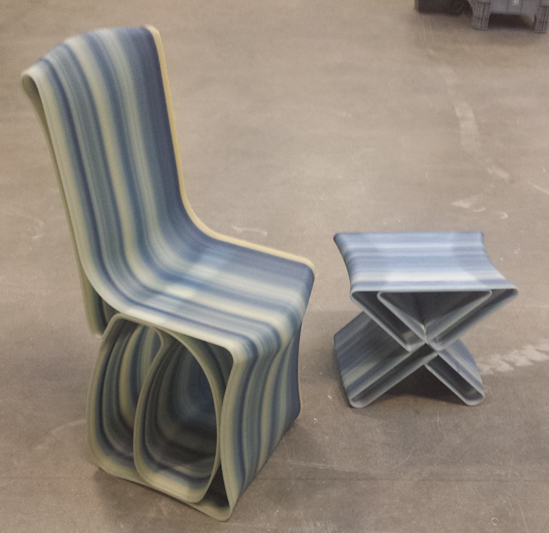 filament fabrication. As a former Robotic Systems Integrator at Roland Robotics, Menger learned a great deal about the field of automation, and decided to put that knowledge to use.
The machine which Menger presented at RapidPro 2015 utilized a Staubli TX200, 6-axis, heavy payload robotic arm. With a reach of 2.19 meters and a compact base which enables self mounting, the arm is able to expand on the typical build envelope of a traditional FFF 3D printer. This means that the machine is able to go almost anywhere that an attachment is possible, and print incredibly large objects. On his website, Menger states that he can create machines which have a build envelope of anywhere between 1 x 1 x 1m and 8 x 3 x 2m depending on the exact robotic arm he uses.
“I was surprised that no one had come up with this idea earlier on,” Menger explained to 3dprintmagazine.eu. “The beauty is that the robot is smarter than the 3D printer. A robot has only a few points in order to make the proper movement. Besides, you have six axes available.”
The machine does not use standard 3D printer filament, instead relying on granulate material which is run through a hopper and then extruded at a 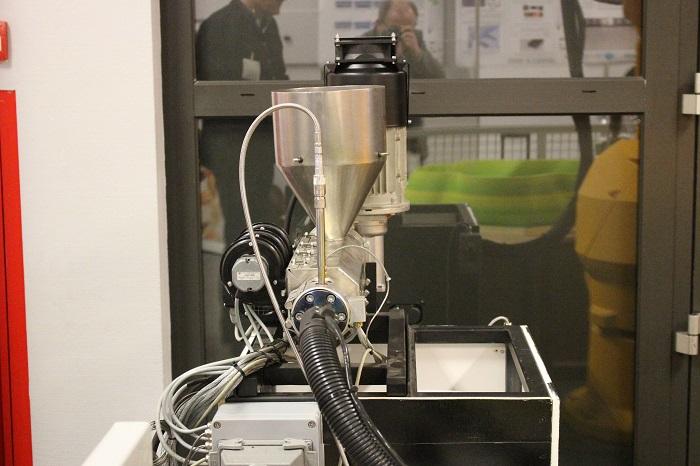 temperature of approximately 220 degrees C, with a layer height as accurate as 1mm. The system is smart enough to adjust the layer heights and amount of material being extruded based on how large a particular print project is. For smaller items it will print with more precision and detail, whereas a larger project it can print faster, with thicker layer heights. It’s also not only limited to 3D printing. In fact additional tool heads can be fit onto the machine, enabling subtractive manufacturing techniques such as milling and engraving as well.
As for the uses for such a machine, Menger is already using it to print out molds for the hulls of fiberglass boats, and he’s not simply satisfied with the statis quo. In fact he already is in the early planning stages to use his robotic arm approach to print using metals such as steel, reduce costs, and make the machine even larger.
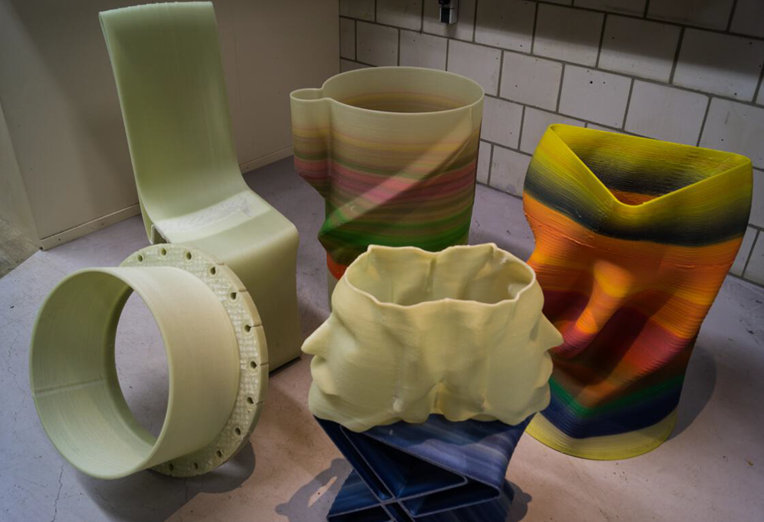
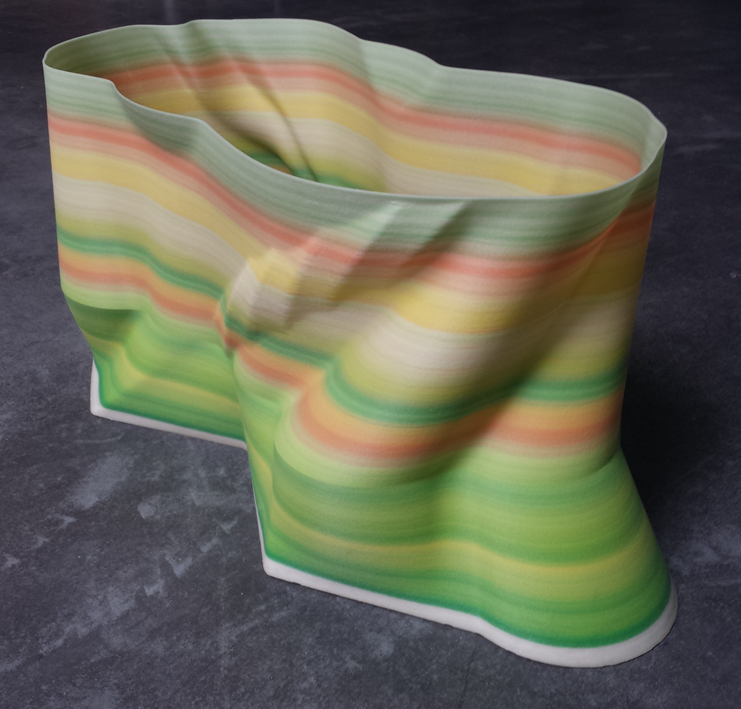
It will be interesting to watch this entrepreneur as he continues to innovate within this field. Let us know if you saw this printer in action earlier this month, and what your thoughts were. Discuss in the Robotic Arm 3D Printer forum thread on 3DPB.com. Check out the video of the printer in action, along with additional images of prints below:
Subscribe to Our Email Newsletter
Stay up-to-date on all the latest news from the 3D printing industry and receive information and offers from third party vendors.
Print Services
Upload your 3D Models and get them printed quickly and efficiently.











You May Also Like
3D Printing Moves Deeper Into Production as Parts Near $110B by 2034
A new report takes a closer look at how much 3D printing is actually being used in real production. The numbers point to a market that is already growing at...
TCT Asia 2026: Empowering Asia · Connecting the World
TCT Asia, now in its 12th year, is more than just a 3D printing exhibition — it embodies its original concept: Time Compression Technology, a vision of making the entire...
AM Applications Expected to Reach $110B in 2034, New Report Finds
Additive manufacturing may still be a relatively young industry, but the number of real parts being produced with 3D printing is growing quickly. According to a new report from Additive...
3D Printing News Briefs, February 28, 2026: Sales Partner, Holographic 3D Printing, & More
We’re kicking off today’s 3D Printing News Briefs with some business news, as Meltio has announced a sales partner in the U.S. and Immensa has joined Shell’s Energy Transition Campus....