3D Printed Artifacts Help Schoolchildren “Dig” Archeology

 Educators know how valuable experiences that are “hands-on” or “in the field” can be for children or students of any age. Reading about a topic is one thing, but learning about it through doing it is quite another thing. That’s why schools make a point of taking students on field trips. Nothing outweighs the value of first-hand experiences when you are trying to teach ideas or concepts to students.
3D printing is a technology that works well for hands-on classroom projects. If you are an educator lucky enough to work at a school with a 3D printer, you already know that 3D printing covers much academic ground from the sciences to mathematics, engineering to design. There’s so much to learn when you consider that not only does 3D printing encourage people to make their own objects, but the technology allows us to consider making things and planning projects and educational programs that would be otherwise difficult to even consider.
Take replications of artifacts as a case in point of objects that have much educational value when replicated through the 3D printing process. A 3D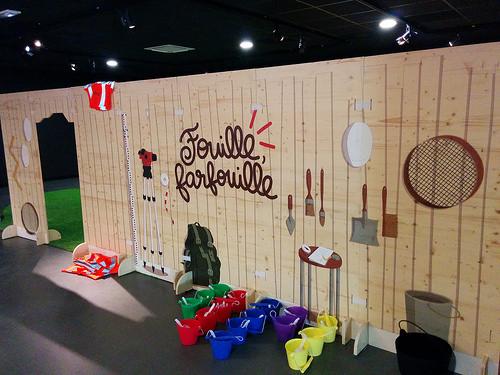 printed hands-on experience is exactly the idea that has motivated a recent collaboration between southern France’s Cap Sciences and Sculpteo called “Fouille, farfouille. Aventure-toi dans le temps!” This project has made approximately forty 3D printed artifacts available for “discovering” by schoolchildren ages 3-6 years old. Cap Sciences is an organization with the mission to bring science education to the public, and so it was a natural fit for them to work on a 3D printing project. Sculpteo, a full-service 3D printing company, was more than happy about the collaboration as well. As it turns out, schoolchildren are not just learning about artifacts, but this is also an opportunity for them to learn about 3D printing technology too.
Real artifacts should not be handled due to their fragile nature, 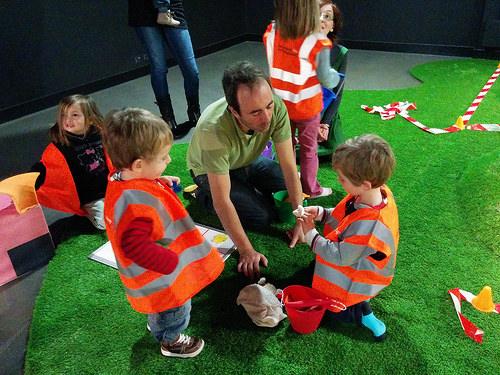 but in order for children to understand what it is an archaeologist does, they can greatly benefit from the experience of digging and finding their very own (3D printed) artifacts. These artifacts — originally ceramic, metal, bone, and stone — were 3D printed in plastic after being photographed in exact measurements using a technique known as photogrammetry. Researcher Henry Elophe ensured that thousands of photos were taken of the replicated objects in order to ensure exact measurements and other details. This process helped Sculpteo replicate artifacts in concise detail so they can give children an educational experience as close to the real thing as possible.
The results are quite impressive as schoolchildren have been able to experience a day in the life of an archaeologist, donning the equipment and setting off in a simulated dig environment that allows them to understand that they are searching to discover remnants of the past (with the aid of a technology that is well-situated in the future).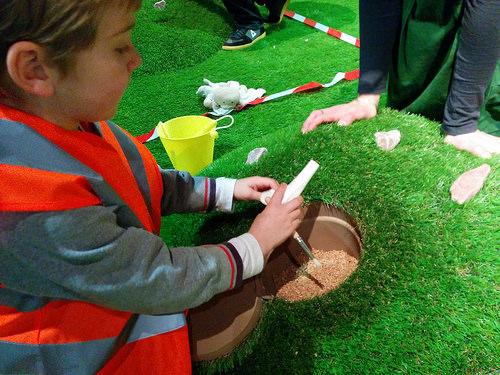
It is certain that this will not be Cap Sciences’ last project that integrates 3D printing. Helping budding learners “dig” archaeology is just the latest of what is sure to be many more innovative educational programs involving 3D printing.
What other innovative uses do you know of for 3D printing for children? Let us know what you think about hands-on learning in the Sculpteo and Cap Sciences’ Archaeology-Themed 3D Printing forum thread over at 3DPB.com.
Subscribe to Our Email Newsletter
Stay up-to-date on all the latest news from the 3D printing industry and receive information and offers from third party vendors.
Print Services
Upload your 3D Models and get them printed quickly and efficiently.











You May Also Like
Bridging the Gap: 2D to 3D AI in Manufacturing
For decades, the early stages of manufacturing have been defined by a simple, frustrating trade-off: you can have it precise, or you can have it fast. AI just broke that...
Takeaways From MILAM 2026: Defense’s Growing Role in Driving 3D Printing – Part I
The annual Military Additive Manufacturing Summit & Technology Showcase (MILAM 2026) once again brought together the defense sector’s top technologists, military leaders, and additive manufacturing (AM) innovators for three days...
Hardware is Dead. Here’s What Actually Wins in Additive Manufacturing.
Hardware is rapidly commoditizing across additive manufacturing. Specifications have converged. Price competition has intensified. Margins have compressed. For companies attempting to scale additive manufacturing beyond prototyping, this shift has profound...
The Real ROI of Personalized 3D Printed Medtech in Oncology
Discover how patient-customized 3D printed devices like Stentra™ significantly reduce high toxicity-related treatment costs and improve workflow efficiencies to handle more cases more effectively overtime. Introduction: The Economic Paradox in...