Meet ‘Eddie’ the 3D Printed Balance Bot

 3D printing and robotics are two fields that continue to converge on a daily basis. We are constantly seeing new ideas and open source projects emerge based on robotic devices that combine 3D printed parts with other up-and-coming technologies such as Arduino, Raspberry Pi, and the Intel Edison. This allows for completely custom robotic solutions for anyone willing and able to 3D print and program their machines.
For one development engineer, currently working at Teledyne, named Renee, 3D printing opened the door to her imagination. Having been into computers and electronics her entire life, she had been passionate about building robots ever since elementary school. Her latest creation utilized a Solidoodle 4 3D printer, which she has been using for 14 months now.
“It all started with the love for creating robots,” Renee tells 3DPrint.com. “This time I wanted to build something I hadn’t done before and I had this Intel Edison sitting on my desk. A self balancing robot was in the top 5 for things I’d like to make when SparkFun released their Intel Edison building blocks. After browsing their selection I saw what was a possible balance bot solution and pre-ordered the needed parts.”
Since she hadn’t created a balancing robot before via 3D printing, she wasn’t 100% certain it would work — but quickly she discovered that it would.
To design the robot, Renee used a free copy of Google SketchUp. Since she had been working with her Solidoodle 4 for over a year, she had already gained a good deal of experience as far as 3D modeling goes. However, Eddie the Balance Bot was the first 3D printable design that she created from scratch.
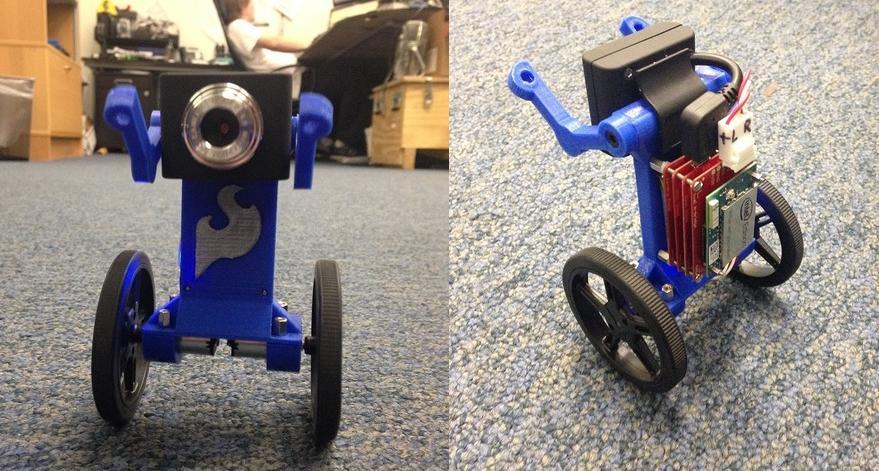
“I worked from the motors up, keeping in mind I wanted this to be easy to 3D print and I wanted it to look cool,” Renee tells us. “When I got to the arms I’m pretty sure I had Johnny 5 on my mind because I think there seems to be some resemblance there.”
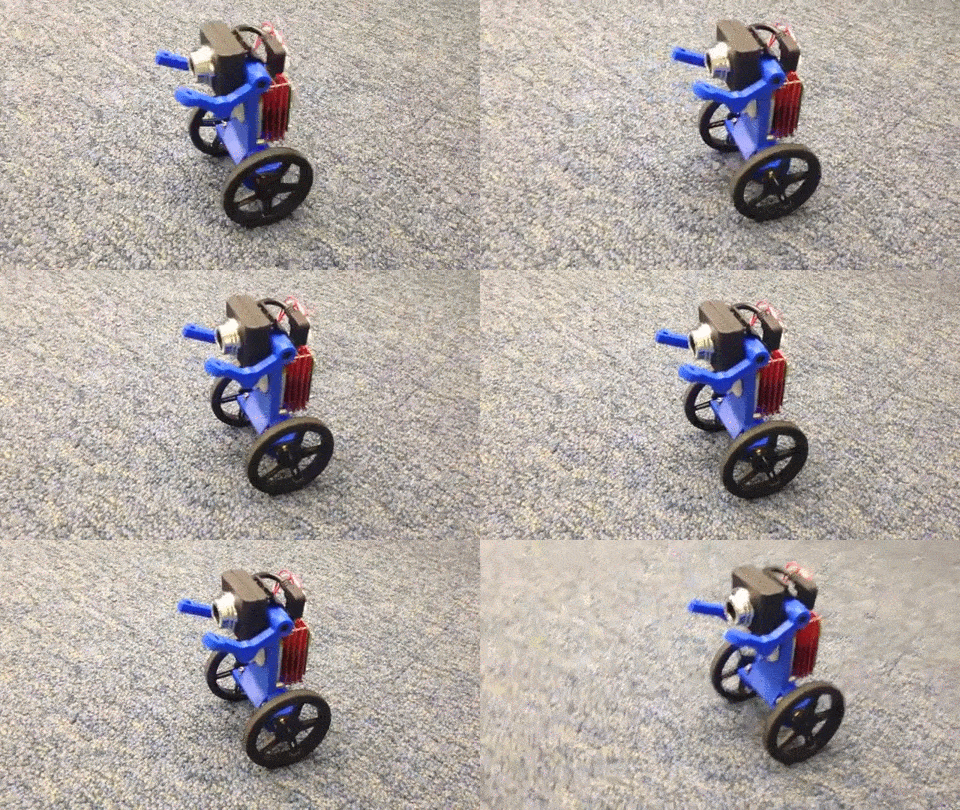
Whether it looks like Johnny 5 or not, we will leave that up to you to determine. When Renee reached the head of Eddie, she had to decide on what type of sensor to use. She found a small USB web camera and decided to utilize that. As you can see in the photos, the body of Eddie turned out quite well, especially considering that it was the first project that Renee designed for 3D printing from the ground up.
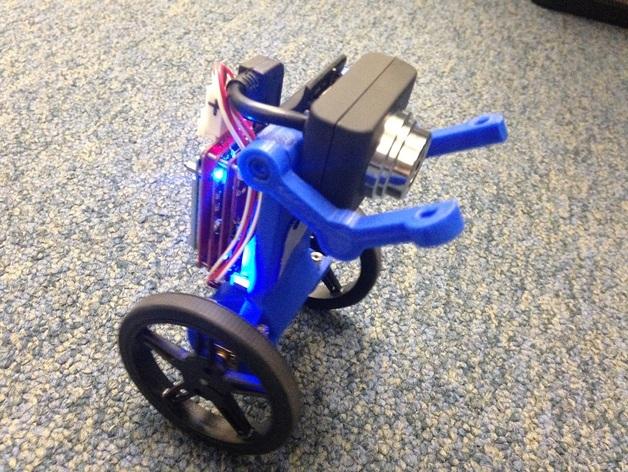 As for how Eddie works, he has an Intel processor and runs off the Linux Operating System. The tiny Intel Edison computer is connected to several components, including an inertial measurement unit, through a 70-pin connector. Eddie is able to sense if his body is falling forward, backward or if it is balanced just right.
“Once Eddie is powered on he automatically runs a C program I created to read and process his current angle,” Renee explains. “The angle is currently measured at 100Hz and processed through a kalman filter.”
Eddie also comes equipped with a remote control, utilizing the fact that the Intel Edison has built-in WiFi and Bluetooth technologies. The camera mounted on the front of Eddie has thus far only been tested with a github project that Renee found after doing a Google search.
So far, Eddie has turned out as well as Renee could have hoped for, but she certainly isn’t done tweaking his parts. Other than 3D printed parts, Eddie features several different electronic devices, including the aforementioned Intel Edison, as well as an IMU, a dual h-bridge motor driver, Li-ion battery, and two motors.
She hopes that others download and improve upon her design, so she has made the 3D printable files available for free download on Thingiverse.
What do you think about Renee’s balancing robot? What improvements would you make? Discuss in the ‘Eddie the Balance Bot’ forum thread on 3DPB.com, and check out the video of Eddie in action below.
Subscribe to Our Email Newsletter
Stay up-to-date on all the latest news from the 3D printing industry and receive information and offers from third party vendors.
Print Services
Upload your 3D Models and get them printed quickly and efficiently.











You May Also Like
Advancing Workforce Development for Industrial Additive Manufacturing
As additive manufacturing (AM) continues its transition from a niche technology to a core element of industrial production, workforce development has emerged as one of the industry’s most pressing issues....
Scaling DLP: How Visitech Moves Production Beyond the “Printer Farm”
With hundreds of light engines shipped in 2025, Visitech is leveraging its new Texas facility and scrolling DLP architecture to redefine industrial throughput. By achieving up to 20 times the...
Reuniting ExOne and voxeljet: An Investor’s View on Building a Global Industrial Sand Printing Leader
Authored by Whitney Haring-Smith, Chair of the Board, ExOne Global Holdings & Managing Partner, Anzu Partners At Anzu Partners, we invest with conviction in industrial technologies that create categories—and then...
Adoption of Advanced Powder Metal Manufacturing in the Global Small Arms Space – SHOT Show 2026 Additive Manufacturing Analysis
Back in 2013, I remember being completely blown away when a company called Solid Concepts reportedly additively manufactured nearly a complete firearm as a proof of concept. Although desktop polymer...