3D Printed Lighted Globe Uses Stereographic Projection to Cast Incredible Patterns


Surely one of the central goals of the maker movement is to encourage a return to self-reliance, something that we all sacrificed to an extent with the industrial and technological revolutions. Somebody else makes it, delivers it, and repairs it — and we find ourselves completely outside of the “How does it work?” loop. Not so with the DIY and maker movement and with the growing accessibility of 3D printing! In many ways, we’ve gone back to the drawing board. In the case of maker and 3D printing enthusiast Jason Cole, the drawing board is at least a few thousand years old.
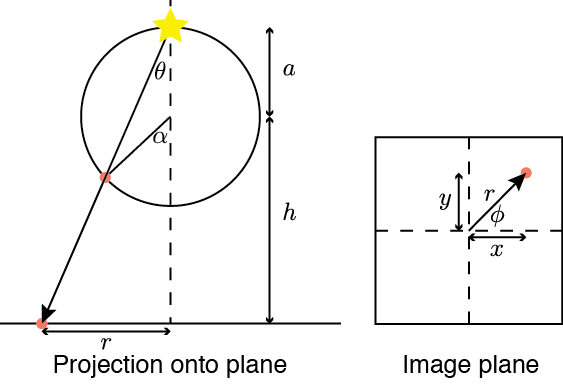
Cole is also a mathematician and was inspired by the work of designers Henry Segermen and Saul Schleimer, who create objects that project images using a system called stereographic projection. Cole set out to produce his own version of the centuries-old technique of projecting a sphere onto a plane, creating a lampshade that projects patterns into the surrounding space.
Stereographic projection was used by the ancient Greeks and probably the Egyptians before them. Ptolemy famously discusses it in his writing, the Planisphaerium (“celestial plane” or “star chart”). In short, the projection is defined on the entire sphere with the exception of one point: the projection point. There are ancient maps of the globe that were produced using this technique, which can now be accomplished using computers.
Cole decided to do the math. His objective was to project a decorative pattern onto a globe to create a lampshade that would project a pattern, not unlike what Segermen and Schleimer are doing. Cole’s, however, is arguably more complex and organic. Cole shows his work on a blog he created to document his process. We can’t check his work but we trust that he got it right because the end result is stunning.
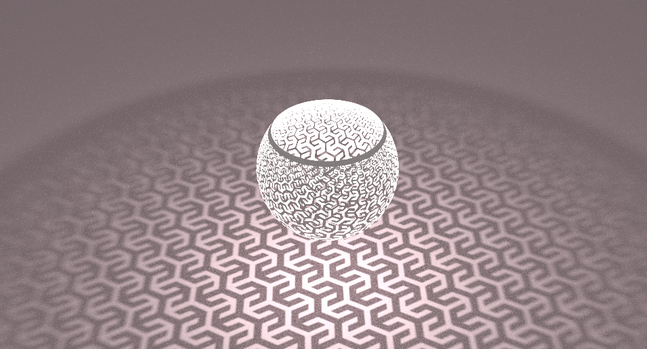
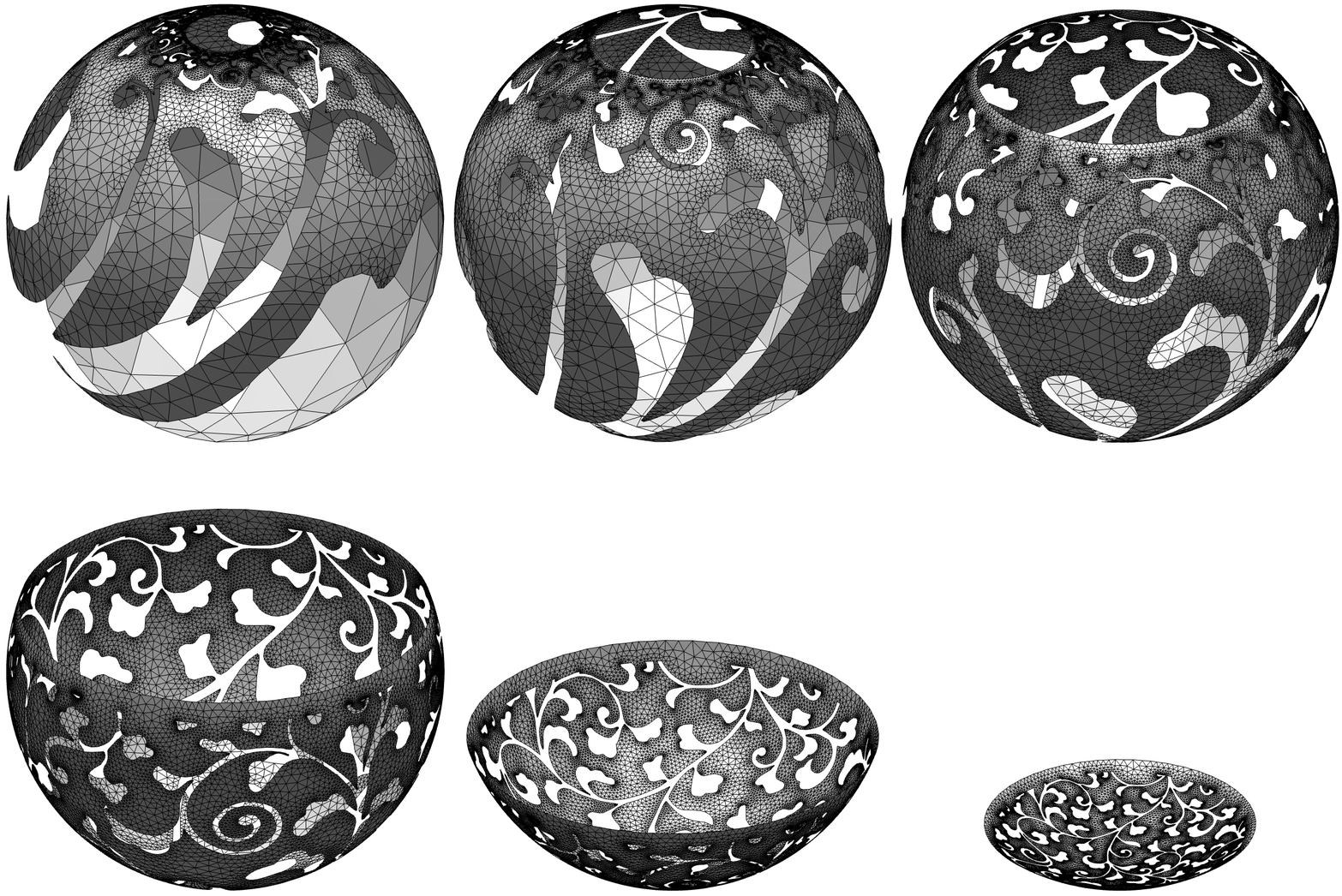
After finding his design for the lampshade using a Google search, Cole figured out how to project the design stereographically and then turned to Matlab for help translating his results into a 3D printable template — a bitmap image converted to a vector format. Next came the task of filling in the spaces between the holes, the beautiful, vegetal flourishes of his design. Cole used Mesh2D to create a mesh — the design at this phase is stunning in itself — around the intricate openings in his design and then it’s back to Matlab to warp the entire design to create the globe.
At this point, Cole is ready to 3D print his design. The globe-shaped lampshade is about 3″ or 3 ½” in diameter and he carefully calculated the precise point of the light source inside of it, although he doesn’t provide details about this phase of the project. Cole’s blog, “Almost Looks Like Work,” includes a comments section where the maker-mathematician has responded helpfully to queries.
A comment on his blog, from Johan, showed an attempt at 3D printing one of the patterns. Cole also provided a geometric design, which Johan attempted to 3D print on his MakerBot 3D printer. While Johan notes that by printing it without supports, the design came out a bit messy, it still looks like a pretty nice print!
We love this project on projection and the way it takes an ancient technique and combines it with cutting edge 3D designing, modeling, and printing technology! Let us know your thoughts on the Stereographic Projection Lampshade forum thread over at 3DPB.com.
Subscribe to Our Email Newsletter
Stay up-to-date on all the latest news from the 3D printing industry and receive information and offers from third party vendors.
Print Services
Upload your 3D Models and get them printed quickly and efficiently.











You May Also Like
Reshoring Requires Rules of Engagement
Reshoring manufacturing in the U.S. is a stated national priority. Policymakers, industry leaders, and defense planners agree that domestic production capacity is essential for economic resilience, national security, and long-term...
When a Factory Stops Being a Building and Starts Being a Machine
Metal manufacturing still carries the layout and logic of an older industrial age. Most factories run as a collection of isolated disciplines, each with its own equipment, staff, and data....
Bridging the Gap: 2D to 3D AI in Manufacturing
For decades, the early stages of manufacturing have been defined by a simple, frustrating trade-off: you can have it precise, or you can have it fast. AI just broke that...
Hardware is Dead. Here’s What Actually Wins in Additive Manufacturing.
Hardware is rapidly commoditizing across additive manufacturing. Specifications have converged. Price competition has intensified. Margins have compressed. For companies attempting to scale additive manufacturing beyond prototyping, this shift has profound...