Synthetic DNA to Become “Ink” for 3D Printed Nanoscale Structures in Medical and Scientific Applications

We’ve heard about filament to produce our common and not so common 3D printed objects and  devices. We’ve also heard about the medical advances that 3D printing facilitates, such as the use of nylon polymer in customized surgical 3D printed implants. Well, science and medical research has taken another large leap toward something virtually unimaginable, yet, closer than it may seem: 3D printing using synthetic DNA. Today, MIT News reports that researchers have come a step closer to replicating DNA structures that can then be used in 3D design and printing — “Where the ink is synthetic DNA.”
Back in May, it was announced that a replicable synthetic form of DNA has been created — none of which is found in nature. Synthetic DNA can aid research in areas of new medicines, diagnostics, and vaccines, and it can also be used to create nanomaterials.
DNA can be programmed by changing its sequence, and has a stable structure, leading scientists seeking to build nanoscale structures to see DNA as an excellent building material. Mark Bathe, an associate professor of biological engineering, led a team of researchers who began to create tiny computer-modeled DNA structures around 2005 via a process they dubbed DNA origami, using DNA “scaffold” strands and smaller “staple” strands that bind to the scaffold. The structures were initially created in 2D, and later were translated into the third dimension.
Researchers eventually developed computer models for the design process to streamline the previously time-consuming activity; the MIT team developed a program called “CanDo” in 2011 in order to generate 3D DNA structures. It was limited to rectangular or hexagonal shapes, but now a computer algorithm can create much more complex structures than were previously possible by cutting DNA sequences into subcomponents, which become the fundamental building blocks of programmed DNA nanostructures.
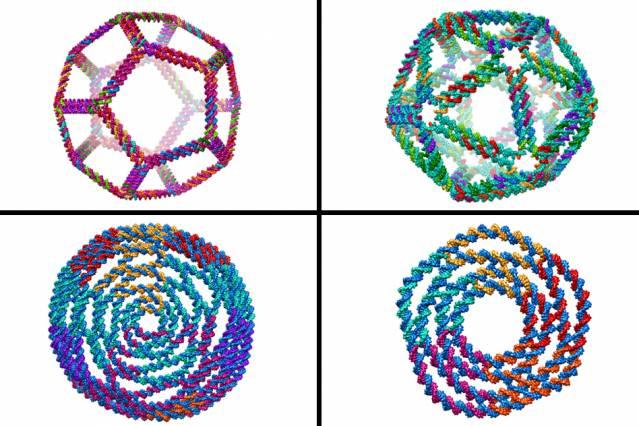
Rings, discs, and spherical containers, all with nano-scale dimensions, are the result of cutting DNA into smaller sections. The designers can then create “symmetric cages” — such as tetrahedrons, octahedrons, and dodecahedrons (see above). This is where 3D printing comes in.
Researchers were predicting the 3D structure of these reassembled “symmetric cages” on computers: “Predicting their 3-D structure…is central to diverse functional applications we’re pursuing, since ultimately it is 3-D structure that gives rise to function, not DNA sequence alone,” said lead researcher Bathe.
Once researchers have access to 3D printing the nanoscale arbitrary geometries of DNA structures, they can use them for many different applications by combining them with other kinds of molecules. Bathe reports molecules being studied here include chromospheres, which are active in the process of photosynthesis. Also, the application can be used with the study of bacterial toxins, aiding in the creation of a system for RNA and other drug therapy delivery.
The algorithm the researchers have developed will be available for public use in upcoming months, allowing for expanded use among others involved in DNA design research. While in its present form, the model requires the designer to supply the sequence of the DNA, Bathe and his team intend for future iterations to allow for a computer-generated model. With the designer providing a shape, the computer model should generate the sequence to produce that shape — this future version would allow for the synthetic DNA to be used as “ink” in nano-scale 3D printing.
While this research progress may seem overwhelming, if you follow the trajectory of precise computer modeling from 2- to 3-dimensional, you can understand that a 3-dimensional design can lead to actual 3D printed materials. This “made-to-order” nanoparticle design and synthesis procedure will be realized using 3D printing technology, but it’s not the usual filament they are talking about here in those cartridges — it’s synthetic DNA!
Let’s hear your thoughts on this story in the Synthetic DNA & 3D Printing forum thread on 3DPB.com. Be sure to check out this video concisely explaining the process:
Subscribe to Our Email Newsletter
Stay up-to-date on all the latest news from the 3D printing industry and receive information and offers from third party vendors.
Print Services
Upload your 3D Models and get them printed quickly and efficiently.













You May Also Like
Metal 3D Printers for the Desktop Are Finally Starting to Feel Like Desktop Products
FDM 3D printing is becoming increasingly accessible, yet metal 3D printers designed for everyday desktop use remain rare on an ordinary workbench. The real challenge is not making a metal...
3D Printing Financials: 6K Additive Sales Rise as Aerospace and Defense Demand Grows
6K Additive (ASX: 6KA) grew rapidly in the first half of 2026 as demand for its metal powders increased, particularly from aerospace and defense customers. The newly public company also...
When Data Becomes the Differentiator: Qualified Material Data is Changing the Future of Structural Additive Manufacturing
For years, additive manufacturing has promised engineers greater design freedom. The challenge wasn’t printing the part—it was proving the part belonged on an aircraft. Designing a lightweight bracket or consolidating...
Amaero Builds U.S. Metal Powder Capacity for Additive Manufacturing
For metal additive manufacturing (AM) to grow in the United States, companies need more than printers. They also need a reliable supply of the powders that go into those machines....