Michigan Tech Researchers Create Two Portable Solar Powered 3D Printer Systems

 Additive manufacturing promises to change the lives of millions, the means of production of thousands of companies, and transform supply chain management in the developed world. It’s really remarkable just how far we have come in such a short span of time.
Living in the United States, I’ve come to realize the many things I take for granted, which are the norm for us, but luxuries for those living in third world countries. Electricity is one of these things, and although there has been tremendous strides in recent years to expand electrical grids into even some of the most remote villages in developing nations, there is still a huge population living with no means of power.
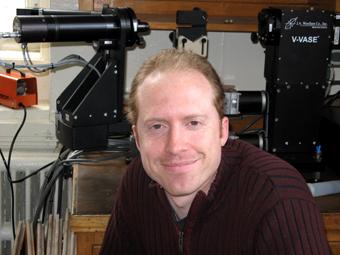
Joshua Pearce
Although 3D printers could provide many needed benefits to developing nations, without a reliable power supply, no such technology can exist. This is why one researcher and engineer, named Joshua Pearce, is combining his two specialties, 3D printing and solar power, to present a couple of interesting solutions for those living in developing nations, as well as those travelling through and providing aid to these countries. Imagine trekking through a desolate area and and having the ability to print out a needed part for a broken backpack, or a bowl to catch rain water in? This could all be possible with a solar powered 3D printer.
Pearce and his team at Michigan Tech, which includes Debbie L. King, Abegboyeg Babasola, and Joseph Rozario, have published a paper called ‘Mobile Open-Source Solar-Powered 3-D Printers for Distributed Manufacturing in Off-Grid Communities‘, where they discuss two particular solar powered 3D printer setups.
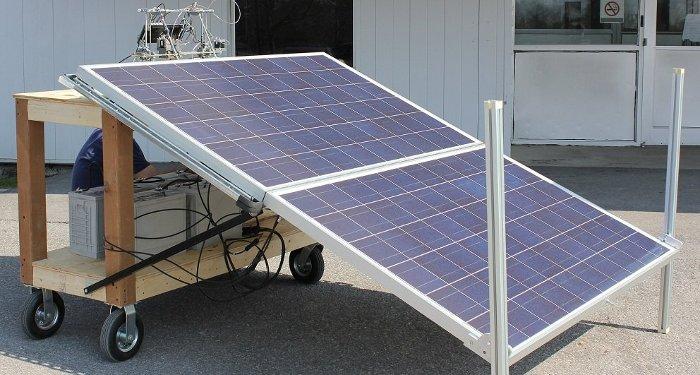
Setup #1 – Large Mobile 3D Printer Systems
The first setup is a quasi-portable solar printer which the team envisions being set up outside of a small business or in a school yard. The printer sits on top of a wheeled cart, while four 120 Ah batteries sit on the lower shelf of the cart, and two 220 W PV panels rest against it all. Because of the large panels and batteries, this 3D printer can run for 35 hours straight on a single charge.
“It can make high-value items for pennies, but it’s not very portable,” stated Pearce.
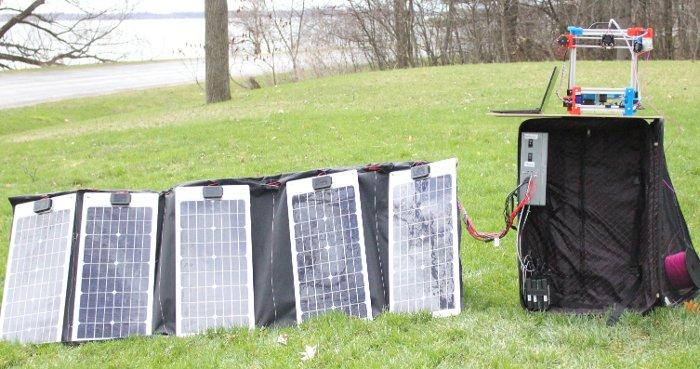
Setup #2 – Portable Solar 3D Printer in a Suitcase
The second setup is much more portable. In fact, it could feasibly be worn on someones back. The entire setup easily fits within a suitcase and features a Foldarap RepRap 3D printer, an Efika MX Smartbook notebook computer to control the printer, and five 20 W solar modules. The 5 modules weigh just 10 pounds combined, making transportation much more feasible. As for batteries, the system actually uses four 14.8 V 6600 mAh laptop batteries. Such a portable system like this one would be perfect for doctors or medical personnel traveling in foreign regions, baron of any power supply.
“Say you are in the Peace Corps going to an off-grid community,” Pearce said. “You could put your clothes in a backpack and take this printer in your suitcase. It’s a mobile manufacturing facility that can make whatever you and the community need or value. It has nearly unlimited flexibility.”
According to the research paper, the team found that not only will such systems allow for additive manufacturing to occur in remote areas of the world, but also may reduce the impact that current supply chain networks have on the environment. As solar cells continue to become more efficient, and battery capacity increases as prices decrease, such technology should rapidly improve over the next 5-10 years. A decade from now, such mobile 3D printer systems may be commonly used for both military and civilian applications.
Let’s hear your thoughts on both of these mobile solar 3D printers. Discuss in the Solar Powered 3D printer forum thread on 3DPB.com.
Subscribe to Our Email Newsletter
Stay up-to-date on all the latest news from the 3D printing industry and receive information and offers from third party vendors.
Print Services
Upload your 3D Models and get them printed quickly and efficiently.













You May Also Like
Bambu Lab Moves Beyond 3D Printing with R1 Laser Cutter
Bambu Lab has gone from one X1 printer, which did very well, to entry-level A1 systems, mid-market P2S systems, and larger H3Ds and more. They’ve also made systems that couple...
Stratasys Wins $27.6M in Patent Case Against Bambu Lab; Bambu Challenges Verdict
Update, September 21, 2026: This article has been updated with a statement from Bambu Lab responding to the verdict, along with additional information about the company’s ongoing patent challenges against...
Ski Lift Foundations Made With 3D Printing in Hemavan, Sweden
While most of the 3D printed construction hype has been around houses, we’re more bullish on infrastructure. By 3D printing in hard-to-reach areas, remote structures can bring infrastructure to new...
3D Printing News Briefs, September 12, 2026: Rebranding, Cybersecurity, Project Call, & More
We’ve got a lot of business news from ATLIX to start off this weekend’s 3D Printing News Briefs, with a new identify for its additive manufacturing (AM) portfolio and some...