Italian Designer Creates Tiny Open Source Vases for Roadside Flowers Received from his Daughter

 ‘Daily utility’: that’s what the desktop 3D printing market needs more of before widespread adoption of the technology will take place. Don’t get me wrong, I love my 3D printer, and I do in fact use it to print all kinds of useful parts and components. My toilet broke yesterday, a tiny clamp needed to hold a hose in place inside, and within 35 minutes I had a new, 3D printed clamp. With that said, the majority of items people are printing on their MakerBots and similar machines are geared more toward hobbyists, model makers, and collectors. As the market expands, and designers continue to innovate, this will gradually change.
A graphic designer based in Milano, Italy is already discovering the usefulness of his 3D printer. Pietro Corraini, author of How to Break the Rules of Brand Design in 10+8 Easy Exercises, is a father of two. Recently he was left without a solution to a major problem. His 2-year-old daughter, Stella, had been bringing him tiny little flowers that she had picked at the park and by the roadside.
“She was giving them to me as a gift and I was always sad because I didn’t have a place to hold them and keep them alive,” Corraini told 3DPrint.com.
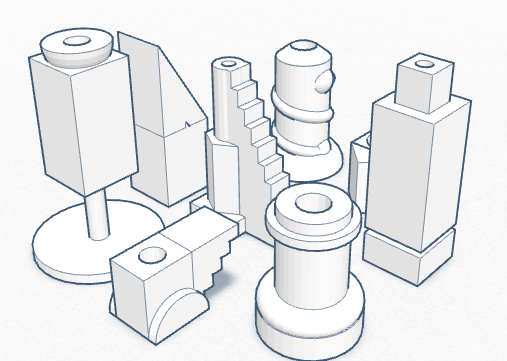
The 3D models
Because of the incredibly small size of these flowers, there was no way that they would fit in a normal sized vase. Even using drinking glasses as makeshift vases was out of the question because their depth would have hidden, or even drowned the delicate beauties. Corraini happened to have a Sharebot 3D printer from work, which sparked the bright idea to make custom vases for these precious little gifts that his daughter had been providing him.
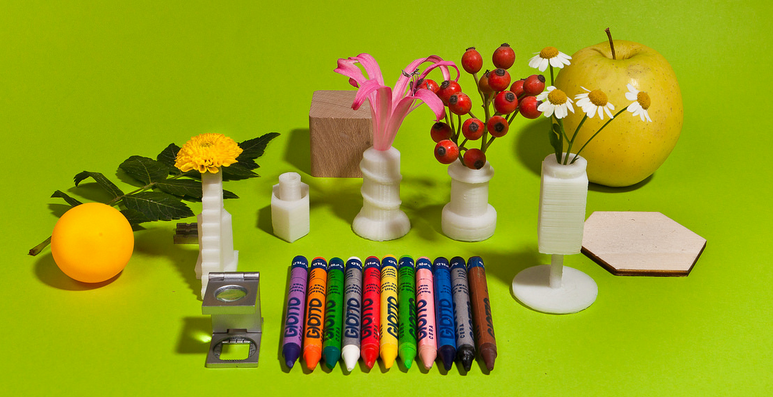
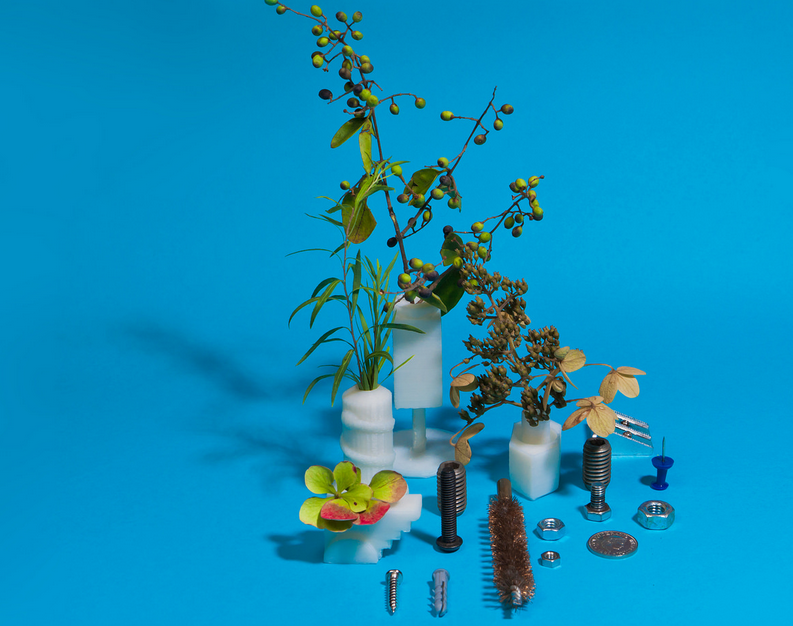
Using his design background, he modeled tiny vases which would fit the flowers he received perfectly. Because of the small structure of the objects, as well as the fact that they were hollow in the inside, the vases were printed out in no time. Being a graphic designer, Corraini decided to be a little artistic, as he explained to us belo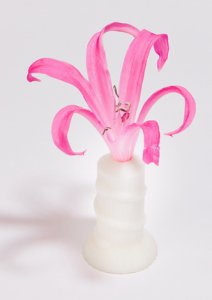 w:
w:
“We decided to take pictures combining the still life of the flowers with small, yet unappreciated everyday objects which are just as important as the tiny flowers, which in turn are just as important as larger flowers.”
Corraini named the pieces ‘Trapulin’ which means ‘small useless object’ in the Milanese dialect, and has made the 3D printable models available online for all to print. He is just waiting for another creative project to come to mind in which he can use his design skill along with 3D printing to tackle.
Let’s hear your thoughts on these tiny little vases. Will you be printing any? Discuss in the 3D Printed Tiny Vase forum thread on 3DPB.com.
Subscribe to Our Email Newsletter
Stay up-to-date on all the latest news from the 3D printing industry and receive information and offers from third party vendors.
Print Services
Upload your 3D Models and get them printed quickly and efficiently.











You May Also Like
Reuniting ExOne and voxeljet: An Investor’s View on Building a Global Industrial Sand Printing Leader
Authored by Whitney Haring-Smith, Chair of the Board, ExOne Global Holdings & Managing Partner, Anzu Partners At Anzu Partners, we invest with conviction in industrial technologies that create categories—and then...
Adoption of Advanced Powder Metal Manufacturing in the Global Small Arms Space – SHOT Show 2026 Additive Manufacturing Analysis
Back in 2013, I remember being completely blown away when a company called Solid Concepts reportedly additively manufactured nearly a complete firearm as a proof of concept. Although desktop polymer...
AM-Europe, operated by CECIMO: Positioning Additive Manufacturing at the Core of Europe’s Industrial Competitiveness
As European industries face growing pressure to strengthen resilience, reduce supply chain risks, and meet sustainability objectives, additive manufacturing (AM) is emerging as a practical and strategic solution. Closely align...
Five Imperatives for CAD and PDM In The Additive Era
Additive manufacturing has reached an inflection point. Hardware capabilities continue to advance, materials portfolios are expanding rapidly, and automation is reshaping post‑processing and production workflows. Yet many additive programs still...