3D Printing Helps Fix Child’s Heart, Save Life

3D printing has been creeping its way into the healthcare industry, slowly but surely, over the last few years. We have seen 3D printed human tissue, 3D printed prosthetics of all types, and now 3D printing is being used as  a model for doctors to better envision particular procedures.
Roland Lian Cung Bawi, the 14 month old son of two Burmese immigrants, now residing in Owensboro, Kentcky, had major defects to his tiny little heart. The defects, which included a hole in his heart as well as misaligned aorta and pulmonary arteries, if untreated would have doomed Roland to a short unhealthy life. This is when Surgeon Erle Austin stepped in. Austin initially had 2D images of Roland’s heart, which he showed to several other surgeons, on his path to correct Roland’s condition. The problem was that the 2D scans were not precise enough, leading to several surgeons offering different suggestions on how to proceed. This is not the kind of advice a surgeon likes to 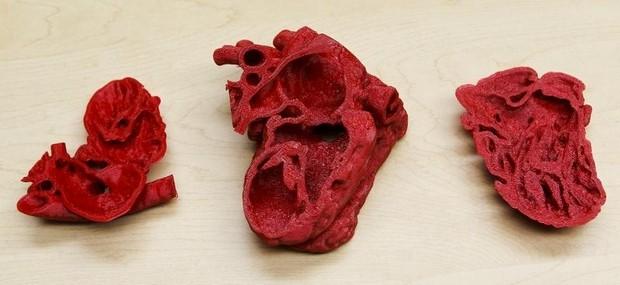 receive, leading up to a major operation.
This is when Austin decided to turn to the School of Engineering at Louisville. They used a Makerbot Replicator 2X, 3D Printer to create a model of Roland’s heart, and all its defects. The model was printed in 3 separate pieces so that the surgeons could take it apart and see the interior.
“Once I had a model, I knew exactly what I needed to do and how I could do it,” said Austin to the Courier Journal, “It was a tremendous benefit.”
Having the model 3D printed allowed Austin to cut out a significant part of exploratory surgeries, and also shorten the time it took to operate on the tiny, delicate heart. The surgery was successfully completed on Monday, February 10th, and marked the first use of a 3D printer in the state of Kentucky for a pediatric heart patient. Roland is doing well and his family is relieved. Discuss this Article At 3DPrintBoard.com.
Subscribe to Our Email Newsletter
Stay up-to-date on all the latest news from the 3D printing industry and receive information and offers from third party vendors.
Print Services
Upload your 3D Models and get them printed quickly and efficiently.











You May Also Like
Asia AM Watch: China’s 5 Million-Printer Export Year Signals Desktop AM at Scale
For years, a lot of the discussion around China and additive manufacturing has focused on industrial competition. Can Chinese companies move into higher-end markets? Can they challenge Western machine makers...
Creality Launches Filament Maker M1 & Shredder R1, Letting Makers Reuse Waste, Cut Costs, and Create Their Own Filament
From Printing Objects to Shaping Materials Desktop 3D printing has made on-demand creation more accessible than ever. Yet one critical part of the process remains fixed: the material itself. Most...
Bambu Lab 3D Prints Miniature Playground City for Kids in China
Bambu Lab has partnered with meland to open what they describe as China’s first 3D printing creativity center for children. The new space, officially named “meland x Bambu Lab,” launched...
Bambu Lab Says 2025 Was a Breakout Year: 10 Million Monthly Users and Real Business Growth
Chinese 3D printer maker Bambu Lab reported strong results for 2025, showing that the company’s push into community and small-business 3D printing is working. The numbers suggest consumer 3D printing...