The Power of NinjaFlex: French Occupational Therapists Create 3D Printed Joystick for Wheelchair

 3D printing has affected manufacturing and designing to the point that nearly everything that can be made is either now rolling off of a 3D printer or will be soon–and usually in some very improved or unique fashion. We follow 3D printing in nearly every sector, from automotive to medical, with everything in between covered–and plenty coming from desktops, labs in universities, and a variety of makerspaces.
Seeing 3D printing technology help those with physical challenges, however, is immensely inspiring. And numerous innovators and medical professionals have been inspired to put their creative minds to use at the 3D printer to help make life that much better for people of all ages with many different challenges.
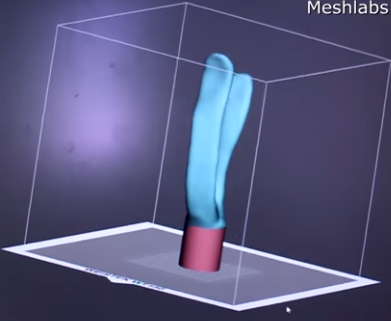
Recently, two occupational therapists in France decided to refine a wheelchair design to help a paraplegic patient (at the C5 level, meaning the individual can still use arms and hands) who would benefit from great ease in getting around. Guy Ehretsmann (Pôle-Ergo) and Jean-François Bodin (ITSR Lyon – HCL Hanry Gabrielle Lyon) created a 3D printed joystick printed in NinjaFlex. Originally this was a test to see if indeed they could replace a traditional joystick successfully with 3D printing and improve directional mobility for the user.
 While at first they were going to fabricate a chin-driven apparatus, that was discovered to be much too inefficient, so they forged ahead and created a hand-maneuvered 3D printed joystick with special thermo-plastic molding, designed in Meshmixer, a free 3D design tool that allows users great latitude in coming up with completely unique designs for 3D printing.
“We are working to find how we could use 3D printing to help disabled people to find a better autonomy in their living day life,” Ehretsmann told 3DPrint.com. “That is why we have worked on a molded, scanned and printed joystick to help a quadriplegic person drive an electric wheelchair.”
“The exponential development of 3D tools (3D scanner, 3D pen, etc.) and the accompanying printer is a powerful inspiration that has opened many horizons for creativity and experimentation.”
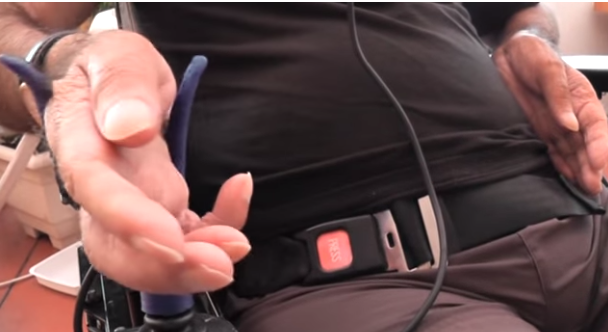
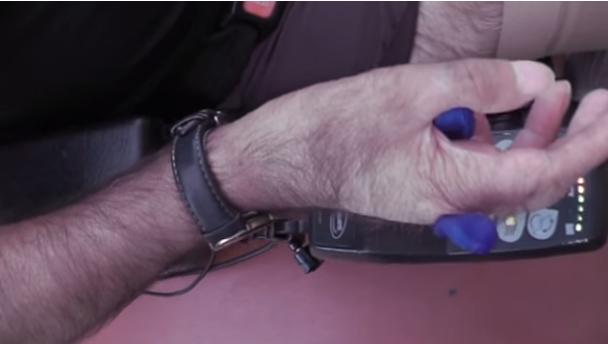 While the project is still ongoing, at this point, they have created a very functional, flexible joystick attachment which allows the user to fit his hand inside the flexible 3D printed material and move it easily as required.
Control of the wheelchair appears to be seamless, and much greater comfort and ergonomics are attained due to the comfortable and pliant material. Testing so far indicates to the therapist/innovators that not only is this a product that has great potential, but they believe that the 3D printer is indeed ‘a tool that deserves to be in the toolbox of the occupational therapist.’
The overall mission is to use digital design and the power of 3D printing to bring greater autonomy to those using electric wheelchairs–and Ehretsmann reports that he is currently teaching the technique to his occupational therapist students at the University of France. Let’s hear your thoughts on this story in the Wheelchair Joystick forum thread on 3DPB.com.
Subscribe to Our Email Newsletter
Stay up-to-date on all the latest news from the 3D printing industry and receive information and offers from third party vendors.
Print Services
Upload your 3D Models and get them printed quickly and efficiently.













You May Also Like
3D Printing News Briefs, August 22, 2026: Polymers for CubeSats, Animal Mobility Devices, & More
We’re starting with defense news in this weekend’s 3D Printing News Briefs, before moving on to polymers for CubeSats and 3D printed prosthetics. We’ll end with a story about engineering...
Pusan National University & ORNL Develop Elastomeric Liquid Crystal Actuators
Researchers from Korea’s Pusan National University and Oak Ridge National Laboratory (ORNL) have developed 3D printed elastomeric actuators. In a paper published in Nature, the team used elastomeric liquid crystal...
Scientists Use BMF to 3D Print Seal Whiskers That Track Prey Long After It’s Gone
Seals use their whiskers to hunt. Not Navy Seals, although they may in some way also, but this article is about lowercase seals. Not Seal the musician either; as far...
Harvard’s Jennifer Lewis Lab Is 3D Printing Artificial Muscles That Twist and Bend on Demand
Researchers at Harvard John A. Paulson School of Engineering and Applied Sciences (SEAS) have developed a new way to 3D print materials that can move on their own, bending, twisting,...