
New Unique 3D Printable Arm, The Printhesis, Wins James Dyson Award

 Go back just a decade or two and when the phrase ‘prosthetic arm’ or ‘prosthetic hand’ came to mind, most individuals likely envisioned a hook-like device attached to a socket. Boy have we come a long way in a short amount of time. In a world with 3D printable hands shaped like the actual human anatomy, bionic hands which can actually be controlled by the wearer’s own muscle fibers, and all sorts of other advancing technologies, the traditional hook hand has somewhat fallen by the wayside.
With this said, many amputees still use these hook-like devices when in the confines of their own homes, as the not-so-aesthetically-pleasing attachments are quite useful tools for performing more intricate tasks. Just ask a young woman named Lianne who recently lost her left arm to bone cancer. Lianne enjoyed making jewelry, but with only one arm, her favorite activity was no longer possible in the same capacity. She required a prosthetic which would allow for fine, intricate grasping and movement, which was something that a typical 3D printable arm or other prosthetic was not of much use for. The hook-like device that she was using may have been a little bit better, but still Lianne was not satisfied.
In comes Roel Deden, who is a graduate of the Dutch Design Academy in Eindhoven, the Netherlands. She also happens to be friends with Lianne, and when she learned that the prosthetic that her friend was currently using, made out of titanium and fiberglass, cost upwards of $8900, was heavy, and oftentimes uncomfortable, she decided to reimagine a 3D printable version of the arm called the Printhesis.
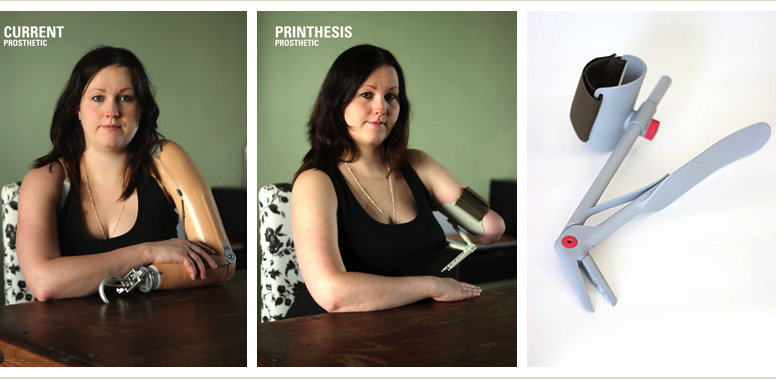
“I’ve always been fascinated by products that have a relationship with the body. Prostheses are thereby more interesting because you get back a skill or that skill even improves. When I saw Lianne’s problem and heard what it had cost to make her prosthesis I decided it had to be simpler and cheaper.” stated Roel.
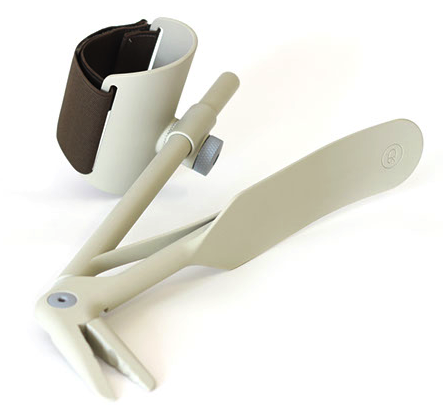
Since Leanna didn’t expect to be wearing this prosthetic while out and about, instead using it for tasks performed at home, such as jewelry making, Roel didn’t concern herself much with the aesthetics of her device. The new design is almost entirely 3D printed, relying on just three standard screws for assembly. At its base is a flexible textile band which is completely adjustable and can be affixed to the stub of the wearer. The area where the hook was, in Lianne’s old device, is replaced by a plier-like tool. The jaws of the pliers feature multiple holes, allowing the user to grip objects of varying sizes , and its modular nature allows for future iterations for additional functionality.
Roel relied on Shapeways, the 3D printing service bureau, to print out all of the necessary components of her Printhesis device. The total cost (approximately $335) was a small fraction of what Lianne paid for her larger, heavy, more clunky device.
After giving the new prosthetic to her friend Lianne, Roel’s design was nominated for The Netherlands’ 2015 James Dyson Award, and unsurprisingly won the 2,000 pound prize.
It’s people like Roel who think outside the box, using the latest technologies to envision a brighter future for the less fortunate, who will take 3D printing and related technologies to the next level. Let us know your thoughts on the Printhesis. Discuss in the Printhesis 3D Printed Arm forum thread on 3DPB.com
Subscribe to Our Email Newsletter
Stay up-to-date on all the latest news from the 3D printing industry and receive information and offers from third party vendors.
Print Services
Upload your 3D Models and get them printed quickly and efficiently.













You May Also Like
Stratasys vs. Bambu Lab: What’s Really Behind the $27.6M Patent Verdict?
Editor’s note: This is Part 1 of a two-part series by Xu Fanglei examining the technology and patent issues behind the Stratasys-Bambu Lab dispute. Part 1 looks at the U.S....
Bambu Lab and SUSAN FANG 3D Print for London Fashion Week
At London Fashion Week, some of the more unusual pieces on the runway came from 3D printers. Chinese fashion designer SUSAN FANG presented her Spring/Summer 2027 Air-Illusion collection at the...
3D Printing News Briefs, September 26, 2026: Bioceramic Implants, 3D Concrete Printing, & More
In this weekend’s 3D Printing News Briefs, we’ll start with an integration between PanOptimization and AMCM, before moving on to healthcare news from KLS Martin and Lithoz, and then UltiMaker...
Bambu Lab Moves Beyond 3D Printing with R1 Laser Cutter
Bambu Lab has gone from one X1 printer, which did very well, to entry-level A1 systems, mid-market P2S systems, and larger H3Ds and more. They’ve also made systems that couple...























































