3D Printing Conductive Food — Professor Powers Up LEDS With Edible, Conductive Vegimite

 Vegemite has been around for a long, long time. If you live in Australia, you know it as a staple. When you lay out the ingredients in a list, it sounds disgusting, but apparently those breakfasting down under have a professed taste for this yeasty paste that also includes some veggie spices and additives to entice the tastebuds further.
Around for nearly a hundred years, Vegemite has served its purpose throughout the lifetimes of many. Now, this traditional household condiment is coming forth, exiting the chill of the Aussie fridge and heading into the high-tech world to be used as a conductive material for 3D printing. Wait, what? Yes, and not only that, tell all your friends you can still eat it too.
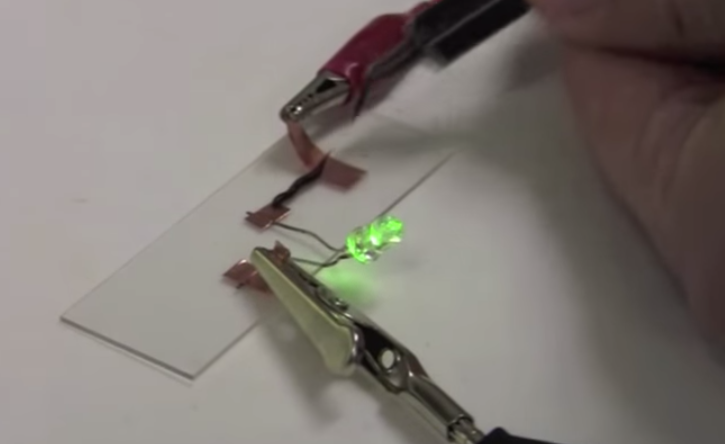 Following an interesting project highlighted by Professor Marc in het Panhuis of the ARC Centre of Excellence for Electromaterials Science, we were able to see that the inimitable spread can actually function as a material for powering up all those LEDs people are so fond of using. As is so often the case, the teacher and researcher was on the prowl for edibles and soft materials to use in 3D printing regarding soft robotics and biomaterials, and something quite functional was sitting right in front him–on the breakfast table.
“The iconic Australian Vegemite is ideal for 3D printing edible electronics,” says the professor. “It contains water so it’s not a solid and can easily be extruded using a 3D printer. Also, it’s salty, so it conducts electricity.”
The main theme here is conductive, as the researcher was interested in seeing how he could use it for power. Loading the Vegemite into a syringe and drawing out a thin strip of the ‘material’ and using it to complete a circuit between an LED and a battery, Professor in het Panhuis explains this level of conductivity is possible because of the ions and water in the Vegemite.
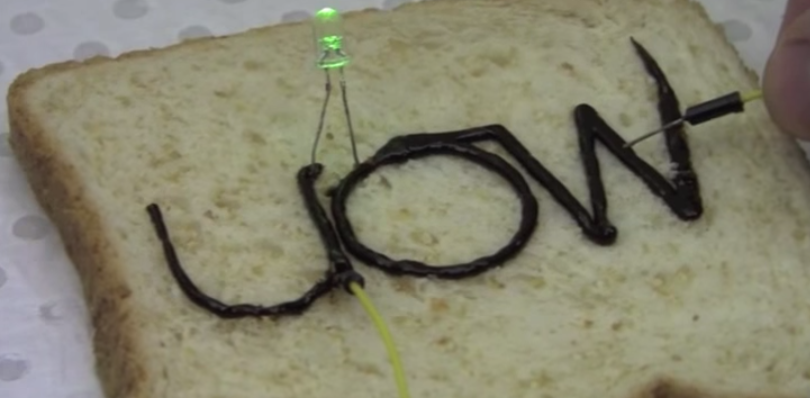 And of course because what we all want to know is if we can put it on some bread, light it up, and eat it too, Professor in het Panhuis good naturedly obliges with the obvious question. He loads the Vegemite into the 3D printer, extruding it onto bread and even spelling out the world ‘wow’. Once again, he is able to demonstrate quite clearly how easy it can be to use a simple household item to produce a current, even as it sits atop a piece of sliced bread. He is once again able to complete a circuit and power up the little LED.
Impressed? We were. And if you’re hungry, don’t forget how simple and nutritious this breakfast of champions can be if you give it a chance. Tens of millions of people in Australia can’t be wrong–it’s all in what you do with it, as witnessed here!
Were you surprised to see that a common food source (for some) can actually light up an LED? Have you attempted using anything like this as a 3D printing material due to its soft, water-soluble qualities? Discuss in the 3D Printed Vegemite forum thread over at 3DPB.com.
Subscribe to Our Email Newsletter
Stay up-to-date on all the latest news from the 3D printing industry and receive information and offers from third party vendors.
Print Services
Upload your 3D Models and get them printed quickly and efficiently.













You May Also Like
The Stories nScrypt Can’t Tell; and Why That Matters
This article is Part 3 of a three-part series based on 3DPrint.com’s visit to nScrypt’s Orlando headquarters and conversations with Ken Church. There’s an interesting dynamic inside nScrypt’s Orlando headquarters. The...
amsight & toolcraft Improve AM Quality Control for the Semicap Market
As it is in the habit of doing at least once per generation, the semiconductor capital equipment (semicap) market is currently in the process of reinventing itself. This is too...
3D Printing Financials: XTPL Adds New Semiconductor and Defense Customers in Q1 2026
Polish microprinting company XTPL (WSE: XTP) reported first-quarter 2026 revenue of PLN 1.6 million (roughly $441,000) as the company expands into the semiconductor and advanced electronics markets, while also launching...
Creality Marks 12 Years with KliTek and AI-Powered Ecosystem Expansion
For 12 years, Creality has advanced accessible 3D printing technologies, enabling global users to turn ideas into tangible creations. What began as a desktop 3D printer manufacturer has evolved into...