Marine Biosystems’ F5 Biopellet Reactors Are 3D Printed for Efficiency in Aquariums

 Aquariums are exceptionally delicate biospheres which require a number of fine-tuned systems to function properly. One of those systems, the biopellet reactor, is meant to provide a reaction chamber where a carbon-based food source, or biopellet, is tumbled to provide an ideal medium for the growth of bacteria. Those bacteria consume nitrate and phosphate, and the goal is to improve the efficiency of the churning of the media to even flow, minimize clumping, and improve the efficiency of the product.
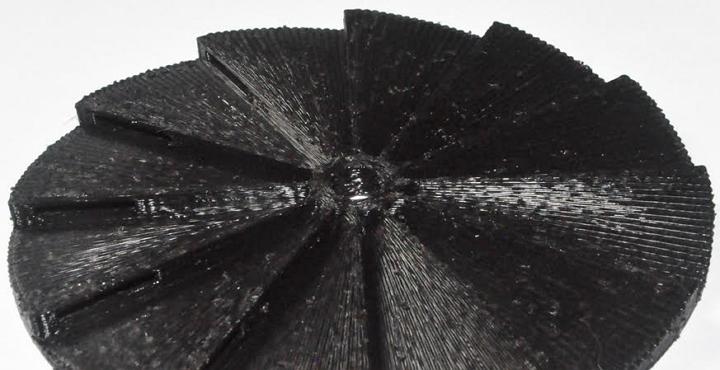
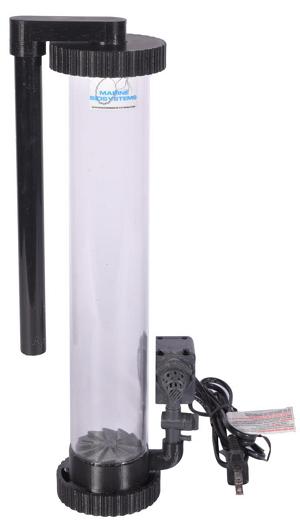 The Marine Biosystems F5 uses a patent-pending finned lifting plate that lifts the entire biopellet mass on a cushion of water, and it uses 3D printing to construct a product which features an innovative design.
“The unique feature of these reactors is the dispersion plate, which cannot be easily injection molded or milled from acrylic,” Tom Blaha, the founder of Marine Biosystems, told Reef Builders. “When water is passed through the plate, the shape of the plate, combined with the radially spaced vertical outlet holes, forces the water under the pellets in a broad shearing sheet. The weight of stationary pellets above forces that sheet to build pressure until it lifts the entire pellet column upward, releasing it from the bottom the reactor. Once its lifted then it begins moving and fluidizes.”
The design of the F5 means very little energy is needed to start the mixing and maintain the motion.
3D printing allowed the Chardon, Ohio-based Marine Biosystems team the ability to produce one-off parts, while simultaneously being able to scale for the later demands of mass production.
The company says that the Marine Biosystems F5 Reactors “are the first commercially available biopellet reactors made up of additive manufactured (3D Printed) components.”
Additive manufacturing allowed the design team to create the patent pending lifting plate design, and the result, they say, is the most efficient reactor on the market. The reactor is capable of “fluidizing” more than 400 ml of biopellets with a very small 67 GPH pump, and the assembly itself fits within a 3″ x 5″ footprint within the tank. The F5 fluidizing plate forces water under the pellets to create a high pressure zone of spinning water within the chamber.
The rotating column of water created by the F5 means the pellets ride in that column, there are no dead spots.
The top and bottom plates were printed in ABS Plastic and then attached to an acrylic reaction chamber.
What do you think of this aquarium system designed with 3D printing? Let us know in the Marine Biosystems F5 forum thread on 3DPB.com. Check out the F5 in action in the video below.
Subscribe to Our Email Newsletter
Stay up-to-date on all the latest news from the 3D printing industry and receive information and offers from third party vendors.
Print Services
Upload your 3D Models and get them printed quickly and efficiently.











You May Also Like
Reshoring Requires Rules of Engagement
Reshoring manufacturing in the U.S. is a stated national priority. Policymakers, industry leaders, and defense planners agree that domestic production capacity is essential for economic resilience, national security, and long-term...
When a Factory Stops Being a Building and Starts Being a Machine
Metal manufacturing still carries the layout and logic of an older industrial age. Most factories run as a collection of isolated disciplines, each with its own equipment, staff, and data....
Bridging the Gap: 2D to 3D AI in Manufacturing
For decades, the early stages of manufacturing have been defined by a simple, frustrating trade-off: you can have it precise, or you can have it fast. AI just broke that...
Hardware is Dead. Here’s What Actually Wins in Additive Manufacturing.
Hardware is rapidly commoditizing across additive manufacturing. Specifications have converged. Price competition has intensified. Margins have compressed. For companies attempting to scale additive manufacturing beyond prototyping, this shift has profound...