3D Print This Case For Your Raspberry Pi 2

It was originally conceived back in 2006 as a tiny – and very affordable – computer for kids.
When Eben Upton, Rob Mullins, Jack Lang and Alan Mycroft took on the task of building such a device, they were all based at the University of Cambridge Computer Laboratory. The group were concerned that the number of students interested in Computer Science courses was dropping at an alarming rate.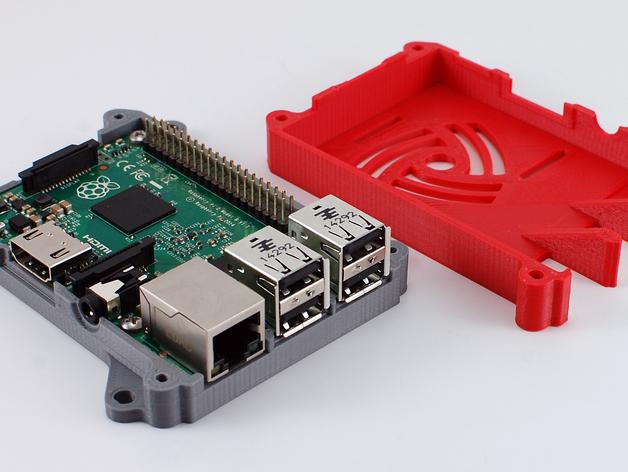
They took it upon themselves to address the issue, and they believed the problem lay in the fact that computers had become “so expensive and arcane that programming experimentation on them had to be forbidden by parents.”
From 2006 to 2008, the team designed several versions of what is now known as the Raspberry Pi and the Raspberry Pi Foundation to support the work, and three years later, the Raspberry Pi Model B had entered mass production. Within two years, that first commercial version it had sold more than two million units.
The group says they’re pleased that the Raspberry Pi now functions as a “catalyst” to encourage affordable, programmable computers everywhere.
Those simple and elegant little devices now power a wide range of useful devices and drive an armada of development activities.
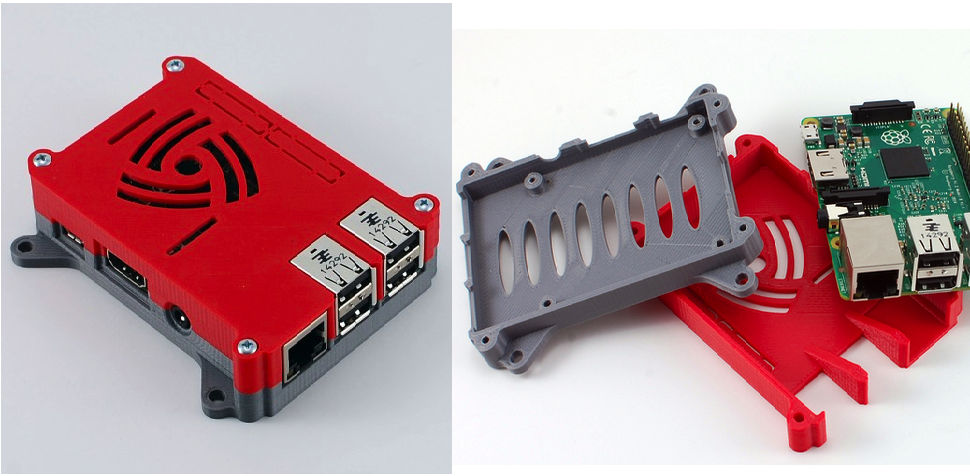
Now a 3D printed Raspberry Pi 2 case promises to give developers a leg up on mounting and managing the hardware requirements of those devices. It includes an access slot for a Pi camera, a screw-together design where the screw mounting of Raspberry Pi to case uses holes in the PCB, a built-in set of 75mm VESA mounting tabs, a” rotary engine” vent design all via a high resolution STL mesh.
 The project also includes .STEP format files of the two halves of the case for use by any designers or developers who would like to tweak the design for specific applications.
Adafruit is hosting the files, and they’ve made it a habit to, on Thursdays, focus on electronics projects integrated with 3D printed enclosures, brackets and sculptures, and you can check them out here.
As for the Pi itself? Up to February of this year, more than five million Raspberry Pis have been sold which makes them the fastest selling British personal computer. The next-generation Raspberry Pi 2 was released during February of this year as well, and the Raspberry Pi 2 retains the same $35 price tag as the model B it’s meant to replace.
Will you grab the files to 3D print out your own Raspberry Pi project case? Let us know in the Raspberry Pi 2 forum thread on 3DPB.com.
Subscribe to Our Email Newsletter
Stay up-to-date on all the latest news from the 3D printing industry and receive information and offers from third party vendors.
Print Services
Upload your 3D Models and get them printed quickly and efficiently.











You May Also Like
Top 10 3DPrint.com Stories of 2025: Kickstarter, Consumer Goods, Bankruptcy, & More
As Vanesa Listek wrote, last year was a major turning point for additive manufacturing (AM), as the industry is working to sort itself out. Customers want proven use cases and...
Will the FCC New Drone Ban Be a Boon for 3D Printing?
The US FCC (Federal Communications Commission) has said that it will not certify any new foreign-made drones for use in the US. Models currently on offer in the US can...
3D Printing News Briefs, December 27, 2025: Additive Construction in the U.S., Canada, & India
In this holiday weekend’s 3D Printing News Briefs, the focus is entirely on additive construction! We’ll start with news out of North America, specifically Canada and the United States, and...
Inside Xometry’s 2026 Outlook: What Manufacturers Are Worried About — and Where AM Fits In
When Xometry released the topline results of its new Manufacturing Outlook Report, the data showed just how much pressure manufacturers feel heading into 2026. Costs are rising, reshoring is accelerating,...