16-Year-Old Creates a Working Laser Engraver From 2 DVD Drives & 3D Printed Parts for $30

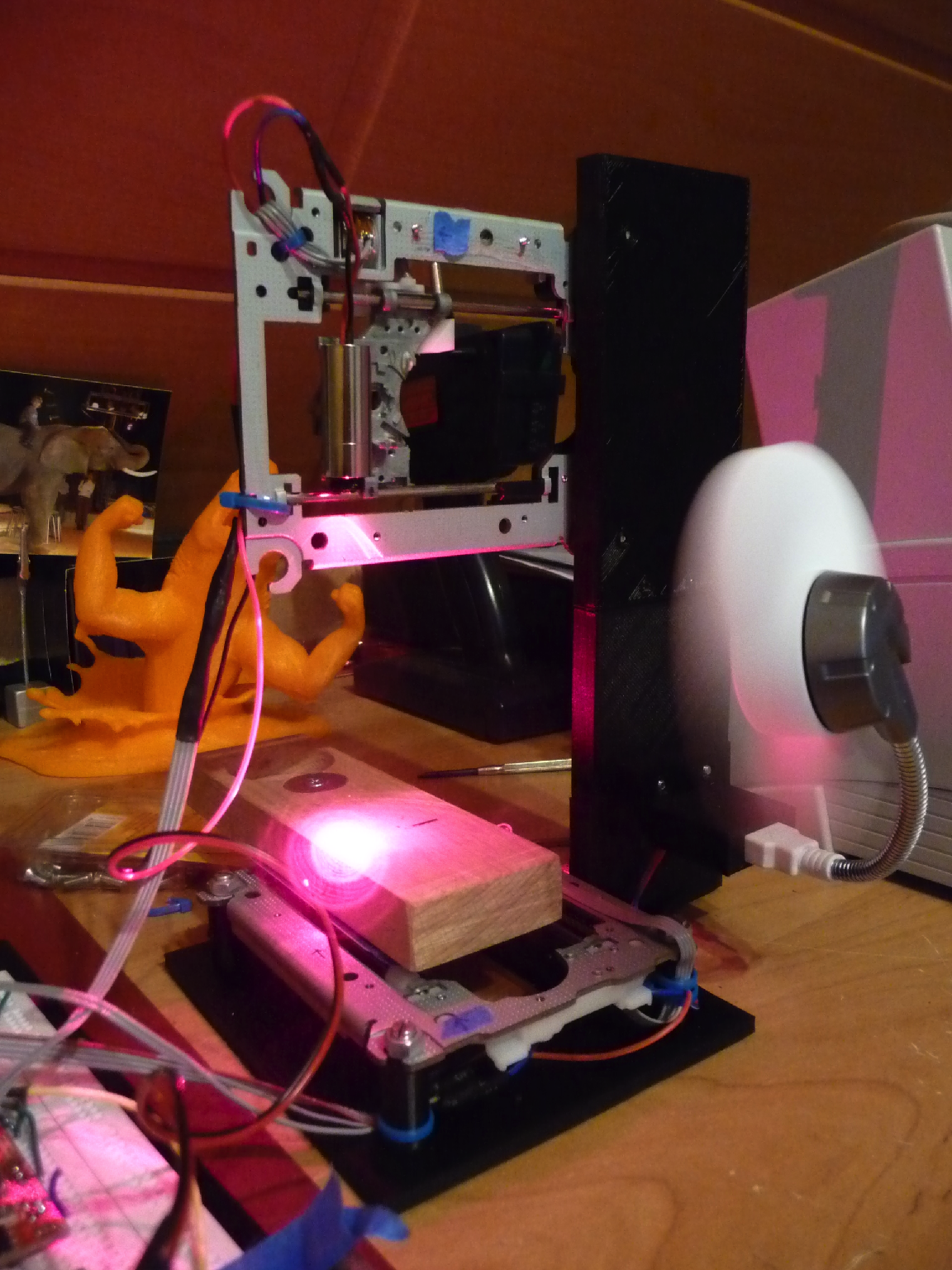 What happens when you mix 3D printing, electronics, and 2 old DVD drives with a 16-year-old German student who loves to “tinker”? The answer? You get an amazing $30 laser engraver that is capable of doing just as much as more expensive off-the-shelf machinery.
This at least was the case for 16-year-old Justin Wunderlich of Germany. So much is made about introducing 3D printing into middle schools and high schools around the world, and this story is a prime example of what can happen when children and adolescence are introduced to the technology.
“I had an unused DVD drive laying around,” Wunderlich tells 3DPrint.com. “One day I was bored, so I started taking it apart and found a wonderful little linear unit. I decided to continue taking apart the DVD drive and found two laser diodes. One laser diode was infrared, and one was red. I tested them by connecting them to 2 AA batteries and found the red laser [worked quite well]. I am always looking for new projects, so I started to think what I could build out of these parts”
After looking up the specifications of the red laser, Wunderlich discovered that he could safely drive them up to 250-300 mAh if he used the proper cooling methods.
“250-300 mAh doen’t sound like much, but you can cut paper and engrave many materials with it,” Wunderlich tells us. “The next day I ordered a cheap used DVD drive on eBay and as soon as it arrived I took it apart, too. The DVD Laser Engraver project was born.”

In order to build his laser engraving machine, Wunderlich needed to created some 3D printed parts. He used Solidworks to design all of the parts, and in an attempt to keep the project as simple as possible, he designed it in a way where no nuts were required, and all of the screws would be utilized by creating their own threads. He also aimed to keep the project as affordable as he possibly could.
The laser engraver that he created consists of two large 3D printed pieces which create the base of the machine. The rest of the machine is created from the two DVD drives, as you can see in the photos and video provided.
As for how the machine works, it is very similar to how a desktop 3D printer operates. A Gcode sender (Raspberry Pi or a computer with a host program) sends data to the brain of the machine, which is an Arduino Nano V3 running GBRL. Then the Gcode commands and the Arduino calculate the movement of the stepper motors and send these signals to the drivers.

As for the detail the engraver is capable of, Wunderlich explains:
“The linear units have very little play, so we are talking about an accuracy of about 150 microns (0.15mm),” Wunderlich tells us. “For example my RepRap Prusa i3 has about 100 micron accuracy.”
He tells us that the engraver is capable of engraving many materials, including wood, but is not strong enough to engrave metal or glass. He made all of the instructions available for others to replicate this extremely affordable machine on Thingiverse, where he has also made the STL files for the 3D printed parts open to download.

While the machine cost Wunderlich about $30 to create, he says that it could be done for as low as $20, depending on the parts purchased. Below you can see a list of the non-printed parts that he used in creating his engraver:
- 2x Easydriver – $6.00
- 1x Arduino Uno/Nano – $4-$20.00
- 2x CD/DVD drives (one must be a DVD writer – $20.00 used
- 1x laser diode driver – $10-15.00 on eBay
- 1x breadboard – $5.00
- Jumper wires for the breadboard
- Wires to connect the steppers
- 8x M3 screws – $2.00
- 1x 5V power supply at least 1A – $5.00
- 1x housing for the laser – $5.00
- Washers to put on the screws to fasten the carriages – $1.00
What do you think about this incredible creation by this 16-year-old student? Will you be attempting to create your own laser engraver? Discuss in the 3D printed laser engraver forum thread on 3DPB.com. Check out the video of the engraver in action below.

Subscribe to Our Email Newsletter
Stay up-to-date on all the latest news from the 3D printing industry and receive information and offers from third party vendors.
Print Services
Upload your 3D Models and get them printed quickly and efficiently.












You May Also Like
The Manufacturing Race Behind the Drone Revolution
We are in the middle of a major manufacturing shift focused on the production speed and payload capacity of uncrewed aerial systems (UAS), or drones. A recent Manufacturing Dive article...
ADDMAN to Buy Up to $10.8M in Nickel 718 Powder from 6K Additive Over 30 Months
After years of buildup, we’re finally starting to see what the US metal additive manufacturing (AM) market could look like at scale. To be sure, it’s still not quite there,...
Metal AM in a Multipolar World, Part 2: How PBF and DED Could Change by 2035
The first decades of PBF development were heavily shaped by machine capability: more power, more lasers, larger build volumes, better recoating, and improved process monitoring. These developments will continue, but...
Advanced Manufacturing at IMTS 2026: 3D Printing and AI and Drones, Oh My!
Last week’s International Manufacturing Technology Snow (IMTS) in Chicago welcomed over 90,000 attendees to the jungle that is McCormick Place. With over 1.17 million square feet of exhibit space, and...