SweptVue Adapter Can Measure 3D Prints at the Micron-Scale


One of the aspects of 3D printing that has been hailed as a great benefit is its ability to produce parts with a very high degree of precision. There are a variety of methods by which measurements 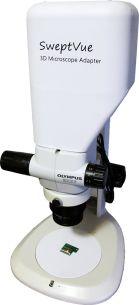 that reflect that precision can be collected. While mechanisms such as standard optical microscopy and scanning electron microscopes can be highly effective, they are not suitable for production-line use.
Now, Swept Image is introducing an adapter call the SweptVue that allows close examination of the printed parts by connecting a USB3.0 camera and a digital light projector. As a result, engineers are able to accurately measure the micrometer-scale parts that they have had manufactured.
The system works by replacing the observation tube from an Olympus SZX7 stereo microscope allowing for digital line scanning by scattering light from one optical pathway into a Sony IMX035 CMOS image sensor. This scattered light is collected by an image sensor in a Flea3 industrial camera produced by Point Grey. A second optical pathway illuminates the object itself, making it visible to the eye. Using this system, images can be recorded at up to 120 frames per second.
The use of a stereo microscope structure allows for the triangulation of the data in order to measure depth. The light’s projection is synchronized as it is dispersed across the object with the position of the camera’s rolling shutter.
 The images collected are stacked after having been captured at varying depths and a ‘depth map’ is produced. It is possible to colorize this map once it has been created in order to make it easier for the human eye to visualize the 3D features of the part. Unlike the human eye, the system has no need for such visual distinctions and can automatically calculate the measurements of the 3D printed parts. Matt Muller, Co-Founder of Swept Image, characterized his company’s contribution:
“While cameras with rolling shutters have been criticized for their performance when imaging moving targets, these characteristics were used to our advantage in the SweptVue system. By synchronizing the illumination pattern on the part with the rolling shutter, light returned from different heights on the part is shifted laterally at the sensor, enabling features to be captured at specific depths. What is more, we can quickly shift between depths by changing the trigger delay on the Flea3 camera.”
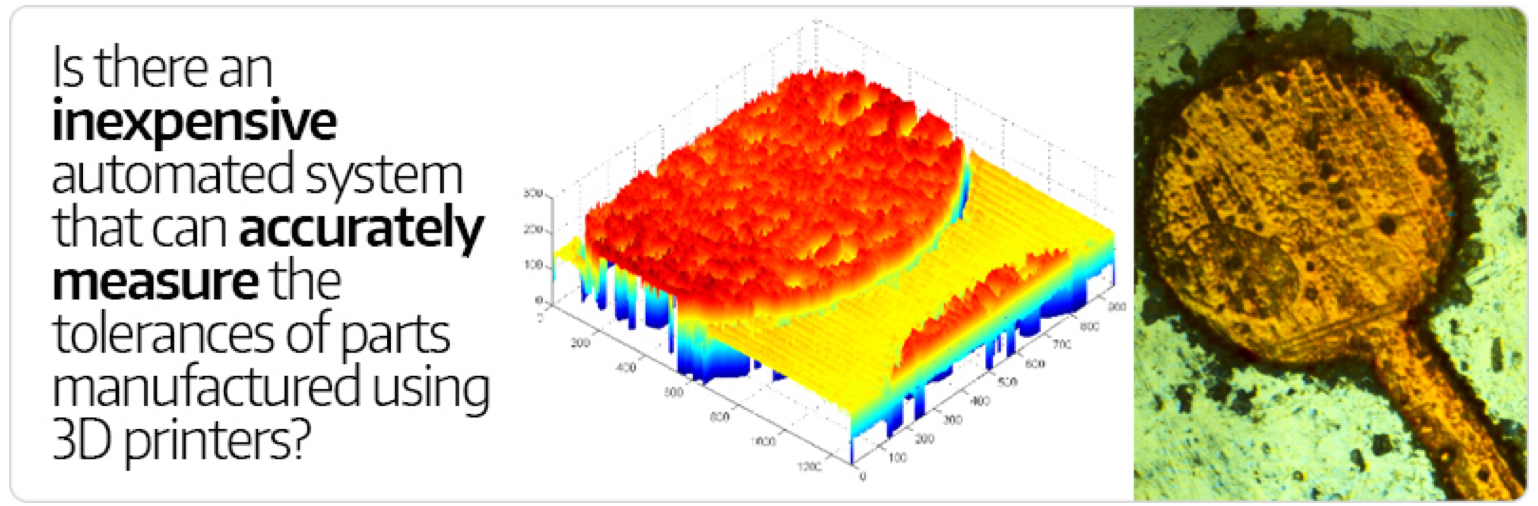 The precision of the measurements collected using this system has allowed engineers to verify part dimensions to within one micrometer. While this may seem insignificant, in situations in which the tolerances are very low and/or the number of components very high, even such a small difference can render a creation useless. Let us know your thoughts on this new adapter and what it may mean for the industry in general. Discuss in the SweptVue forum thread on 3DPB.com.
Subscribe to Our Email Newsletter
Stay up-to-date on all the latest news from the 3D printing industry and receive information and offers from third party vendors.
Print Services
Upload your 3D Models and get them printed quickly and efficiently.












You May Also Like
Formnext 2026 Preview: Ceramics 3D Printing, Post-Processing, & More
In just a few weeks, it will be time for the biggest trade show extravaganza in the additive manufacturing (AM) industry. Soon, we’ll all be hopping planes bound for Frankfurt...
How AM Funding Shifted in China and the US, 2021–2025
Additive manufacturing (AM) funding has shifted in China and the United States over the past five years, but in different ways. In China, metal 3D printing companies accounted for a...
Additive Manufacturing Strategies Gets Ready for Its 10th Year – and the Industry’s Next Decade
If we’re inclined to organize our thoughts about history into decades for reasons other than the fact that we use a base-10 number system, it’s because in so many contexts,...
3D Printing Financials: 6K Additive’s Orders Surge as Revenue Climbs 61%
6K Additive (ASX: 6KA) reported higher revenue and a record order backlog in its latest quarterly results, as growing demand for metal powders continues to push the company to expand...