3D Printing Helped HTW Motorsport Find an Extra Edge


The margins in motor sports racing are razor thin. An extra tenth of a second a lap can be the difference between being a winner and finishing back in the pack.
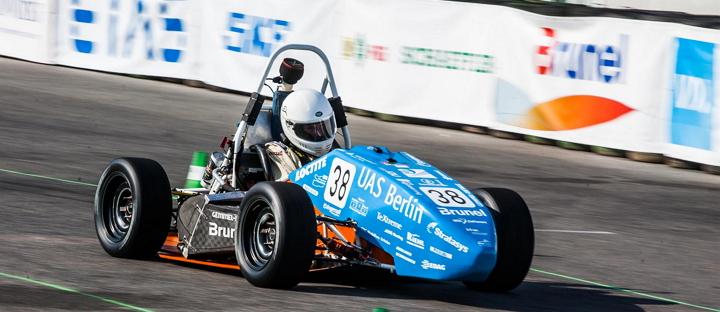 That’s why HTW Motortsport turned to Stratasys to help them find a 10% increase in horsepower with 3D printed parts which outperform parts made via traditional manufacturing methods.
HTW Motorsport says they’ve found cost and workflow efficiencies all while increasing their on-track performance of their Formula-type race car as a result of Stratasys 3D printing technology.
The HTW car participated in the global Formula SAE competition in which teams design, build, test, and race small-scale, Formula-style cars which are then judged on their design, fuel economy, acceleration, and endurance capabilities. The race vehicle in question was the result of a student project at the University of Applied Sciences in Berlin, Germany.
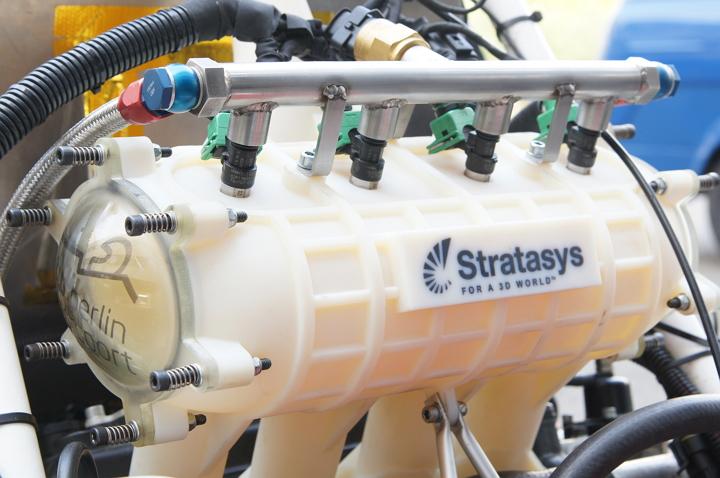
Patrick Harder, a team engineer at HTW Motorsport, says 3D printing complex parts is the preferred method of manufacturing the race-ready airboxes used in the Formula SAE entry, the BRC14.
“As a university project, having access to Stratasys’ advanced 3D printing technology offers us a massive boost. It enables us to develop the required parts much faster and incredibly more cost-effectively than we would otherwise be able to,” Harder says. “This has delivered proven, quantifiable benefits on the BRC14’s airbox system, with a comparative increase in horsepower of around 10% versus the system we used two years before. We also enjoyed an increase in torque of almost 12% over the same time frame.”
The airbox system was built with a Stratasys Objet500 Connex multi-material 3D Production System from high-performance, photopolymer Digital ABS material.
“A well-designed airbox will draw air more efficiently and effectively into the engine, and thus improve performance,” Harder says. “The role of 3D printing is fundamental as it allows us to create a functional prototype which then becomes part of the final race vehicle.”
Stratasys Digital ABS was the material of choice as it meets the various requirements for the airbox design and performance.
“High temperature resistance and fuel resistance are vital prerequisites for the airbox, so Digital ABS is perfect,” Harder says. “Its high strength-to-weight ratio makes it the best material for the airbox’s plenum chamber which requires a combination of toughness, unique geometry and high surface finish.”
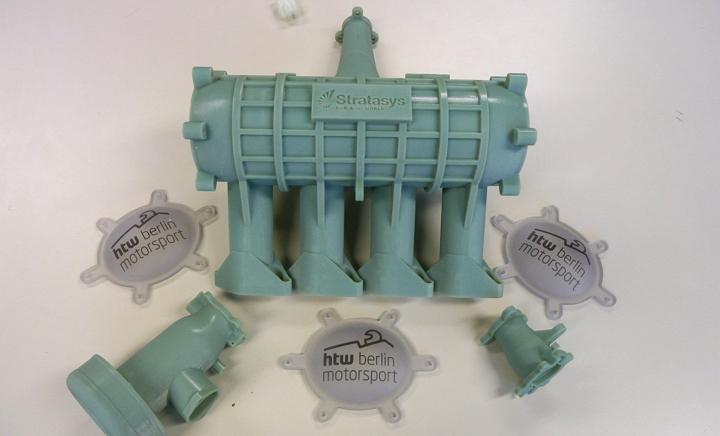
HTW Motorsport Stratasys Airbox
Harder says HTW Motorsport is in the design process right now to build their next, and he says it should be ready to roll out in June in preparation for this year’s race season.
“With the help of Stratasys 3D printed parts, we are aiming to reduce the weight of our next car by around 45Kg,” says Harder. “This will see us incorporate a fully-3D printed steering wheel and fuel tank, as well as a slightly smaller 3D printed airbox. We’ll also be constructing a number of boxes that house the many micro-controllers on the car and expect 3D printing to deliver almost 80% weight reduction compared to using standard options from electronic suppliers.”
The design competition was organized by the Society of Automotive Engineers and established as Formula SAE in the US. The Formula Student is held in Germany, and HTW Motorsport has taken part in the competition since its inception in 2006. A jury of experts from the automotive industry uses the competition to find future engineers and assess the initiative and commitment of the students involved.
Do you know of any other motorsports applications of 3D printing? Let us know in the HTW Motorsport 3D Printed Airbox forum thread on 3DPB.com. Check out the video below of the ‘track test’ for HTW Motorsport’s airbox.
Subscribe to Our Email Newsletter
Stay up-to-date on all the latest news from the 3D printing industry and receive information and offers from third party vendors.
Print Services
Upload your 3D Models and get them printed quickly and efficiently.












You May Also Like
3D Printing in Drones Could Reach $900 Million by 2034, AM Research Report Says
For years, additive manufacturing has searched for applications where its advantages clearly outweigh the limits of traditional production methods. Now, according to a new report from Additive Manufacturing Research (AM...
Largest Publicly Announced, Single Order in EOS History: Beehive Industries Spends $50M on M4 ONYX 3D Printers
Earlier this year, Beehive Industries received a $29.7 million contract to produce its Frenzy 6 and Frenzy 8 engines for the US Air Force. The metal additive manufacturing (AM) user...
3D Printing News Briefs, June 10, 2026: Grand Opening, Photoresins, Footwear, & More
We’re starting with some exciting news in today’s 3D Printing News Briefs: Stratasys just celebrated the opening of its new North American headquarters in Minnesota. Moving on, Nanoscribe is scaling...
Formlabs Launches the X1: Let’s Pack It In?
I’d like to share my disappointment. When Formlabs teased that something big was coming, I really hoped the firm would finally get around to making CNC machines, as it always...