3D Print That Perfect Lithophane — ‘Image to Lithophane’ App Receives Major Upgrade


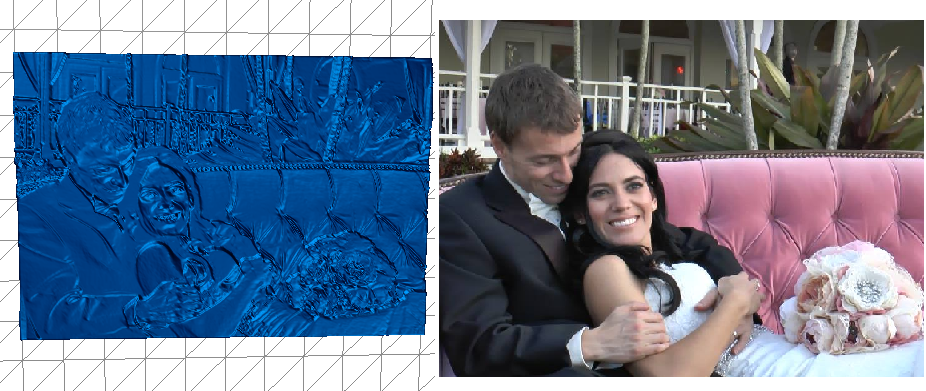
Recently married, my family, new and old, have been pestering me for wedding photographs, despite the fact that we haven’t even received any hard copies from the photographer just yet. With that said, we do have a handful of digital photos that the photographer provided us with as a sneak peek, and if I wasn’t writing about 3D printing 24/7 I probably could take a few minutes to print some photos out for my family.
I’m one of those people who is always looking to step outside the box. Because of my obsession with 3D printing, often times that ‘box’ is the 3D printer I have sitting on my desk. So as I sat here  pondering how I could incorporate wedding photos with 3D printing, I stumbled upon an article that Eddie Krassenstein wrote for us back in January covering a web application which allows you to create 3D Printable Lithophanes of any photo on your computer. When I clicked through to go to the 3dp.rocks application I was amazed that it had changed quite substantially over the last couple of months, with all sort of new controls and features. Before getting to those changes, let me briefly explain what a lithophane is.
The art form is believed to have originated in Europe, namely England, but emerged in France, Germany, and Prussia all around the same time, the late 1820s. Lithophanes were, and still are, used  to present 3D images. During the early 19th century artists would engrave an image in wax before a gypsum mold was cast from the wax. When these lithophanes are put up to a back light, the areas where the image was carved the thinnest allow the most light to shine through, and the thicker the area, the less the amount of light you’d see.
The process in the 19th century was extremely time consuming and expensive. Here we are almost 200 years later and thanks to 3D printing that process is now incredibly affordable and quite easy.
3dp.rocks launched their application back in January with a few simple features. Users could upload an image and then turn that images into a 3D model for a lithophane, which they could then download and 3D print. Recently, however, the app has received a substantial update, making the user interface more appealing to the eye, while presenting all sorts of cool new options. Instead of only being able to download and print a flat lithophane, there are now options for several new shapes. These include an inner curve, outer curve, solid cylinder, rectangular pillow, dome (image on top), dome (Image on side), and a heart (perfect for my wedding photos!)
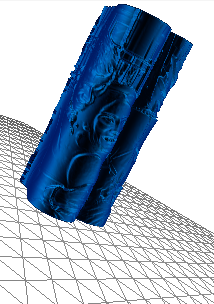
The Heart-shaped Lithophane
Additionally, there are now all sorts of settings for both the image and the model itself, so that the user can fabricate their lithophane just the way they want it. Users can now choose between a ‘positive’ or ‘negative’ image, can repeat the image, flip it, or mirror it. As for the 3D model itself, users now have the ability to finely tune it before download by changing its thickness, border size, curve, vectors per pixel, and more.
So far I have created several models to download, but have yet to print them out. Perhaps this will be my weekend project. Yes Aunt Betty, you will finally get a wedding photo, perhaps not in the traditional sense though.
Let us know if you have tried out the new and improved ‘Image to Lithophane’ app. Have you printed any out? Let’s see them! Discuss in the Lithophane forum thread on 3DPB.com.
Subscribe to Our Email Newsletter
Stay up-to-date on all the latest news from the 3D printing industry and receive information and offers from third party vendors.
Print Services
Upload your 3D Models and get them printed quickly and efficiently.













You May Also Like
Metal 3D Printers for the Desktop Are Finally Starting to Feel Like Desktop Products
FDM 3D printing is becoming increasingly accessible, yet metal 3D printers designed for everyday desktop use remain rare on an ordinary workbench. The real challenge is not making a metal...
What 3D2GO Says About 3D Printing’s Growth in Southeast Asia
The Philippines offers an interesting case study in how 3D printing can develop in Southeast Asia, and Manila-based 3D2GO helps illustrate it. 3D printing in Southeast Asia doesn’t have to...
The Frankenservice Part 2: Have Your Cake and Eat it Too
This series of articles delves into a thought experiment. What if we let go of using a few machines very optimally, but instead use lots of different machines to meet...
Silencer Market Set to Test Metal Additive’s Readiness for Production Prime Time With Enormous Market Expansion
Throughout the history of additive manufacturing (AM) technologies, there are only a couple of really interesting case studies in which we see a market significantly disrupted and revolutionized by AM....