Breakthrough Molecular 3D Printer Can Print Billions of Possible Compounds


What will 3D printers ultimately evolve into? No one has a functioning crystal ball in front of them I assume, but a good guess would be a machine which can practically build anything its user desire, all on the molecular, and eventually atomic levels. Sure we are likely multiple decades away from widespread molecular manufacturing, but a group of chemists led by medical doctor Martin D. Burke at the University of Illinois may have already taken a major step in that direction.
Burke, who joined the Department of Chemistry at the university in 2005, heads up Burke Laboratories where he studies and synthesizes small molecules with protein-like structures. For those of you who are not chemists, small molecules are organic compounds with very low molecular weight of less than 900 daltons. They usually help regulate biological processes and make up most of the drugs we put into our bodies, along with pesticides used by farmers and electronic components like LEDs and solar cells.
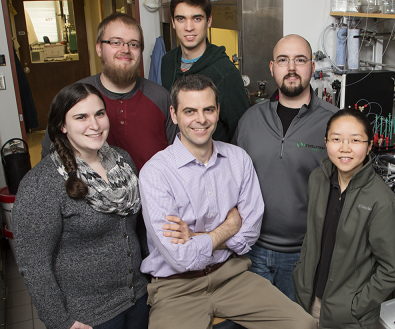
Martin Burke and his team
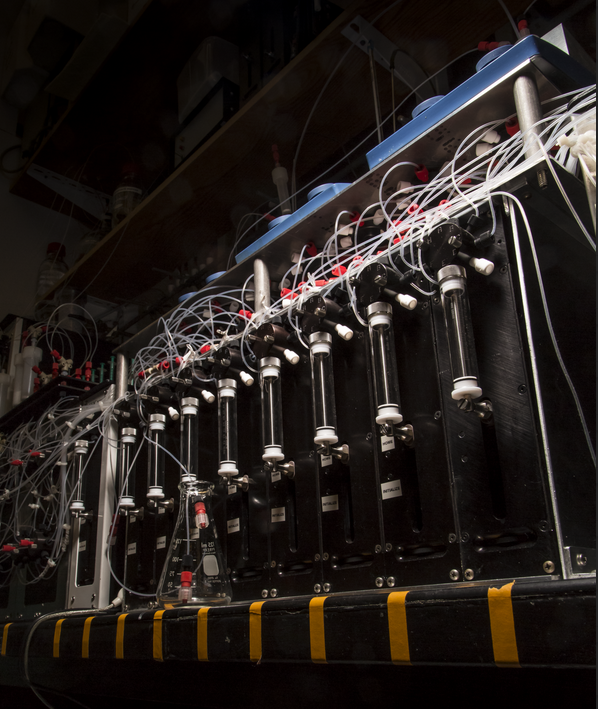
Burke and his team have created a machine which could be described as a major breakthrough in the field of chemistry, a ‘molecule-making machine’. Sound futuristic? Well that’s because it is. The machine, which was described in a paper featured in today’s issue of Science, could best be described as a 3D printer for chemicals.
“We wanted to take a very complex process, chemical synthesis, and make it simple,” explained Burke. “Simplicity enables automation, which, in turn, can broadly enable discovery and bring the substantial power of making molecules to nonspecialists.”
The way the machine works is quite extraordinary. It is able to break down very complex molecules into their basic chemical building blocks. To put things 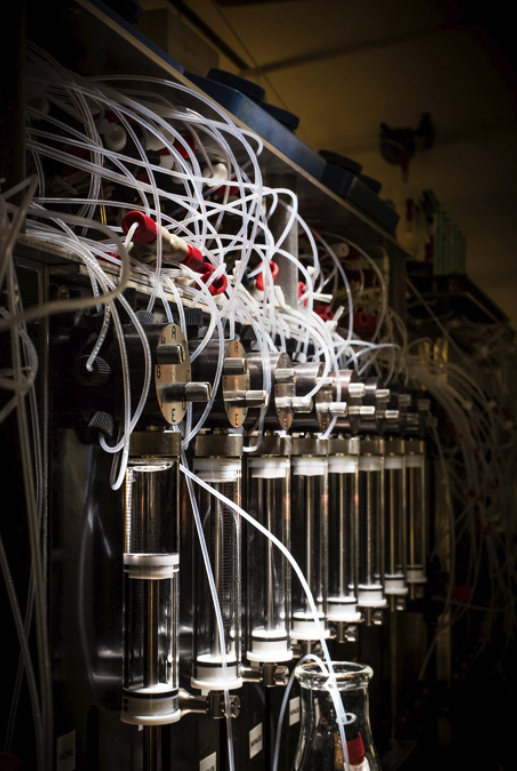 into perspective, imagine each chemical building block as a different LEGO brick. They all share the same connectors, but may be totally different from one another. The machine is able to use a catch-and-release method to automate the process of connecting these building blocks together, one brick at a time, while releasing the byproducts of each chemical reaction. It was this technique of releasing the unwanted byproducts which made this breakthrough a reality. Using this process the machine can utilize over 200 different building blocks along with thousands of other molecules to ‘print’ billions of different organic compounds, many of which make up 14 classes of small molecules, including the ratanhine molecule family. Also, according to Burke, it can even synthesize chemicals which were never before created by human beings.
“The vision for the future is that anyone who needs a specific small molecule can essentially print it out from their computer,” explained Burke. “We are really excited about the immediate impacts that this will have on drug discovery.”
A new company, co-founded by Burke, called REVOLUTION Medicines, Inc. has already licensed the technology and is investing heavily in developing next generation molecule-making machines which will be much more powerful and easier to scale. If things go as planned, these machines have the potential to do to chemistry what 3D printing has done to engineering; making it fast, less complicated and accessible to pretty much anyone. In fact, the company already is working to improve upon an anti-fungal compound known as Amphotericin B, which is found in  nature and used to treat patients with life-threatening fungal infections.
“Perhaps most exciting, this work has opened up an actionable road map to a general and automated way to make most small molecules,” stated Burke. “If that goal can be realized, it will help shift the bottleneck from synthesis to function and bring the power of making small molecules to nonspecialists….A 3D printer for molecules could allow us to harness all the creativity, innovation, and outside-the-box thinking that comes when non-experts start to use technology that used to only be in the hands of a select few.”
The potential this new machine could have for new rapid drug discovery as well as new chemically spawned technologies could be staggering. Imagine a website like Thingiverse, where instead of open sourcing 3D design files for printing, you could open source medications and other chemicals. That’s where the future may be headed!
Let’s hear your thoughts on the possible implications of this new machine. Discuss in the 3D Molecule Printing Machine forum thread on 3DPB.com. Check out the video below where Martin Burke further explains the process and how his machine works.
Subscribe to Our Email Newsletter
Stay up-to-date on all the latest news from the 3D printing industry and receive information and offers from third party vendors.
Print Services
Upload your 3D Models and get them printed quickly and efficiently.











You May Also Like
Hardware is Dead. Here’s What Actually Wins in Additive Manufacturing.
Hardware is rapidly commoditizing across additive manufacturing. Specifications have converged. Price competition has intensified. Margins have compressed. For companies attempting to scale additive manufacturing beyond prototyping, this shift has profound...
The Real ROI of Personalized 3D Printed Medtech in Oncology
Discover how patient-customized 3D printed devices like Stentra™ significantly reduce high toxicity-related treatment costs and improve workflow efficiencies to handle more cases more effectively overtime. Introduction: The Economic Paradox in...
Why SiC-Dedicated Additive Manufacturing Is Gaining Industrial Relevance
Silicon carbide is not a material problem—it’s a manufacturing one. Silicon carbide (SiC) has become a critical material across semiconductors, aerospace, energy, and defense. Its exceptional thermal stability, chemical resistance,...
Championing a Made-in-America Future for Additive Manufacturing
As the additive manufacturing industry continues its rapid global evolution, one theme has risen to the top of strategic conversations: the importance of strengthening domestic production to support national competitiveness...