Virginia Tech Kicks Off Second Spring Additive Vehicle Design Challenge for Engineering Students

 Design, creativity, problem-solving, and a whole lotta fun are just kicking into high gear with Virginia Tech‘s second annual AM Grand Challenge: the Spring Additive Manufacturing Vehicle Design Challenge, which started last week.
With the goal being to educate students about and raise enthusiasm and inspiration regarding 3D printing and design while also integrating mechatronics, the challenge is on — and a challenge it is indeed, to use 3D design and printing for a remote-controlled vehicle that not only drives but goes airborne too. The design challenge is two-fold in that students work hard to achieve new and innovative designs that also may be used later for the military in the area of remote-controlled vehicles that are used in environmentally challenging and isolated locations.

Christopher Williams
The challenge is being organized by associate professor Christopher Williams’ Design, Research, and Education for Additive Manufacturing Systems Lab, associate professor Al Wicks’ Mechatronics Lab, and the Virginia Tech Applied Research Corporation. Both Williams and Wicks are part of the mechanical engineering department in the Virginia Tech College of Engineering, where they set off the challenge on February 18th.
Mechatronics is a multi-faceted area that includes:
- Mechanical engineering
- Electrical engineering
- Telecommunications engineering
- Control engineering
- Computer engineering
Integrating knowledge from all of these fields will assist the entrants in creating their 3D printed remote controlled vehicles that can handle themselves on rough terrain and around obstacles, as well as flying around items. There are no rules as to components for the vehicles in terms of locomotion, but they will be required to show that they can toggle between both driving and flying modes — and just to make the challenge a little more exciting, the vehicles must be able to shoot images with a built-in camera.
“My goal is the same as last year, and that is to get as many students engaged in the emerging fields of 3-D printing and mechatronics, whether they come from the College of Engineering or from across Virginia Tech,” said Williams, the W.S. ‘Pete’ White Chair for Innovation in Engineering Education. “This is a competition about design, creativity, and problem solving.”
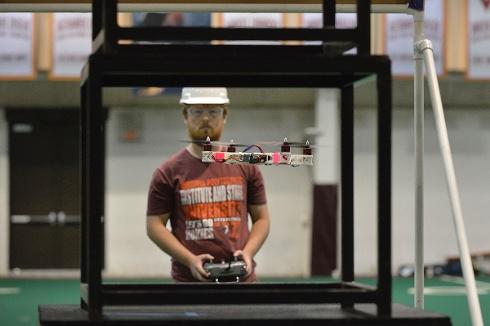
Quadcopter design from last year’s challenge
Such 3D designs could even be helpful in the future for areas experiencing disaster where search and rescue is required, as well as helping with reconnaissance missions.
With twelve teams being selected for the May 1 finale and judging, crucial factors in the winning design will be effectiveness both on the ground and in the air, how well 3D printing was used in the design, how long it took to make the design and the 3D printed item, as well as how many 3D printed parts it possesses.
“The goal of this semester’s competition is to establish a strong foundation, so we can go bigger next year and increase the scale to a national competition,” said Williams.
Last year, over 200 students participated in the challenge (a team of mechanical engineering graduate students won both the then-separate air and ground categories). The College of Engineering at Virginia Tech boasts 14 different engineering disciplines, as well as computer science, and educates 6,000 undergraduates yearly, and they have access to 50 research centers and labs, as well as comprehensive advanced studies.
Hoping for an even better turn out this year, Virginia Tech has also invited students from US Air Force Academy. The challenge will be judged by experts from the:
- US Air Force
- US Department of Homeland Security
- US Small Business Administration
- US Army Acquisition Support Center
The first-prize winner will receive $3,000, with $15,000 in prizes awarded in total.
Have you used 3D printing to make any remote controlled vehicles or similar designs that might have uses for the military? Tell us your thoughts in the Virginia Tech Second Spring Additive Vehicle Design Challenge forum thread over at 3DPB.com.
Subscribe to Our Email Newsletter
Stay up-to-date on all the latest news from the 3D printing industry and receive information and offers from third party vendors.
Print Services
Upload your 3D Models and get them printed quickly and efficiently.











You May Also Like
AM Demand Signals: Global Grid Resilience
We’re one year and a few days removed from the DeepSeek meltdown that rocked U.S. equity markets, not to mention the de facto U.S. AI brain trust, with fears that...
Critical Alloy Powder Manufacturing: CAPP Prioritizes AM Feedstocks and Advances U.S. Materials Leadership
Scaling additive manufacturing (AM) supply chains, particularly for metal powder-based processes, depends on the economic viability of products. The development of critical high-temperature metal alloys in powder form requires customer...
3DPOD 290: 3D Printing Since 1993 with Rajeev Kulkarni, Axtra3D
Rajeev Kulkarni was an early 3D Systems employee. He would spend 29 years at 3D Systems and was their VP of Corporate Strategy, CPO Printer Products, Manager of their Desktop...
The AM Adoption Problem No One Models
Through its short history, Additive Manufacturing has been presented to the investment community as a classic high growth technology story. Manufacturing is a multi-trillion-dollar market. Even a small percentage looks...