The Virtual Foundry Launches Filamet, Metal Composite ABS and PLA 3D Printer Filaments

 As we have stated time and time again, and recently backed up by a research report presented by SmarTech, the materials portion of the 3D printing industry is just as important as, if not more important than, that of the hardware and software side of things. Because of this, material scientists are working for some of the largest 3D printing companies on the planet, testing new formulas to present all sorts of amazing possibilities.
When it comes to 3D printer filament, up until just a couple of years ago, there was primarily just pure ABS and PLA thermoplastics available for consumer use. Over the last year or two, however, the market has expanded rapidly, leading to new base materials as well as composite materials which take on entirely new properties. An example of such thermoplastic composites would be the extremely popular colorFabb filaments like bronzeFill and copperFill. These materials use a mixture of actual metal powder along with PLA to create a filament which can print objects which appear to be fabricated with pure metal.
Leading consumer-based 3D printer manufacturer MakerBot has also recently unveiled a whole line of composite filaments which include iron and bronze. Clearly this is a trend which is only getting started.
Today we got word that yet another company, based in Madison, Wisconsin, called The Virtual Foundry, is also jumping into the metal composite filament fray. They’ve recently launched a Kickstarter crowdfunding campaign for a line of several high-quality metal composite filaments called Filamet.
The team behind this new line of filament includes Bradley Wood, Glenn Prescott, and William Howard, all of whom have vast experience within the metal-working space.
“We believe that the art world has much to learn from the engineering side of 3d printing development,
and perhaps vice-versa,” wrote Brad Wood. “The products we are presenting here are our first foray into a commercial solution to an affordable method of creating metallic items from a desktop 3d printer.”
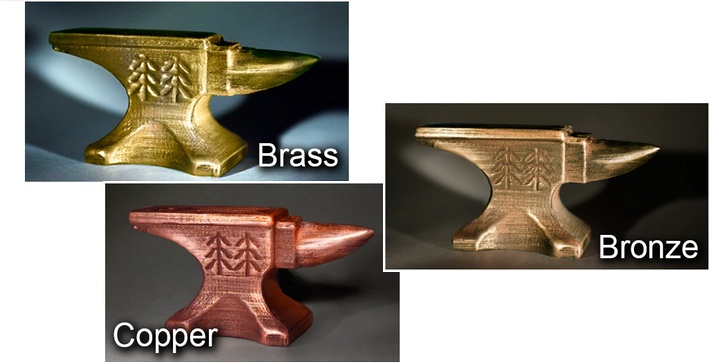
Filamet is being offered in three different material options which include brass, copper, and bronze. With up to 85% of the filament consisting actual metal, they all obtain a substantial amount of their physical characteristics. This means that typical finishing techniques such as polishing can easily be performed on printed objects, similarly as we have seen with colorFabb’s filament.
Each metal will be available in both ABS and PLA composites, and in 1.75mm and 3mm diameters. The company is offering all of these filaments for a Kickstarter backing price of $60 per 1/2 kilogram spool. This may seem like a hefty price for filament, but from the images provided on their Kickstarter campaign, the finished items look just amazing.
Let us know your thoughts on these new filaments. Have you backed The Virtual Foundry’s new product? Let us know in the Filamet forum thread on 3DPB.com.
Subscribe to Our Email Newsletter
Stay up-to-date on all the latest news from the 3D printing industry and receive information and offers from third party vendors.
Print Services
Upload your 3D Models and get them printed quickly and efficiently.













You May Also Like
How Drone Proliferation Is Forcing a Rethink of Defense Manufacturing
The rapid proliferation of low-cost drones is forcing manufacturers to rethink their approach to design, production, quality, and scale. For defense manufacturing teams, the challenge is both how quickly a...
What 3D2GO Says About 3D Printing’s Growth in Southeast Asia
The Philippines offers an interesting case study in how 3D printing can develop in Southeast Asia, and Manila-based 3D2GO helps illustrate it. 3D printing in Southeast Asia doesn’t have to...
3D Printing News Briefs, September 12, 2026: Rebranding, Cybersecurity, Project Call, & More
We’ve got a lot of business news from ATLIX to start off this weekend’s 3D Printing News Briefs, with a new identify for its additive manufacturing (AM) portfolio and some...
Silencer Market Set to Test Metal Additive’s Readiness for Production Prime Time With Enormous Market Expansion
Throughout the history of additive manufacturing (AM) technologies, there are only a couple of really interesting case studies in which we see a market significantly disrupted and revolutionized by AM....