UC Berkeley and Prusa Open Up the World of Volumetric 3D Printing

The University of California, Berkeley (UC Berkeley) has released OpenCAL, a DIY volumetric 3D printer developed in collaboration with Prusa Research and Formlabs. Formlabs produces the resin, which will be sold through Prusa Research. Several printers are already up and running, including units installed at MIT, the National Institute of Standards and Technology (NIST), and Purdue University.
The UC Berkeley team extended the Computed Axial Lithography (CAL) process to an open-source machine. Professor Hayden Taylor developed CAL together with scientists from the Lawrence Livermore National Laboratory, and the resulting system was tested in space. In OpenCAL, the resin vial rotates while a projector illuminates it. This can lead to a much faster, layer-free path to manufacturing. Usually, these kinds of volumetric processes are limited in the size of objects they can produce. Attenuation means that as the build box grows, the light has to travel farther to reach the build area. It gets distorted, and at one point you can’t coherently make anything bigger.
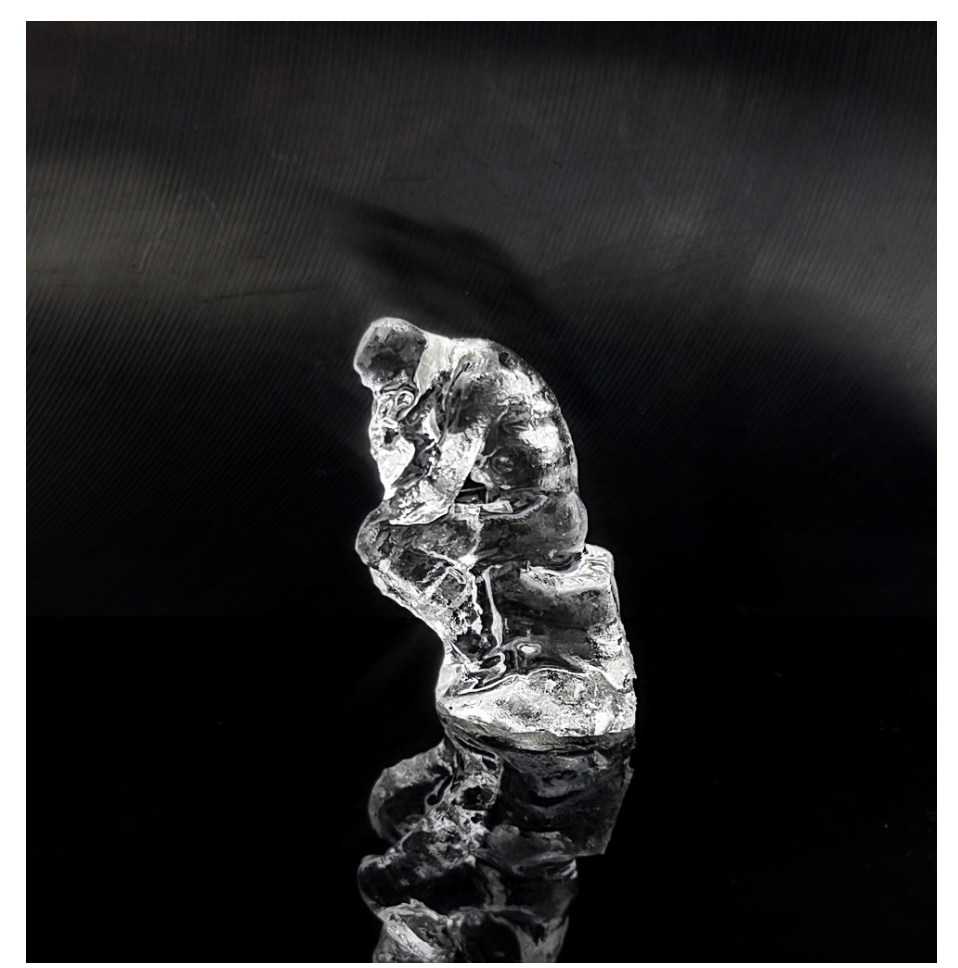
A Rodin’s Thinker replica printed on OpenCAL in 90 seconds, formed all at once with no layers or support structures. Image courtesy of OpenCAL / UC Berkeley.
OpenCAL leader Taylor Waddell stated,
“CAL has lived in a handful of research labs for almost a decade, Now almost anyone can be a part of this exciting research field, and actually make a meaningful difference and improve the technology through their contributions.”
The goal here is to make volumetric 3D printing more widely accessible for universities and people at home. The group really wants to expand to the point of seeing a liftoff,
With “OpenCAL..every drawing, line of code, and resin recipe is public, the hardware is released under Prusa’s Open Community License, and the two companies that helped make the last two generations of 3D printing accessible are now helping launch the next one.”
The team worked with other universities and research institutes to iron out the kinks before releasing it. Before, people had to make the resin themselves, and now it’s much easier. In February, they will host a workshop as part of the volumetric manufacturing symposium. The parts needed to build OpenCAL cost around $1,600, and the printer can reportedly be assembled in about six hours. Some components are 3D printed, while others can be ordered from the Prusa store. All CAD files are available on Printables.

OpenCAL resin. Image courtesy of Prusa.
Rudolf Krčmář of Prusa Research noted that,
“OpenCAL is the kind of project that shows where 3D printing could be heading next, built by an extremely enthusiastic community and our friends at Berkeley. Releasing it under the Open Community License means anyone can build, improve and share it, and we want to see OpenCAL printers popping up all over the world, because the faster it spreads, the faster this technology evolves.”
The kit includes laser-cut and 3D printed parts, diagrams, and assembly guides. At its heart is a regular consumer projector, a Raspberry Pi 5, and a frame. It also includes Tomo, a software tool that takes STLs and makes them printable. The resin is $119.99 per 1 L bottle. If you’d like to make your own resin, they’ll still offer the recipe online. You can find the documentation here. The resin can be found here, the files for the parts are here, and the source code is here.
This is a very exciting project. VAM and the entire volumetric family of technologies have been underused by members of the public and industry. It’s a research darling that needs to be more widely known. It is limited in size, but it’s blazing fast. It can make lenses and other optical components, and it can also do bioprinting.
Now that our Material Extrusion 3D printers run flawlessly and have high uptime, don’t you miss the good old days? When half of all prints failed. When you desperately wanted a few more layers this time so you could see an artifact or moiré pattern in the part and figure out what was happening. People could hear that you needed to tighten your belts. Printers were always surrounded by tools, as if beleaguered, under siege. The thwack of an extruder backing up, the eeerch aawss of rods needing to be lubed up. Noisy machine dada, machine data poetry for years. This could be like that, but with resin! Or you could pioneer something completely new again? Start something that you’ll never know the end of and never know where it’s going?
I like that the team reached out to two of the largest companies in our industry. And they’re clearly trying to socialize and spread this technology too. Max actually tried this too when he was at Hod Lipson and Evan Malone’s Fab@home. This paste extruder was a 2006, $2,300 desktop machine that can do so much more than the RepRaps that came after. Fab@home systems could make batteries, circuits, fill things variably, print multiple materials, do elastomeric materials, and more. We could have done so much more if we had gone with Fab@home. But the price tag was a bit too much. The initial RepRaps were around $300 to make. And the RepRap crowd had the whole printer-prints-its-own-parts thing going on, which was good for marketing. Fab@Home could also do so much that it was hard to assign a specific claim or value. The RepRaps could do so little, but self-replication was enough to drum up noise.
What’s really missing is the applications. That, coupled with human stories, could really be very impactful here. Showing the technology as empowering and in context would be key. So 9th grader Sally makes a contact lens that changes color when you’re drunk; Senior Paul invents a skin patch for burn victims. In my opinion, making it relevant and empowering while linking it to helping other people and large markets will be key. So we can not say yet if this project will really gain traction. But in tissue engineering, optics, and electronics, you could make some exciting things with this.
Subscribe to Our Email Newsletter
Stay up-to-date on all the latest news from the 3D printing industry and receive information and offers from third party vendors.
Print Services
Upload your 3D Models and get them printed quickly and efficiently.












You May Also Like
Seven Trends Reveal What’s Next for 3D Printing at TCT Shenzhen 2026
TCT Shenzhen 2026 opened on October 14 in Hall 15 of the Shenzhen World Exhibition & Convention Center in Bao’an, and ran through October 16. The event brought together equipment...
Beyond the Printer: HP and DyeMansion Tackle the Future of Prosthetics
Making a custom orthotic or prosthetic device involves much more than producing the final part. Patients need to be measured, devices must be designed to fit their bodies, and finished...
Oerlikon Adds ATLIX’s xBUILD 5000, Plans More for 2027
Oerlikon has installed a new ATLIX xBUILD 5000 metal 3D printer at its facility in Huntersville, North Carolina, marking the first production deployment of the system worldwide. The machine will...
10 Years of Multi Jet Fusion: Onsite at HP’s Vancouver, Washington Facility
At this year’s RAPID event in Boston, HP Additive Manufacturing Solutions celebrated ten years in the additive manufacturing (AM) market. The company ushered in the milestone with several innovations, including...