UCLA 3D Prints Zinc-Ion Battery With Seven Times More Energy


Just days after researchers at the California Institute of Technology unveiled a 3D printed design for lithium-ion batteries, another university team has announced a different battery breakthrough using additive manufacturing (AM).
This time, researchers at the University of California, Los Angeles (UCLA) developed a 3D printed hybrid zinc-ion battery that can store more than seven times as much energy as similar devices. The team says the technology could one day help store electricity from renewable energy sources such as solar and wind power.
Unlike traditional lithium-ion batteries, the hybrid zinc-ion battery combines features of both batteries and supercapacitors, allowing it to store large amounts of energy while delivering it quickly. These batteries use zinc, a material that is cheaper, easier to find, and typically considered safer. That has made them a promising option for storing renewable energy, where cost and safety are usually more important than keeping batteries small and lightweight. Batteries used to store electricity from solar and wind farms also need to last for years and recharge quickly. The challenge has been storing enough energy to compete with other battery technologies.
“The future of energy storage won’t be defined by a single technology,” said co-corresponding author Maher El-Kady, an assistant researcher in UCLA’s Department of Chemistry and Biochemistry and co-founder and Chief Science and Technology Officer of Nanotech Energy. “At some point, we will need to look for something to complement the current options for grid-scale energy storage. What we’ve done in this study essentially gives us zinc-ion hybrid devices that can store nearly one order of magnitude higher capacity.”
The findings were published in the journal Small in the paper titled “High Mass-Loading Vanadium Oxide on 3D Printed Carbon Lattices for Zinc-Ion Supercapacitors.”
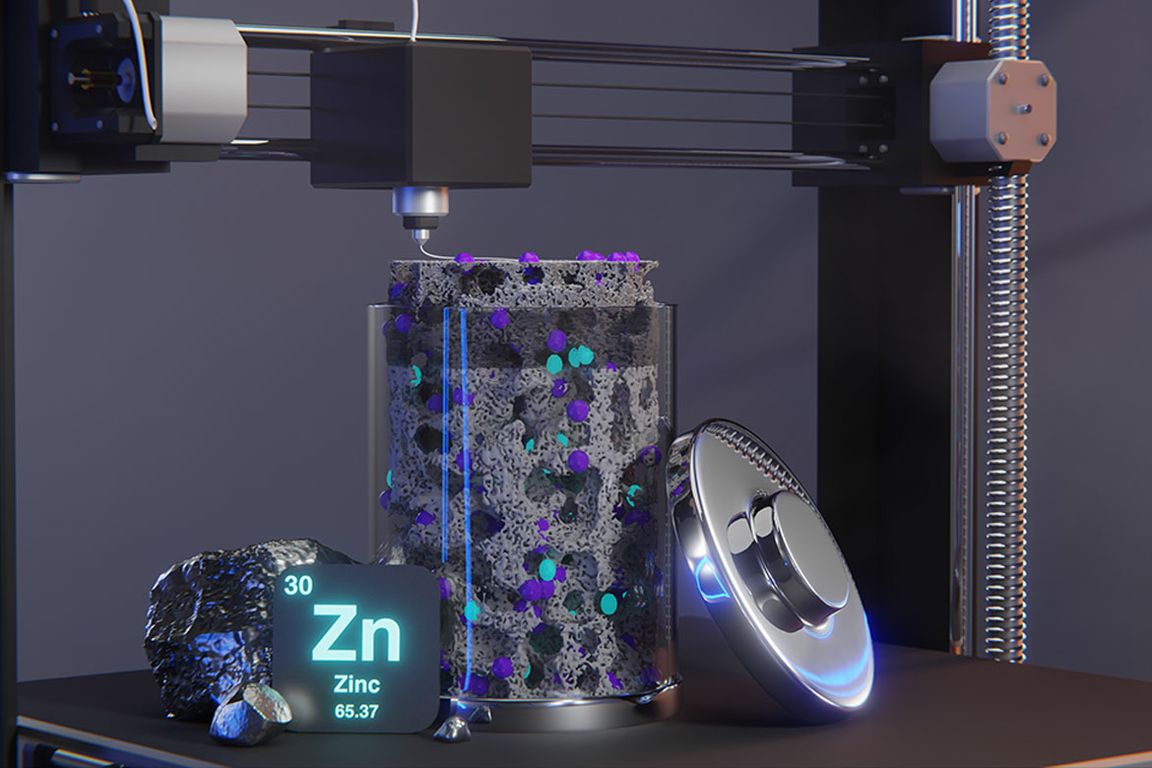
A UCLA-led research team developed a 3D printed electrode with a hollow structure that expanded the capacity of hybrid zinc-ion energy storage devices. Image courtesy of Maher El-Kady / UCLA.
A New Design
Instead of creating a new battery chemistry, the UCLA team decided to redesign one of the battery’s main parts. The researchers first 3D printed a lightweight lattice on an Elegoo Mars 3 Pro resin printer. After printing, the structure was heated at high temperatures until it became a conductive carbon framework. That carbon lattice acts as the battery’s electrode. The team then coated it with vanadium oxide, the material that stores and releases energy. Because the lattice contains billions of tiny pores, it provides a huge internal surface area while still leaving room for zinc ions to move through the battery.
“The method we used lets us build any 3D scaffold, layer by layer, and control its microstructure,” said co-corresponding author Ric Kaner, a UCLA distinguished professor of chemistry and biochemistry and of materials science and engineering, holder of the Dr. Myung Ki Hong Endowed Chair in Materials Innovation, and a member of the California NanoSystems Institute at UCLA. “We can actually have billions and billions of these tiny holes, producing an enormous internal surface area. That means we can store a lot of charge.”
The researchers say that combination helped the battery store more than seven times as much energy as similar devices while retaining 82% of its capacity after 1,500 charge and discharge cycles.
More Than Just a Better Battery
The study also describes a second innovation made possible by 3D printing. The team designed a sealed electrochemical test cell that could make battery research easier. The test cell was designed in Onshape and printed on a Bambu Lab X1 Carbon using transparent filament. The device is used to measure the performance of experimental batteries, and the team says it improves on one of the most common testing methods used in laboratories today. Instead of building custom testing equipment for every experiment, researchers could use the standardized design to evaluate and compare new battery technologies more consistently.
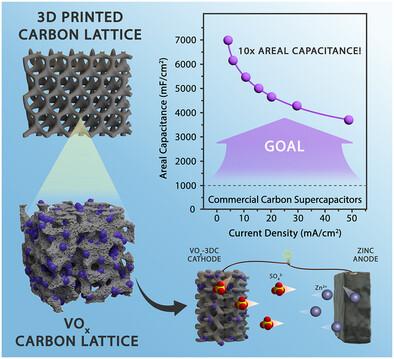
High mass-loading vanadium oxide on 3D printed carbon lattices for aqueous zinc-ion energy storage. Image courtesy of Maher El-Kady / UCLA.
Lithium gets most of the attention, but it isn’t the only option. Zinc is cheaper, easier to find, and generally considered safer because zinc-based batteries are less likely to overheat. That is why researchers have long seen them as a good fit for storing electricity from solar and wind farms, where low cost and long life matter more than keeping batteries small and lightweight.
The biggest challenge has been storing enough energy to compete with today’s lithium-ion batteries. Zinc-ion batteries simply haven’t been able to hold enough energy to compete with today’s leading battery technologies. The UCLA team believes its new 3D printed design could help change that.
“It’s a concept that we hope can be useful to other researchers in the field by helping them obtain more consistent measurements and reliable data for their devices,” said first author Sophia Uemura, who recently earned her Ph.D. from UCLA. “One of the exciting things about 3D printing is how accessible it has become. In this case, anyone with access to a 3D printer will be able to make a test cell like ours and adapt it for their own work.”
The UCLA and Caltech projects take different approaches. One focuses on lithium-ion batteries, while the other aims to improve zinc-ion technology. Both, however, rely on 3D printing to create battery designs that would be difficult to manufacture any other way. Together, the studies suggest researchers are beginning to use additive manufacturing not just to make battery parts, but to rethink how batteries are built.
Subscribe to Our Email Newsletter
Stay up-to-date on all the latest news from the 3D printing industry and receive information and offers from third party vendors.
Print Services
Upload your 3D Models and get them printed quickly and efficiently.












You May Also Like
Fathom CEO Rush LaSelle on Why Additive Manufacturing Is Growing Up
For years, the additive manufacturing (AM) industry promised to reinvent production. But as the technology matured, the real challenge turned out to be proving that 3D printed parts could be...
3D Printing News Briefs, June 13, 2026: Management Changes, Project Calls, & Wheelchairs
We’ll kick this weekend’s 3D Printing News Briefs off with some advisory board and management changes, and then move on to project call news. We’ll end with some heartwarming stories...
3D Printing Financials: Stratasys Bets on Defense and Drones as Printer Sales Slow
Stratasys (Nasdaq: SSYS) started 2026 with lower revenue and a larger loss as customers continued to slow down spending on new 3D printers. Still, the company pointed to stable recurring...
Beehive Gets $29.7 Million Contract
The US military is pivoting from a world where it fields a few exquisite craft to one where it can manufacture swarms of vehicles. Additive manufacturing at scale, along with...