Our Industry’s Shipping Container Moment


The additive manufacturing industry likes to think of itself as disruptive, fast-moving, and future-oriented. In many ways, that is true. The technology works. The machines are better than ever. The materials are more capable. And yet, despite all this progress, there is a persistent feeling that we are not quite where we should be. Not in scale. Not in impact.
The question is not whether additive manufacturing can deliver value. It clearly can. The real question is why that value remains so hard to scale.
Hardware innovation has been an important catalyst. On one end of the spectrum, we are seeing an explosion of affordable, high-quality printers that sit between hobbyist tools and full industrial systems. These machines have lowered the barrier to entry and enabled many companies to move from prototyping into small-series production. On the other end, industrial systems continue to grow in size, capability, and complexity, enabling the production of larger and more demanding parts. Access has improved, quality has improved, and production potential has expanded.
But hardware alone will not get us where we need to go.

Materialise CEO Brigitte de Vet-Veithen
As the industry matures, the role of software becomes more visible — and more consequential. The additive manufacturing software landscape has grown organically, shaped by proprietary systems and vertically integrated solutions. That approach made sense in the early days, when the priority was to make individual technologies work. But as the industry matured, those same closed systems became a constraint. Data lives in silos. Workflows are stitched together manually. Engineers spend more time moving files between tools than improving processes. Scaling across machines, sites, or applications multiplies complexity instead of reducing it.
To understand where this leads, it helps to look outside our own industry.
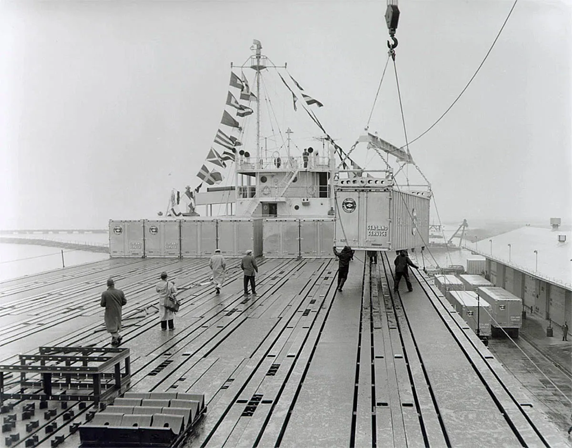
In the middle of the 20th century, global shipping faced a similar problem. Ships, trains, trucks, and ports all worked, but they worked in isolation. Cargo had to be unpacked and repacked at every step. There was no shared system, no common language. Ports were slow, expensive bottlenecks. The breakthrough did not come from faster ships or bigger cranes, but from something deceptively simple: the standardized shipping container.
What followed was not just standardization, but transformation. Once the industry spoke a shared “container language,” it suddenly made sense to invest in automation, tracking, route planning, and integrated logistics systems. Shipping evolved from fragmented local operations into a global, interconnected network. That change did not just optimize ports; it reshaped manufacturing, retail, and global trade itself.
Additive manufacturing today looks a lot like shipping did back then. Powerful, but fragmented. A typical AM workflow relies on a patchwork of tools, each with its own data format and logic. The problem is not getting from design to part. The problem is making that journey repeatable, automated, and scalable across technologies and organizations. What we are missing is a way to move our “digital cargo” smoothly from one step to the next, without friction.
This is why the industry’s next phase is not about individual tools, but about ecosystems.
The first step is a shared language — much like the universal shipping container once provided a common language for global trade. Today, different companies often use different terms for the same concepts, slowing collaboration and integration. Initiatives like the Leading Minds consortium exist to address exactly this problem: reducing confusion, aligning terminology, and creating a common foundation on which the industry can build.
But, as the shipping analogy shows, language alone is not enough.
The second step is an open software ecosystem where tools, partners, and workflows can connect without forcing manufacturers to give up control over their data, processes, or intellectual property. This is the thinking behind platforms like CO-AM: not as a single solution that replaces everything else, but as a foundation for a connected manufacturing environment. By making automation accessible and allowing recurring processes to be configured without deep programming expertise, such platforms aim to remove the manual glue that currently holds AM workflows together.

This brings us to the first call to action.
If we truly want to scale the impact of additive manufacturing, we need to look beyond our own industry bubble. Too often, the conversation is dominated by machine builders, software developers, and service providers talking among themselves. What is missing are the industries we exist to serve. The real measure of success is not how elegant our internal ecosystems become, but how profoundly we can impact these industries. That requires active engagement, clearer storytelling, and a willingness to meet customers where they are.
The second call to action is about the kind of ecosystem we choose to build.
An open ecosystem is not always comfortable. Openness does not mean that every participant benefits equally at every moment, or that established business models remain untouched. In the short term, it can feel risky to give up control. But ecosystems do not scale through control; they scale through openness. Global logistics works not because one player dominates, but because many specialized players operate within a shared framework.
Additive manufacturing now faces the same choice. We can continue to optimize locally, around individual machines, materials, or platforms. Or we can optimize globally, around the ecosystem as a whole. The first may protect short-term advantages for some. The second is what enables long-term growth for all.
 A rising tide lifts all boats. The real test is whether we are willing to build the conditions that allow that tide to rise.
Brigitte de Vet-Veithen, CEO of Materialise, participated earlier this year at the Additive Manufacturing Strategies conference in New York City and spoke on this topic.
Subscribe to Our Email Newsletter
Stay up-to-date on all the latest news from the 3D printing industry and receive information and offers from third party vendors.
Print Services
Upload your 3D Models and get them printed quickly and efficiently.













You May Also Like
50,000 Orders and Counting: EPlus3D & Chinese AM Services Provider Are Scaling Liquid Cooling Solutions for AI Servers
An under-appreciated story driving the additive manufacturing (AM) industry this year has been the divergence between what’s driving the market in China and what’s driving it everywhere else. Let’s start...
Additive Manufacturing Has a Major Growth Opportunity; Trust Will Decide Who Captures It
After years of overpromising, the next phase of AM growth will be won by companies that consistently deliver what they say. When I entered additive manufacturing in 2014, after 15...
Seven Trends Reveal What’s Next for 3D Printing at TCT Shenzhen 2026
TCT Shenzhen 2026 opened on October 14 in Hall 15 of the Shenzhen World Exhibition & Convention Center in Bao’an, and ran through October 16. The event brought together equipment...
AM Investment Strategies 2026 Sets the Stage for AMS 2027
AM Investment Strategies 2026 Nov. 5 · 12 p.m. ET · Free online event RESERVE YOUR SPOT ↗ A one-hour online discussion featuring some of the biggest names in 3D...