Orano Federal Services & UNC Charlotte Show How AM Could Cut Costs in Nuclear Energy Resurgence

Outside of the defense sector, few industries have been impacted by Russia’s ongoing occupation of Ukraine more than nuclear energy. The same appears to already be happening in response to the US-Israel attacks on Iran.
Nations, including the US, that have seen a resurgent interest in nuclear energy since 2022 have learned that revitalizing a nuclear energy supply chain is anything but a short-term process. The long-term nature of nuclear energy buildup could work in favor of using additive manufacturing (AM) to aid in that buildup, and there has been notable growth in AM R&D for nuclear power applications over the last several years. A new case study from the University of North Carolina (UNC) Charlotte and nuclear cleanup specialist Orano Federal Services demonstrates how AM might be used not only to help make a US nuclear energy renaissance possible, but also to make such a scenario cheaper.
The key to understanding how lies in spent nuclear fuel (SNF): these are the uranium oxide pellets used in fuel rods, which US nuclear facilities recycle at a rate of 2,000 metric tons a year. As the case study explains, the current recycling protocol in the US leaves individual operators in charge of their own disposal processes, but that’s expected to change over the next 10-15 years, the timeline that the Department of Energy (DOE) is targeting for the construction of a central repository for SNF. This creates demand for the production of the hardware required for transporting SNF, most notably transportation casks.
These are giant structures, with typical casks used for truck transport weighing 50,000 pounds and those used for rail transport weighing as much as 250,000 pounds (in both cases, the weight includes the fuel). The Orano and UNC Charlotte case study involves using AM to produce impact limiters for casks: circular components that sit at both ends of a cask, designed to protect its contents in the event of an accident.
For the case study, researchers tested both fused filament fabrication (FFF) and powder bed fusion (PBF) methods, substituting stainless steel for the conventionally-used materials, which are most often redwood or balsa-wood, or aluminum. Using both simulations and real-world compression testing, the Orano and UNC Charlotte team determined that a 5 percent gyroid infill design, for FFF as well as PBF, “produce[d] acceptable results for drop events”. Assuming a cost of up to $1 million per impact limiter when produced conventionally and 2 impact limiters per cask, the researchers found that using AM could result in up to $1 million in savings per cask with FFF and up to $1.7 million with PBF.
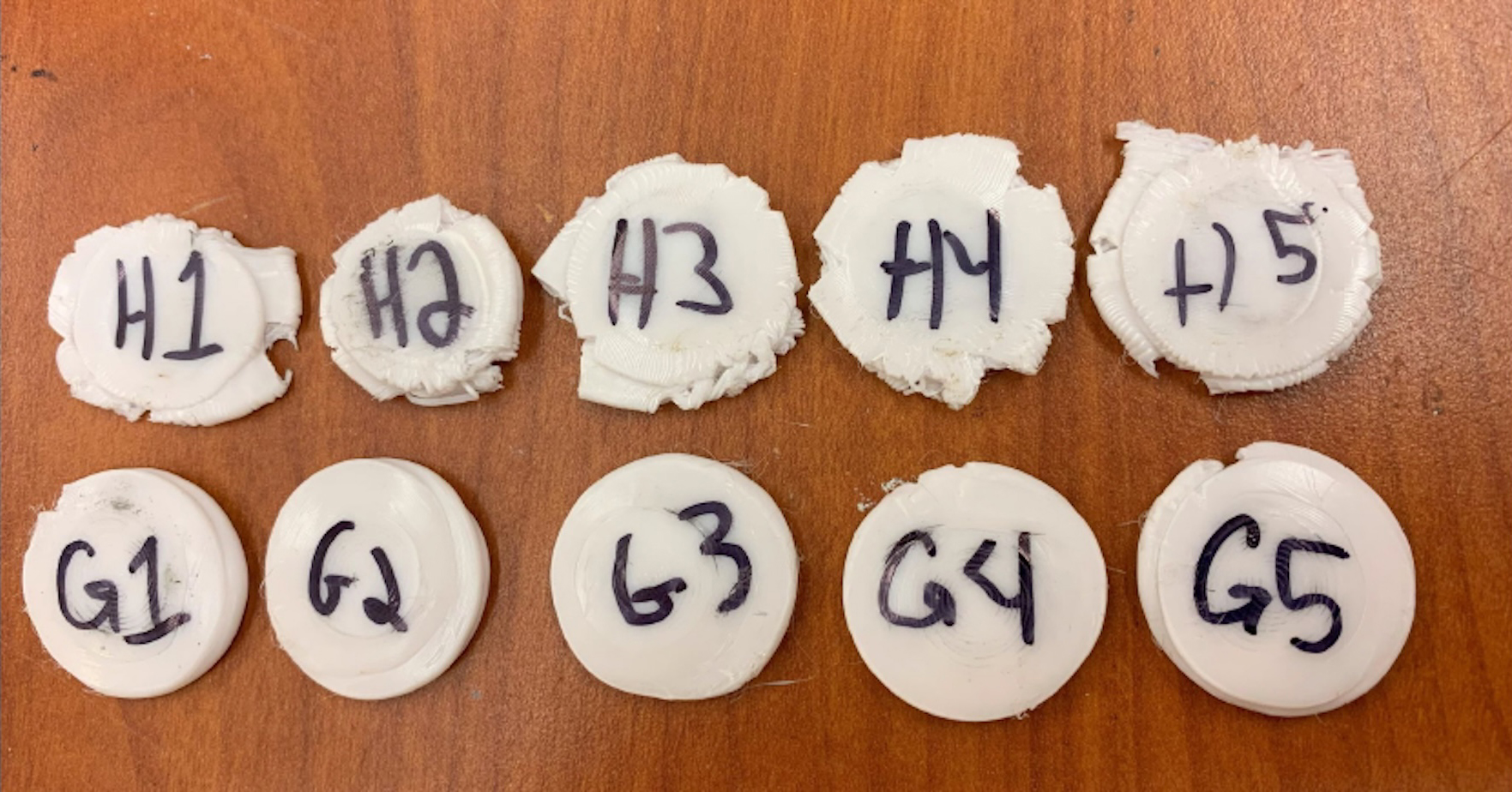
Results of compression testing: honeycomb design (top row) vs gyroid design (bottom row).
Of course, the caveat, as usual with AM components, is that the lack of existing relevant standards stands in the way of pivoting to AM at scale:
As the case study notes in its conclusion, “However, the lack of codes and standards to support the use and verify the efficacy of AM components makes the proposed new impact limiter design an exercise in need of justification, likely beyond single component testing and numerical modeling of the composite design and most likely in need of actual drop testing data. Therefore, although this work shows the promise of AM, the path forward is focused on the development of codes and standards for AM components, which will require test data to complete.”
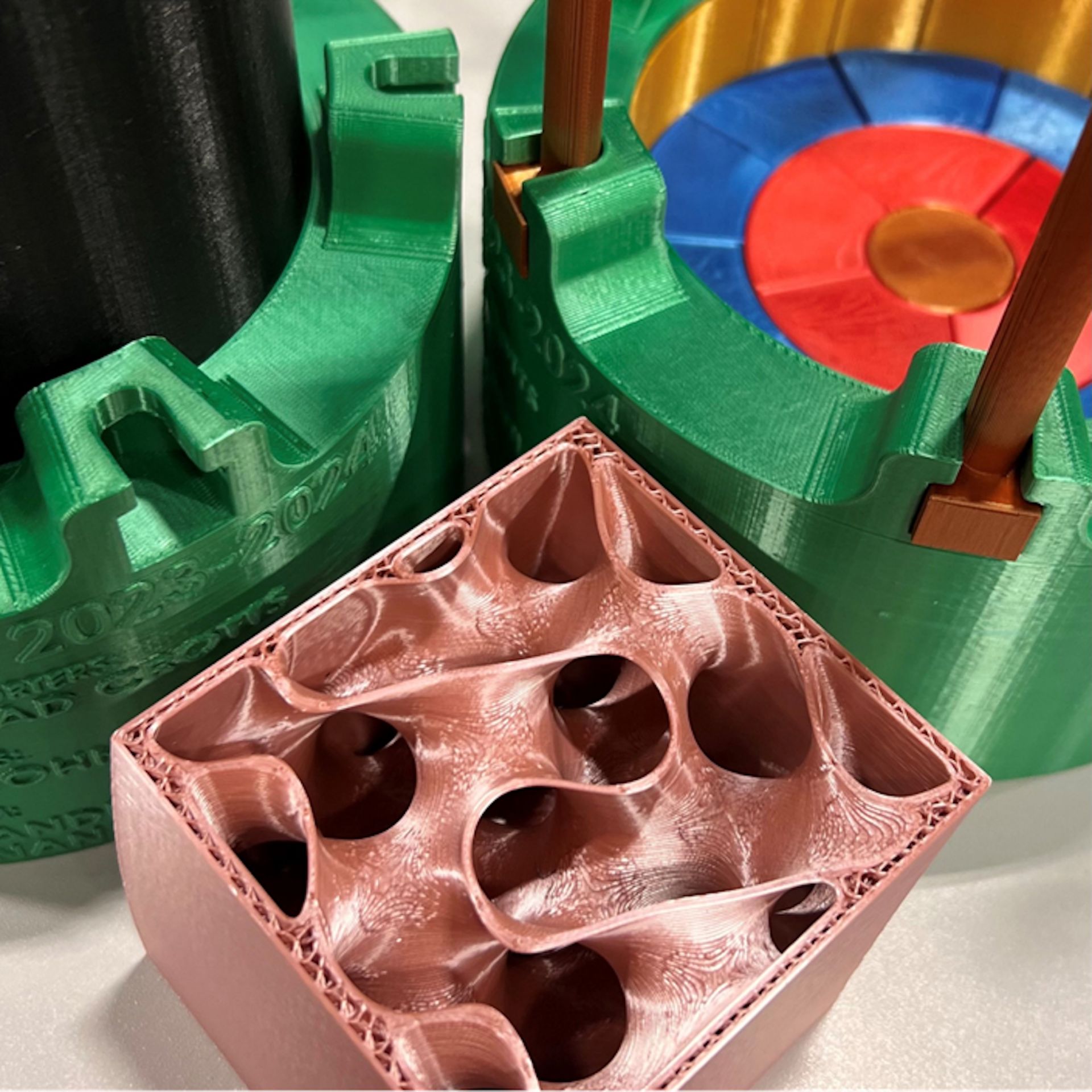
AM PLA plastic scaled replica of an impact limiter (1/12 scale) with 36 bricks (red, blue, and gold) and stainless steel cladding (green) and gyroid infill pattern in foreground (pink).
On the other hand, the qualification process should be made easier precisely because the R&D is related to a DOE objective. As Vanesa Listek described in her excellent article on the many ways 3D printing contributed to the Artemis II launch, AM tends to prove most viable when its use is supported by the combination of public and private funding to solve a complex of technological problems over a lengthy timeframe.
Nuclear energy can be thought of as a space program that doesn’t leave orbit. It’s one of those quintessential technological arenas that has never existed, and probably can’t/shouldn’t exist, without heavy government involvement. That’s exactly the sort of context that calls for a publicly funded qualification accelerator program.
That is the case, especially given the value inherent in recycling SNF. In addition to its potential viability as a future fuel source, the material can also be used for a growing number of applications, including medical treatment. That provides an additional incentive for the government to expedite the process, enabling the use of new manufacturing techniques for SNF transportation.
Finally, as the entire AM industry has benefited from the knock-on effects of federal funding for accelerated standardization in the defense sector, the entire industry would benefit from a concentrated effort to expand AM use in nuclear energy. Given all the government money already spent on R&D for nuclear submarines, there’s even greater potential to combine those two goals.
Images courtesy of Radwaste Solutions/ American Nuclear Society
Subscribe to Our Email Newsletter
Stay up-to-date on all the latest news from the 3D printing industry and receive information and offers from third party vendors.
Print Services
Upload your 3D Models and get them printed quickly and efficiently.











You May Also Like
HADDY’s Large-Format Robotic 3D Printing to Power Red Cat’s Drone Boat Production
In May 2025, Joris Peels, as is his custom, wrote a prescient article about Unmanned Surface Vehicles (USVs) and Unmanned Underwater Vehicles (UUVs), i.e., drone boats. Listing a multifaceted range...
EOS to Spotlight AI, Robotics, and Industrial Tooling at Hannover Messe
The US-Israel war on Iran is already catalyzing the sorts of major shifts to global supply chains that will effectively amount to permanent economic changes. In this context, the nations...
When Castings Take 18 Months: How 3D Printing Helped Fix the Soo Locks
This article is Part II of a two-part series on Lincoln Electric’s large-format metal additive manufacturing operations. In Part I, we looked at how Lincoln Electric built one of the...
What the 2026 Post-Processing Survey Reveals About the Future of AM
As additive manufacturing (AM) continues its transition from prototyping to production, industry attention is shifting toward one of the most demanding but often overlooked parts of the workflow: post-processing. The...