Nikon AM Synergy Gets Defense Innovation Unit FORGE Contract


Nikon AM Synergy has received an Other Transition Agreement (OTA) contract from the U.S. Department of War (DoW) Defense Innovation Unit (DIU). The Foundry for Operational Readiness and Global Effects (FORGE) contract is aimed at increasing the use of metal parts on airborne systems and replacing cast parts. FORGE is aimed at high volume, high criticality, scaled-up manufacturing solutions. Nikon AM Synergy’s Long Beach headquarters will handle the contract.
DIU Program Manager Derek McBride stated,
“The DIU is excited to partner with Nikon AM and leverage their extensive engineering, manufacturing and qualification capabilities as we work to expand production capacity and alleviate aeronautical component bottlenecks.”
Nikon AM Vice President of Technology Dr. Behrang Poorganji said that,
“Nikon AM is uniquely positioned to support the DIU through Nikon AM Synergy’s comprehensive design and materials qualification capabilities combined with our industry-leading, Nikon SLM Solutions’ laser powder-bed fusion AM systems and advanced Nikon inspection capabilities, all operating together under stringent manufacturing requirements in our Long Beach facility. As we continue to execute our holistic approach to deliver vital manufacturing capabilities to the United States and allied partners, we are proud to support the DIU in accelerating adoption and scaling of AM to strengthen warfighter readiness.”
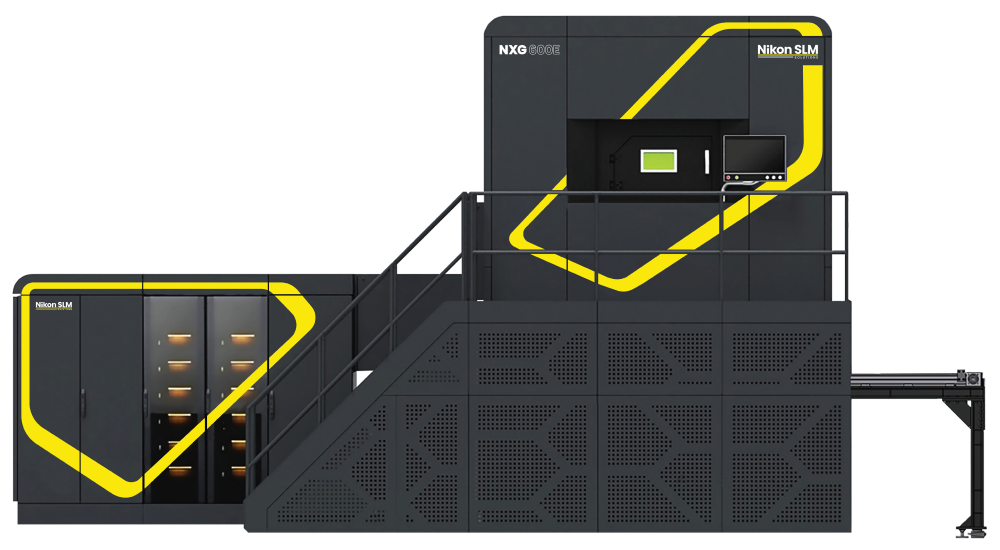
NXG 600E. Image courtesy of Nikon SLM Solutions.
The US government is accelerating its public deployment of funding for scaling up additive. Whereas initially defense money from the AFRL and Navy was all about qualification, materials, or technology development, now funding is moving towards production. We know that there are still qualification bottlenecks. Especially in taking a lot of 2D (and some kind of CAD but we don’t know which) parts into production, there is still a lot of work to be done. Materials may be suited and processes may be applicable, but turning a geometry into a working design still requires a lot of manual labor and knowledge. It would be wrong of us to just simply march onwards to production while forgetting this. If we look just at the military, they have millions of parts that have been made with many processes and materials across decades. Filtering these would take ages, and making them work would also be a considerable amount of work.
Having said that, to look beyond the now and into the future, production will be a bottleneck as well. LPBF is great at making precise geometries in a machine along with a bunch of subsequent steps and optimization. To lower costs will require a rethinking of the economics of the process. Machine costs, speed, powder costs, and build volume, but also turnaround costs on machines, maintenance, and file handling matter. Any money spent on reducing these costs is well spent.
The DIU previously gave money to Velo3D for rapid qualification for LPBF parts. This particular FORGE solicitation was first published just ten months ago, so this is light speed stuff for the government. And that is what the DIU is setting out to do here. It wants to make the government move faster on defense and the future of defense. The DIU says that it wants to “rapidly prototype and field dual-use capabilities that solve operational challenges at speed and scale.” To leverage the industrial might of the US and partner countries in delivering on defense innovation is a smart idea. Especially in scale and cost-driven solutions or new technologies, the market could deliver much faster than existing pathways. In terms of scaling up additive, we are expecting much more money to flow in the coming months. Hundreds of millions will be spent over the next year in scaling up the technology for defense in the US. This is a win for Nikon, but there will be many more for our industry in the coming year.
Subscribe to Our Email Newsletter
Stay up-to-date on all the latest news from the 3D printing industry and receive information and offers from third party vendors.
Print Services
Upload your 3D Models and get them printed quickly and efficiently.













You May Also Like
3D Printing Financials: Xometry Sets New Record in Q2
Xometry (Nasdaq: XMTR) has reported its best-ever quarterly results, with strong growth across its online manufacturing marketplace. The company saw gains in revenue, profit margins, and customer activity, pointing to...
South Korean 3D Printing Industry Sounds Alarm Over Data Leakage
An article recently published in BusinessKorea has highlighted that small and medium-sized enterprises (SMEs) utilizing additive manufacturing (AM) in South Korea are increasingly worried about the threat of leaking intellectual...
3D Printing News Briefs, May 31, 2025: Project Call, Consortium, Certification, & More
We’re starting with the latest America Makes Project Call in today’s 3D Printing News Briefs, and a consortium to promote the adoption of additive manufacturing has been founded in Spain....
Burloak and MDA Space: 8 Years of Transforming Aerospace with Metal 3D Printing
Burloak Technologies, Canada’s largest contract manufacturer specializing in metal 3D printing and post-processing for flight applications, recently celebrated 8 years of partnership with MDA Space, Canada’s largest space technology company....