Targeted Applications, Expanded Platform: XJet’s Strategic Vision for AM’s Next Chapter


The additive manufacturing sector has undergone a period of “creative destruction” over the past months, moving beyond a “growth at all costs” mentality into an era of consolidation and strategic focus.
In this refined landscape, XJet has charted a distinctly different course. By focusing on a narrow yet essential segment — small, complex, high-value parts — the company has navigated 2025’s industry turbulence with notable stability, strengthening its leadership in technical ceramic AM and accelerating its global partnership network. More importantly, XJet is now executing a deliberate strategy to expand its addressable market without diluting its core strengths.
Vertical Focus Four High-Value Markets
Rather than competing across the entire $37 billion additive manufacturing landscape, XJet has concentrated on four high-value verticals where its NanoParticle Jetting™ (NPJ) technology delivers differentiated value: aerospace and defense, technical ceramics, precious metals, and luxury manufacturing.
In technical ceramics, XJet’s position exemplifies this vertical strategy’s strength. Despite macroeconomic uncertainty, the ceramic business expanded steadily throughout 2025, driven by accumulated expertise and a growing install base among industry leaders in aerospace, medical, and manufacturing services, particularly in Europe and the United States, with XJet systems in production.
The company’s expanded material portfolio in advanced ceramics and metals strengthens value propositions to existing customers while opening new application possibilities. A global reseller network efficiently extends XJet’s reach, enabling geographic expansion without the capital intensity of direct operations worldwide, a disciplined approach aligned with profitable growth.
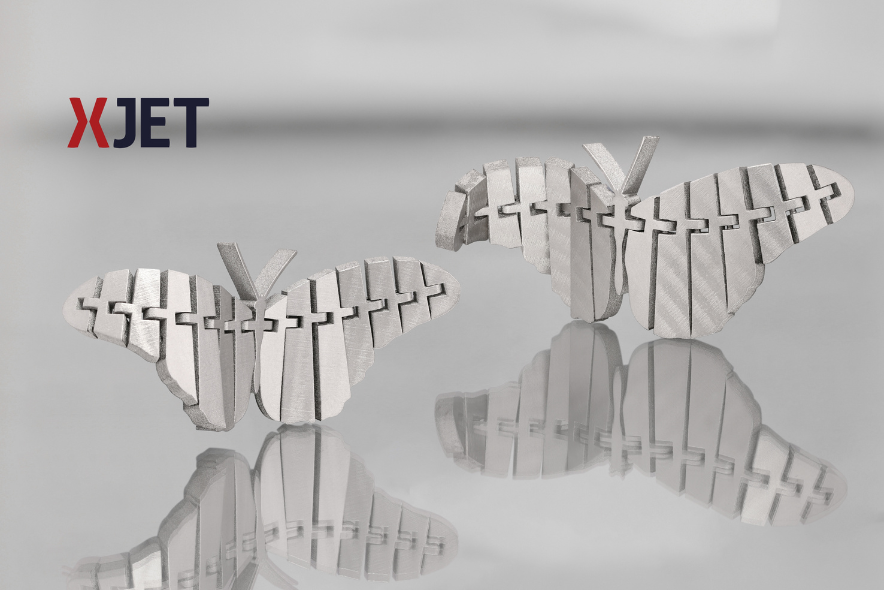
Printed as an assembled butterfly decoration piece in stainless steel 316L. Image courtesy of XJet.
Strategic Democratization: The Carmel Pro Revolution
While XJet built its reputation serving industrial production environments, significant opportunities remained out of reach. Research institutions, academic labs, and boutique contract manufacturers faced prohibitive barriers to entry.
In November 2025, XJet introduced the Carmel Pro — not merely a product launch but a calculated move to broaden the customer base while maintaining capital discipline. The system delivers up to 30% lower investment costs than previous platforms, making NPJ technology viable for SMEs and research centers that were previously priced out.
But accessibility alone doesn’t guarantee success. XJet designed the Carmel Pro with a clear eye toward tomorrow’s manufacturing requirements. The four-channel printhead configuration is a strategic architectural decision that positions customers — and XJet — for additive manufacturing’s next evolution: direct multi-material production.
This robust infrastructure elevates XJet’s previous build-plus-support capability to a new level. Coming capabilities include ceramic and metal multi-material printing with options for color gradients and density variations on demand, all directly printed in a single part. The Carmel Pro becomes not just an entry point but a platform capable of growing with customer needs.
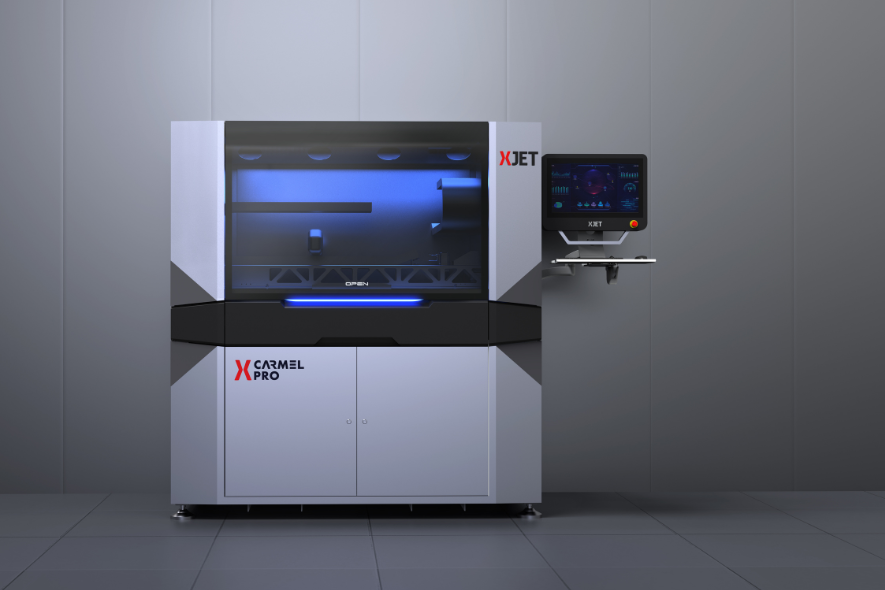
Jet Carmel Pro Compact System with a four-channel printhead. Image courtesy of XJet.
Premium Jewelry: Technology Meets Artistry
The Carmel Pro’s multi-material printhead has paved the way for XJet’s focused entry into premium jewelry manufacturing, where design freedom, complexity, and surface quality are paramount. Debuted at Formnext 2025, XJet’s integrated solution — comprising the Carmel Pro and precious metals materials, especially sterling silver — addresses a market where traditional manufacturing constrains creative expression and economically viable production of complex designs.
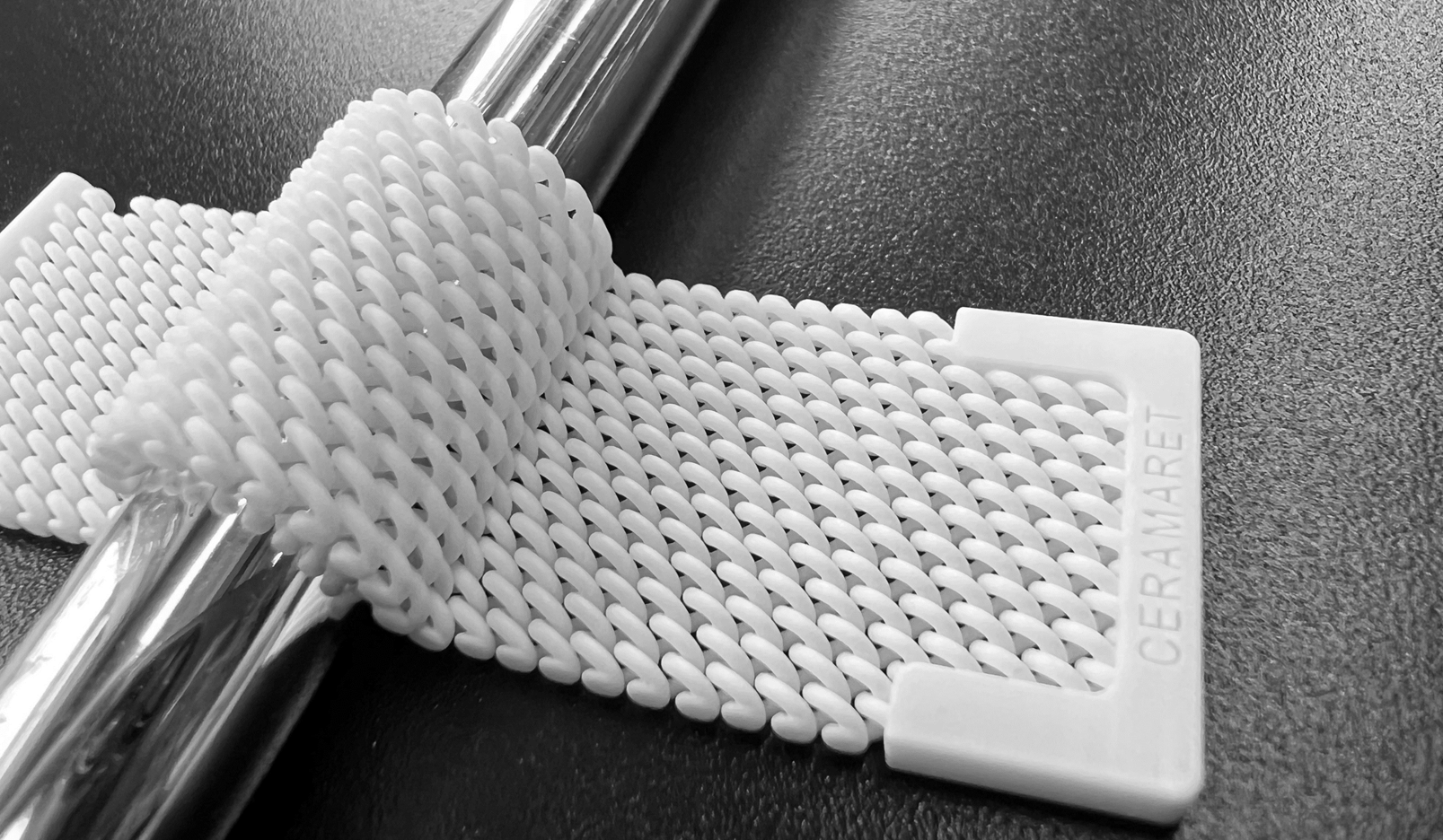
Ceramic bracelets are already assembled. Image courtesy of Ceramarat.
This vertical demonstrates XJet’s disciplined expansion approach. NPJ technology delivers the fine surface finish luxury applications demand, enables geometric forms impossible with traditional casting, eliminates material waste inherent in subtractive processes, and transforms production economics for small-batch and custom pieces. This is the best example of how XJet enters the game, where its differentiated capabilities create compelling customer value.
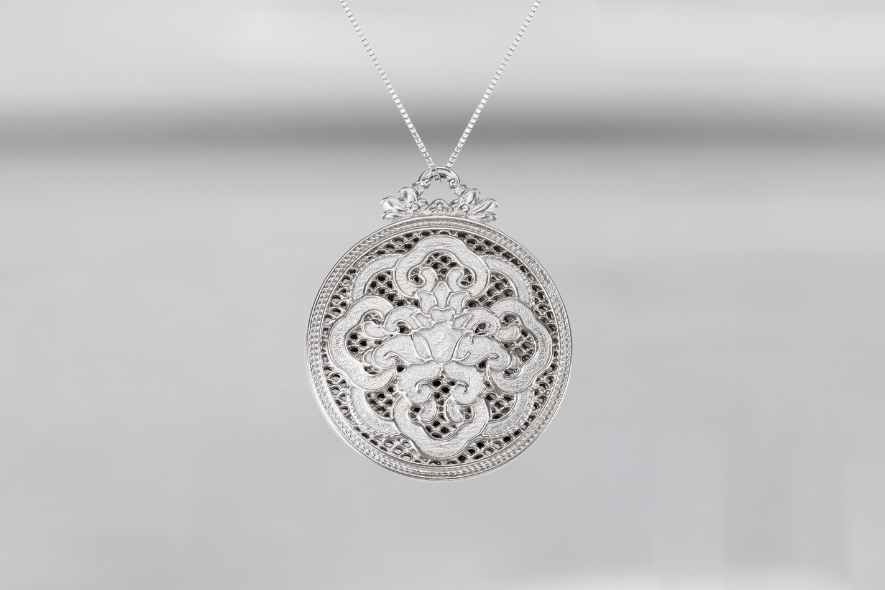
Jewelry pendant at hollow cavities and comple surface patterns. Image courtesy of XJet.
Focused, Sustainable Expansion
As the industry enters 2026, XJet’s leadership sees the market moving from experimentation to implementation, from hype to tangible ROI requirements. Companies are standardizing additive manufacturing within production workflows only when the technology delivers measurable business value.
XJet’s outlook centers on maturation within its chosen verticals, positioned to benefit from two parallel trends: consolidation favoring specialized players with defensible technology and deep vertical expertise, and democratization enabling broader adoption within targeted markets.
The democratization strategy isn’t about racing to the bottom on price, it’s about strategic market expansion, creating customer value while building a more resilient business. By making industrial-grade capabilities accessible to a broader market while maintaining vertical focus and technological differentiation, XJet is building a business model aligned with the industry’s evolution from speculative growth to profitable sustainability.
As additive manufacturing transitions from emerging technology to essential manufacturing tool, this approach — deep vertical expertise combined with strategic accessibility — may well define which companies lead the next decade.
XJet is a Bronze Sponsor of Additive Manufacturing Strategies (AMS) 2026, a three-day industry event taking place February 24–26 in New York City. The conference brings together industry leaders, policymakers, and innovators from across the global additive manufacturing ecosystem. As a sponsor, XJet will support conversations centered on scaling AM technologies, advancing industrial adoption, and exploring the next generation of production solutions. Registration is open through the AMS website.
Subscribe to Our Email Newsletter
Stay up-to-date on all the latest news from the 3D printing industry and receive information and offers from third party vendors.
Print Services
Upload your 3D Models and get them printed quickly and efficiently.











You May Also Like
Will Desktop Firms Push Shoe 3D Printing Forward?
Recently, Bambu Lab announced that it was working with FORMISM by SCRY on releasing shoes. These six designs will be shared and printable through its Makerworld platform. Using the platform,...
3D Printing Predictions 2026: The Material Extrusion Market in 2026
The material extrusion market has seen titanic shifts over the past few years. A new bevvy of low-cost 3D printers have turned to software and sensors to make reliable high-speed...
Top 10 3DPrint.com Stories of 2025: Kickstarter, Consumer Goods, Bankruptcy, & More
As Vanesa Listek wrote, last year was a major turning point for additive manufacturing (AM), as the industry is working to sort itself out. Customers want proven use cases and...
3D Printing Predictions 2026: Industrial Production & Polymer Additive Manufacturing
Polymer additive manufacturing is seeing less investment, attention, and disruption than metal additive manufacturing currently. Less crucial for defense needs, it has of late had far fewer new entrants. But,...