Unlocking Big Part Manufacturing for the Energy Sector: How EPRI’s Convergent Approach Proves the Potential of Large-Area DED 3D Printing

The U.S. hydropower fleet, more than 2,200 plants averaging 65 years of age, relies on large, bespoke components that are increasingly difficult to source. Long lead times, disappearing suppliers, and aging infrastructure create mounting risks for operators trying to maintain reliability. Within this context, EPRI has emerged as a leader in applying convergent manufacturing—the combination of conventional metal stock and advanced 3D printed features—to demonstrate practical, near term solutions for manufacturing “big parts for energy.”
In a first of its kind research, development, and demonstration (RD&D) project, EPRI partnered with Salt River Project (SRP) and Lincoln Electric Additive Solutions (LEAS) to design, manufacture, inspect, and install a convergently manufactured hydropower wicket gate, showcasing how wire arc directed energy deposition (DED) can dramatically shorten schedules, meet stringent utility requirements, and build a path for widespread adoption of large-area additive manufacturing.
The Big Parts Challenge: Supply Chains Strained by Scale
Hydropower components such as wicket gates, runners, and housings are often enormous, weighing hundreds to thousands of pounds. While small and midsized components have benefited from powder bed fusion additive manufacturing for years, the scale of hydropower applications makes powder bed processes impractical. Wire arc DED, however, can produce large components at industrially relevant sizes and deposition rates.
Yet utilities have been slow to adopt AM citing lack of internal experience and engineering, limited supplier familiarity, and uncertainties around codes, standards, and qualification. Through its Advanced Manufacturing Methods and Materials (AM3) program, EPRI is driving thought leadership by addressing these barriers head-on with targeted demonstrations that de-risk new technologies for the energy sector.
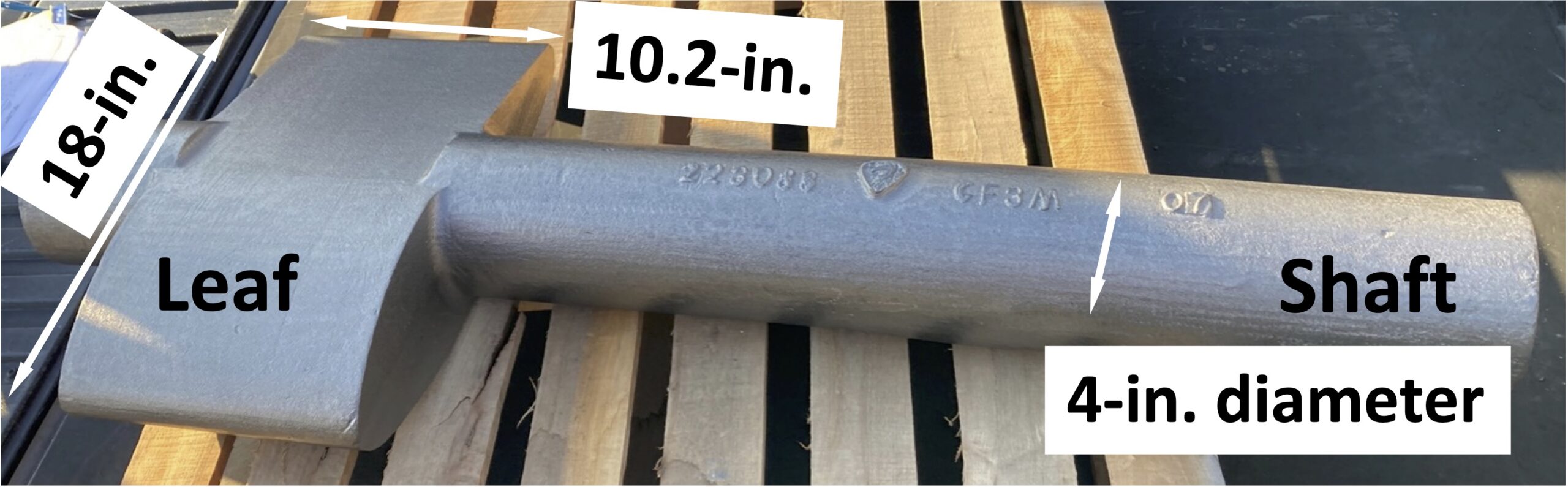
Figure 1. Wicket gate casting (~550 lbs. before machining)
SRP’s Real World Need: Casting Bottlenecks and 30-Month Lead Times
SRP’s century-old hydropower facility needed a new set of CF3M stainless steel wicket gates. The casting procurement took 30 months, driven by supply chain constraints and the need to reverse engineer legacy components with no existing drawings. This challenge created the perfect test case to evaluate whether additive manufacturing could deliver a high-quality alternative with fewer bottlenecks.
EPRI’s Demonstration: Proving Technical and Economic Viability
EPRI’s collaborative RD&D effort evaluated material readiness, build strategies, and extensive testing requirements. CF3M’s close similarity to 316L, a well-established wire DED alloy, made it an ideal candidate. The project leveraged a supplier with an ASME Section IX AM process qualification to ensure minimum 316L properties across the build envelope.
Two build strategies were considered:
- Full-build DED of the entire part (feasible but costly).
- Convergent manufacturing: printing a ‘leaf’ onto a 316L forged bar. EPRI chose the convergent approach, cutting wire use by ~50% and simplifying handling.
For this first-application SRP required rigorous acceptance criteria: liquid penetrant inspection, dimensional scanning, full volumetric radiography, and both destructive and nondestructive evaluations of a sacrificial part (Phased array ultrasonic examination, tensile tests in multiple orientations and locations, impact testing, and metallography).
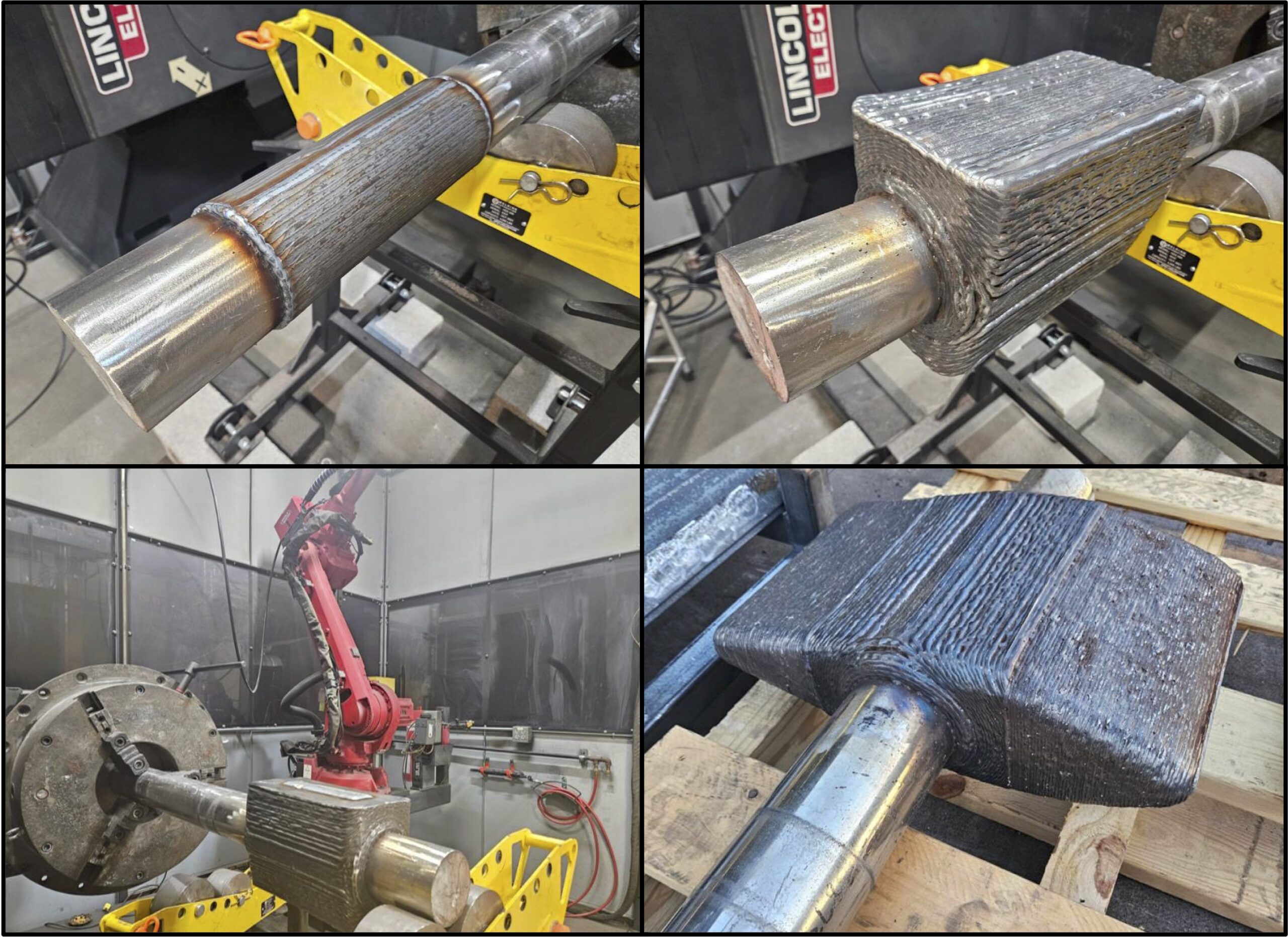
Figure 2. Convergent manufacturing of the wicket gate leaf onto a 316L bar stock at Lincoln Electric Additive Solutions (LEAS)
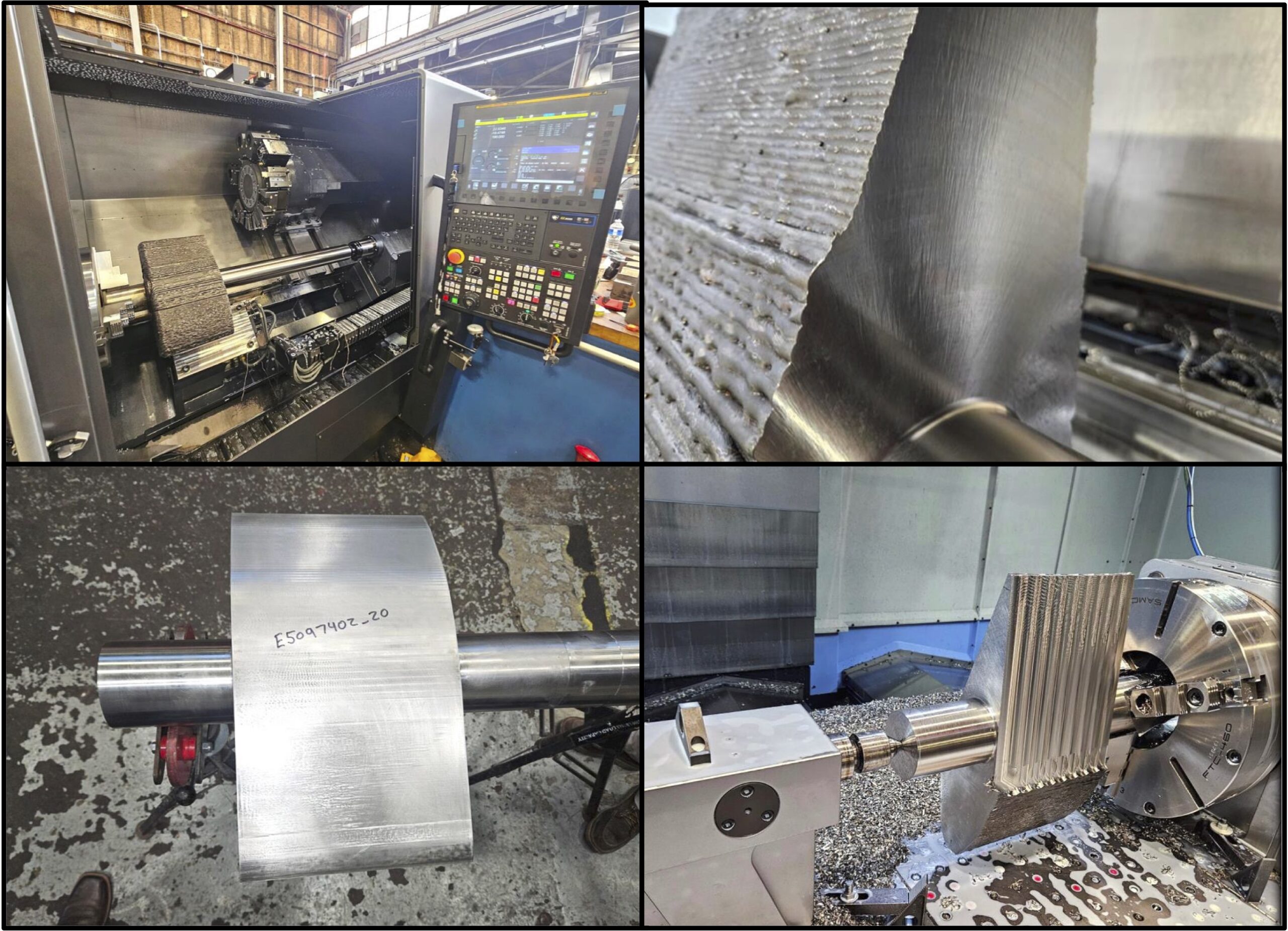
Figure 3. Final machining and surface inspection of the AM wicket gate at SRP
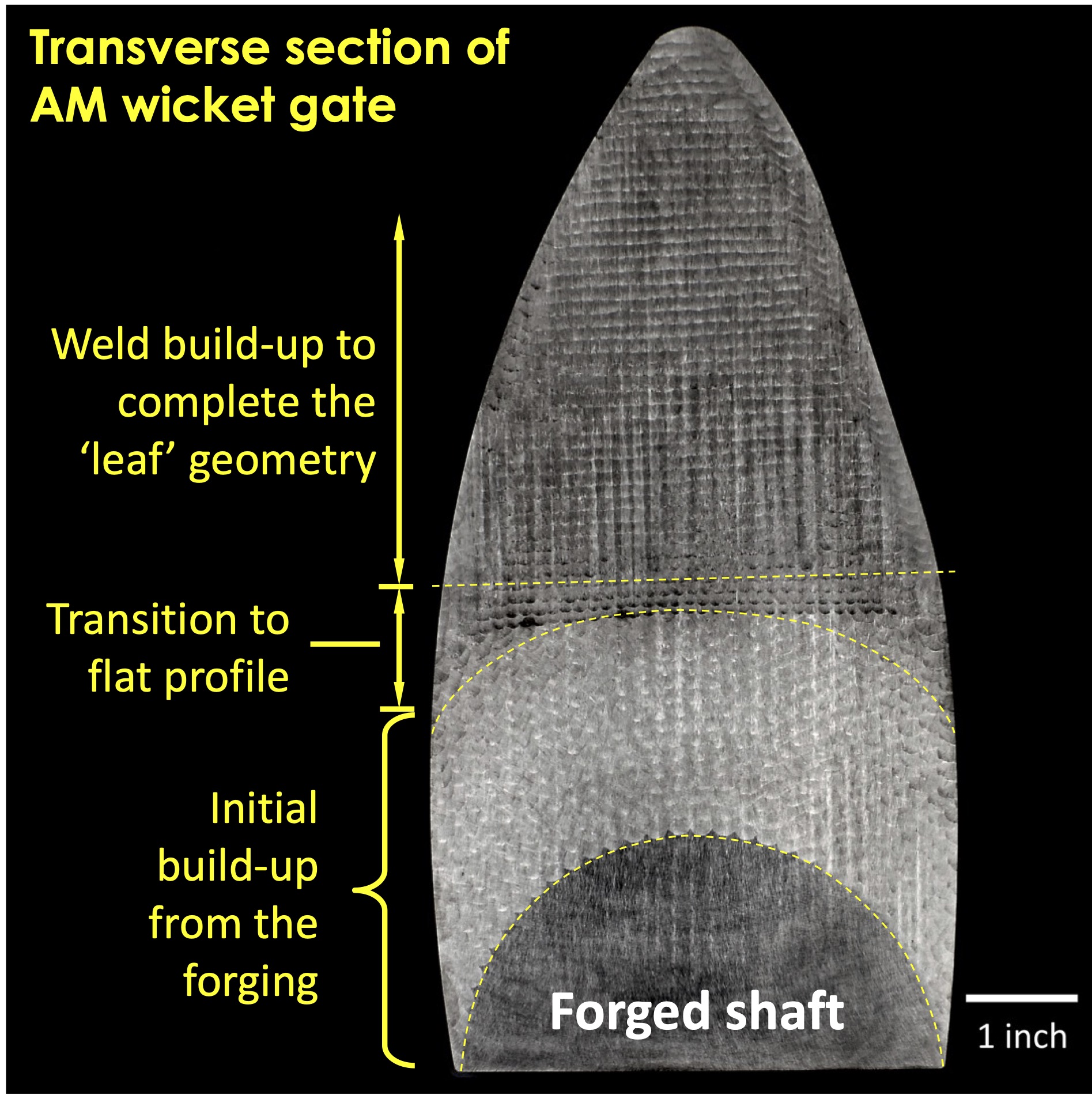
The successful manufacturing trial at LEAS produced two convergently manufactured wicket gates, each using ~250 lbs. of wire over two and a half days of print time. SRP performed the final machining and quality evaluations. Indications in the AM part were minimal with far smaller and fewer defects than the accepted in cast parts. EPRI conducted full destructive evaluation of one of the components. Tensile testing in all critical locations and orientations exceeded ASTM CF3M minimums and metallographic inspections showed no cracking or major discontinuities.
Based on these findings, one AM wicket gate was installed during SRP’s 2025 outage and will continue to be monitored in service as one of the first utility-installed large-area DED components in hydropower.
Why Convergent Manufacturing Is the Key
The results offer a compelling case for convergent approaches:
- Cost: A single convergent DED wicket gate cost was equivalent to the per-part casting cost, despite the overhead of a first article demonstration. In contrast, fully printed versions would have exceeded 140%. Optimized convergent manufacturing based on the learnings from this demonstration, reducing overbuild to reduce machining time, batching heat-treatments, and right-sizing inspection requirements, are estimated to bring costs down to 75% of casting prices in future production.
- Schedule: The convergent manufacturing project took six months, with a clear path to three-month delivery for planned replacement compared to 30 months for castings.
- Performance: AM parts demonstrated better or comparable material properties and fewer internal defects than cast equivalents.
The Bigger Picture: Demonstrations as Catalysts for Industry Adoption
This project exemplifies EPRI’s role as a trusted, neutral convener that helps utilities explore emerging technologies with confidence. Demonstrations like this accelerate adoption not by theorizing but by proving, under real manufacturing, inspection, and installation conditions, that advanced manufacturing can meet the expectations of the energy sector.
Convergent manufacturing stands out as a transformative approach with the potential to reduce cost, mitigates supply chain risk, and unlocks the full potential of large-area DED 3D printing. For an industry managing aging assets, scarce suppliers, and increasing demand for reliability, this method may define the next era of large-component manufacturing.
John Shingledecker is a Principal Technical Executive in the Electric Power Research Institute (EPRI). As a recognized industry thought leader and technical expert, he is responsible for Innovation and Government Strategy across EPRI’s Energy Supply research (thermal and renewable generation, conventional and advanced nuclear technology, low-carbon resources, long-duration energy storage…). He leads integration of EPRI activities in advanced manufacturing methods and materials for current and future power generation technologies with a focus on supply chain resilience. He is responsible for building and leading internal and external collaborative teams to address pressing industry challenges and enable technology maturation in the energy industry.
Prior to his current role, Dr. Shingledecker held various positions including leading EPRI’s Cross-Sector Technologies Group and EPRI’s Materials & Repair Program. He has extensive experience in global collaboration with utilities and their supply chain conducting workshops, conferences, and training. Prior to EPRI, he was a research staff member at Oak Ridge National Laboratory. He has published more than 240 papers, proceedings, and reports on the metallurgy and behavior of engineering alloys, has won numerous awards for transferring technology to industry, served on industry and scientific advisory boards, and is an adjunct faculty in Materials Science at Michigan Technological University.
At Additive Manufacturing Strategies (AMS) 2026, Dr. Shingledecker will participate in a panel about “Really Big Parts for Energy” on February 25th. This session is part of the broader AMS 2026 conference, which brings together industry leaders, policymakers, and innovators from across the global AM ecosystem. Learn more and register here.
Subscribe to Our Email Newsletter
Stay up-to-date on all the latest news from the 3D printing industry and receive information and offers from third party vendors.
Print Services
Upload your 3D Models and get them printed quickly and efficiently.











You May Also Like
Takeaways From MILAM 2026: Defense’s Growing Role in Driving 3D Printing – Part II
At the recent Military Additive Manufacturing Summit & Technology Showcase (MILAM 2026), additive manufacturing wasn’t just being discussed as a production strategy; it was being packaged for deployment. A big...
From Vision to Volume: The Next Chapter for Additive Manufacturing
Additive manufacturing has spent years navigating skepticism, hype cycles, and industrial validation. Now, the industry finds itself at a decisive turning point. The conversation has shifted away from futuristic possibilities...
Velo3D Becomes First Qualified AM Vendor for US Army’s Ground Vehicles Program
One indicator that I’ve used to help me track the additive manufacturing (AM) industry’s progress in terms of its technical maturity is the relative progress that each U.S. military branch...
Nikon Records $591M Metal AM Write-Down, Maintains Long-Term Focus
Nikon (OTCMKTS: NINOY) has announced a large impairment loss tied to its Digital Manufacturing business, the part of the company that includes metal 3D printing and advanced manufacturing operations. This...