Spielautomaten: High Performance Materials on Desktop Machines

A new generation of more sophisticated desktop 3D printers is revolutionizing the 3D printing market. Bambu, Creality, and Prusa Research have leaped ahead over the past few years. More firms, such as Snapmaker and Elegoo, could join them if they iron out some kinks. These firms have, in effect, digitized extrusion on fast printers with high yield and great surface quality.
Competition in this segment is ruthless and fast-paced, with millions of these systems being sold. Some of the biggest firms in 3D printing are now desktop 3D printing firms. Bambu is probably the highest-grossing 3D printing firm out there. Its P2S printer is available for €519 or with its excellent AMS unit for €749. The printer is rock solid, fast, and reliable. It moves around a bit and can be noisy, but as a printer, I can’t fault it. The Prusa Research Core L at €1,699 is an excellent 300×300×330mm build volume system. I’m stunned by the reliability and surface quality I get from it. I’m surprised now when a print doesn’t work. Yields I’m getting are over 95%.
Expansion
Many print farms now run on desktop printers. These businesses are expanding the market by making it cheaper to get 3D printed parts. New people are now buying 3D printers because they’re easier to use. Printers are now being bought en masse by the cosplay crowd. Parents are buying them in great numbers for their children as well. 3D printing was initially a hobby for the hardy, techy, and perseverant. Now it’s becoming a tool to make things for another hobby.
But many in the industrial market still seem prone to self-delusion. Yes, these things are powering millions of people’s hobbies, but they are not hobby machines. Yes, they are used ot print many trinkets, toys, and dragons, but this is not all they can print. We’re seeing electronics housings, military components, drone components, industrial machine parts, factory automation components, and more being produced at scale on desktop machines. Many of these systems are also being bought by companies to prototype and build within the enterprise. Here they are displacing more expensive industrial systems. People are turning off older systems and buying desktop machines instead. A broader selection of lower-cost materials, coupled with reliability and speed, is a reason for these purchases. The uptake of 3D printing at large enterprises is accelerating thanks to desktop machines. Yes, this will make the overall consumer market bigger. Yes, this will grow the 3D printing market. And yes, this is competing with existing 3D printing players. Many firms will be pushed aside and bankrupted by the spread of more accurate desktop systems. This is being accelerated because not only are printed parts cheaper when made on these machines, but they can be had in a wide range of materials. PLA is far from the only game in town.
New Materials
Blended Polycarbonate
One new 3D printing material that I’ve been using extensively is Polycarbonate. This high-impact, resistant material prints very well on the Core One. I can make large housings, cases, protective gear, and long lasting parts with it. I’ve printed around 3 kilos of stuff with it and haven’t had a failed print. Things made with it are very tough, have great heat resistance (above 110 °C), and strength. At €45, it perhaps could be cheaper, but it’s a steal for the functional area it unlocks in heat-resistant, strong industrial parts at this price.
Victrex Low Temperature PEEK
Victrex’s LMPAEK is a PAEK family polymer that has successfully been 3D printed on the Bambu H2D. The low-melt polyaryletherketone VICTREX AM 200 variant was first printed by Xioneer in August last year. Newer PEKK variants can also be 3D printed on desktop machines. Part size is limited, and these materials are very expensive. But we are seeing high-strength materials being made specifically for desktop machines.
Tullomer
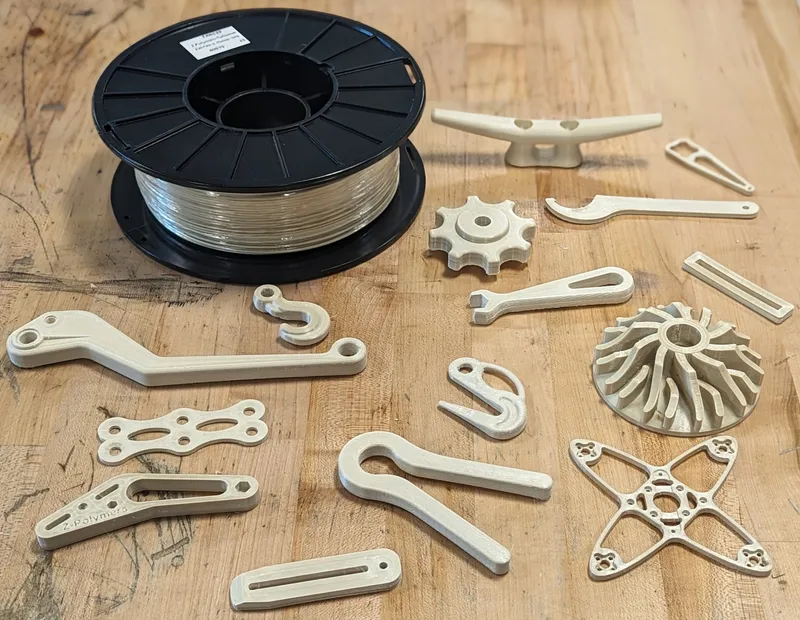
Z Polymer’s Tullomer has been designed as a filament for desktop machines, to be used in place of PEI and PAEK materials. The crystalline polymer has a temperature resistance of over 200 °C, is PFAS-free, has a V-0 flame rating, and offers excellent chemical resistance to a wide range of chemicals. It’s a clear PVDF replacement for those trying to eliminate PFAS from their factories or companies. It prints at around 325 °C and has been used on a wide array of desktop machines. Years ago, this kind of material would have been introduced together with an industrial firm, but now the path to revenue seems surer on desktop machines. At $275 for a 500-gram spool, it’s very expensive indeed and a quarter the price of many of the systems now printing it.
Tectonic 3D
The company Tectonic 3D has a lineup of filaments, all made for high-performance applications. The firm’s KRATIR PP-CF is being used to manufacture drone bodies that are one single line of filament thick. The firm also has EN45545-2 & FAR-approved PPO for rail use and a PA6 for under-the-hood automotive use. A foaming PA11 has been developed for low-density use in drones. By custom-developing materials for particular uses, Tectonic is enabling more manufacturing cases for military and industrial firms.
Colorfabb
Colorfabb has been the most innovative company in the 3D printing materials space for many years now. Its AllPHA filaments are the first truly sustainable 3D printing filaments. With a bio-based and biodegradable material that has a heat deflection temperature of around 120°C, PHA really should be our standard go-to material. The company will also make its filaments in any color you want.
But it also has LW-PLA-HT, a higher-temperature foaming PLA variant for lightweight applications. But, its most amazing material may be Varioshore TPU — an elastomer where you can alter the shore hardness locally by altering your nozzle temperature. Hard and soft regions of parts can be printed in a single print run using a single nozzle, enabling the production of low-cost yet high-performance insoles, mildoles, and shoe components. This functionality is only available with a desktop printer.
Zetamix
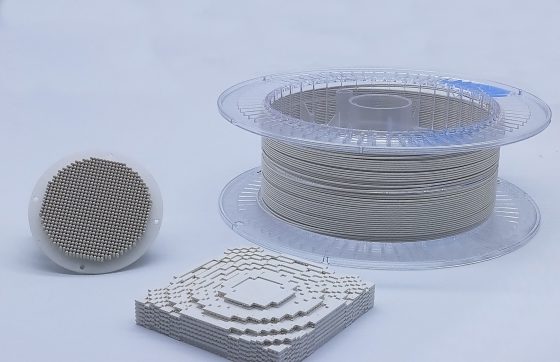
Nanoe’s Zetamix line lets you use bound filament and an oven to make metal and ceramic parts. White & black zirconia, alumninia, silicon carbide, 316L stainless steel, H13 steel, 17-4PH & Porcelain are all possible. Silicon carbide and H13 will already enable many 3D printing applications. Of course, the parts are cruder-looking than alternatives made with SLA or binder jet. But the low cost and low startup cost are real enablers. Its Ɛ filament does not need to be sintered or debound and can be printed on desktop machines. That low-loss, high-permeability material has been developed specifically for RF applications and is used to make antennas and radar components. Satellite antenna and RF devices are being made with these filaments worldwide. Cheaper and faster to make, these devices are also more compact than conventionally made alternatives.
Final Thoughts
Desktop 3D printers are being sold in their millions. Their capabilities are advancing rapidly. Reliable, quick, and low-cost, these machines are being used to make industrial parts and serve tens of thousands of businesses. With new materials available across many systems, materials companies can see real returns and growth as desktop 3D printing becomes more attractive to more businesses. Materials are lower cost in the desktop market, and there is less vendor lock-in. This is attracting more materials firms making high-performance materials suited to desktop 3D printers. We’re now seeing parts made from foaming TPU and RF materials that you couldn’t make on industrial machines. Further innovation could make desktop machines even more attractive. With millions more desktop machines being sold each year, these will soon become a mortal threat to the rest of the industry.
Subscribe to Our Email Newsletter
Stay up-to-date on all the latest news from the 3D printing industry and receive information and offers from third party vendors.
Print Services
Upload your 3D Models and get them printed quickly and efficiently.











You May Also Like
AMS 2026 in Photos: Snow, Songs, and Serious Conversations
AMS 2026 may have been altered by flight delays and snow-covered streets, but once you made it, the energy felt anything but frozen. This year’s Additive Manufacturing Strategies, which wrapped...
AM I Navigator and Leading Minds Launch AM Alliance at AMS 2026
At Additive Manufacturing Strategies (AMS) 2026, which just wrapped up in New York City yesterday, AM I Navigator and the Leading Minds consortium announced a new alliance aimed at accelerating...
3D Printing Financials: Xometry Reports Record 2025 Results and CEO Transition
Xometry (Nasdaq: XMTR) just delivered a milestone quarter and also announced a major leadership change. The company posted record results and made it clear it feels confident about the future....
The Great AM Reset: Why Applications Will Decide Who Survives
For decades, the AM industry has been powered by an exciting narrative of endless growth and disruptive potential. We celebrated every new technology, every injection of capital, and every bold...