AIM3D Opens Voxelfill to Everyone


German medium-format pellet extrusion company AIM3D is creating its own slicing software, SlicEx, for its systems. But, through Create it REAL, you can now use AIM3D’s Voxelfill process on standard material extrusion printers. The company wants to go further and, later on, will let desktop 3D printers also run Voxelfill. The feature will be available through the REALvision-Pro Slicer with the Voxelfill product. Pricing is indeed affordable, coming in at €4.38 per month. The company is also offering the Strong Print capability. Outlined in a recent paper, Strong Print lets users make more isotropic parts through material extrusion, boosting tensile strength for parts. In one PETG test, “anisotropy was significantly reduced from 56.71% to 13.47%.”
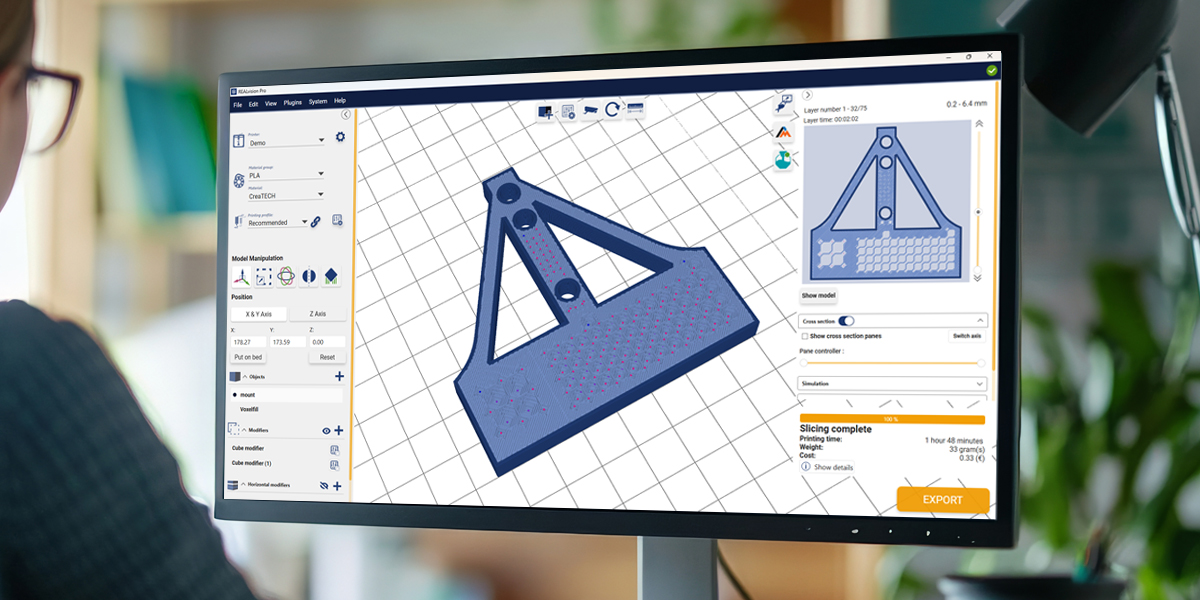
REALvision Pro slicer interface featuring AIM3D’s Voxelfill plug-in. Image courtesy of AIM3D.
AIM3D’s Voxelfill volumetrically fills chambers rather than just building up parts layer by layer. This far faster approach is now being extended to work with different infill patterns and materials. It’s, in fact, a much more logical way to make parts quickly. If this approach can be extended, we may see people trying to add to it with different hardware configurations and materials. This could potentially let people design very different properties than they have been doing so far. Diamond-shaped ABS chambers, partially filled with printed TPU and liquid latex, for example, could provide a much broader palette of materials and ways to organize them. I don’t yet know how many people will pay for a monthly slicing fee, but I know that for some, this would be super valuable.
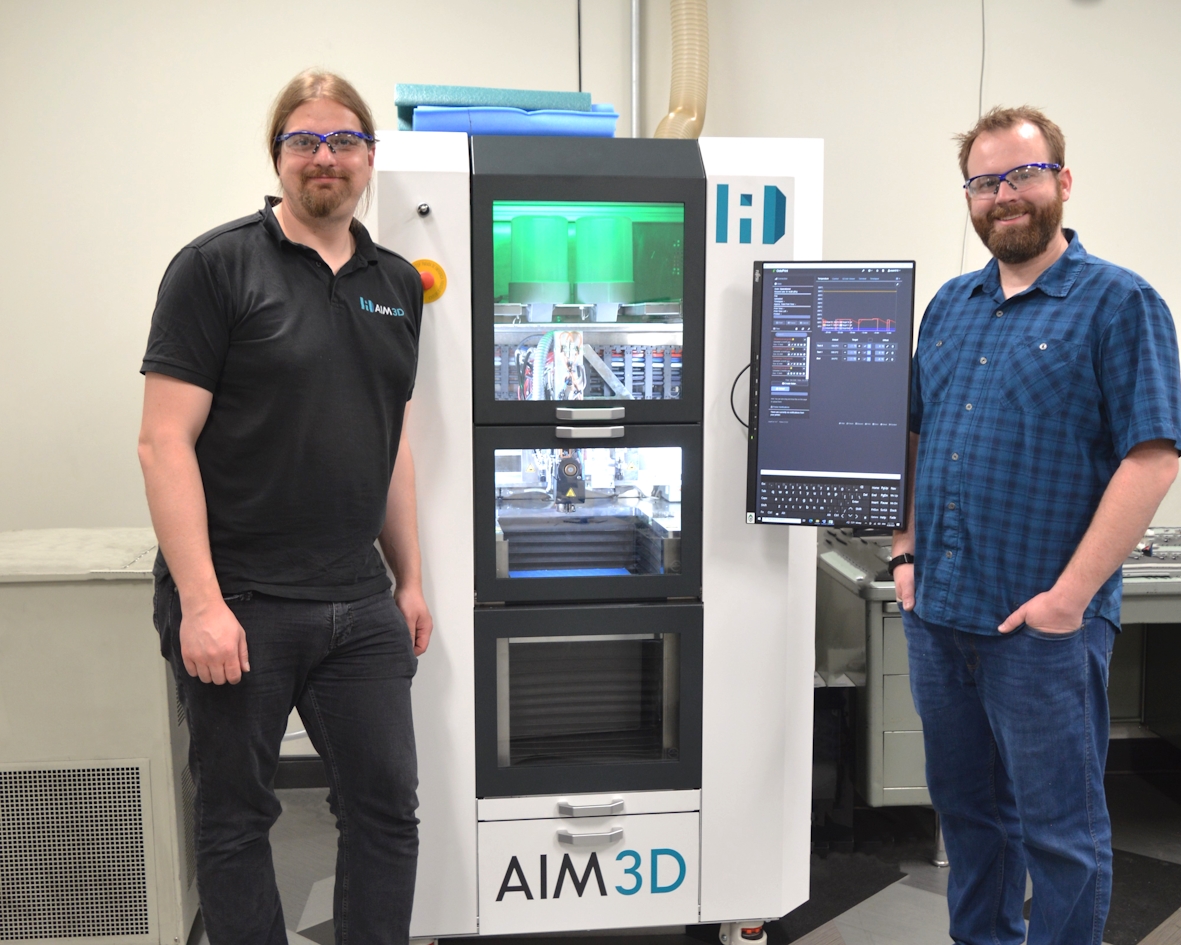
At the Fraunhofer USA Inc. Center, Midwest. Image courtesy of AIM3D.
Upgrades
Additionally, the firm has announced some machine improvements to its own systems and those of its partners.
AIM3D CTO Clemens Lieberwirth stated,
“The High Performance Upgrade comprises two optimization modules: Firstly, Input Shaping, which acts as a filter for the acceleration of the axes, increasing component quality at high travel speeds, and secondly, Extruder Pressure Control; for improved dosing and higher component quality.”
Performance upgrades include vibration reduction and better extruder control. The better extruder control, especially, should lead to more sharply defined edges, improving part quality. On top of this, the company is expanding into the US.
CEO Dr. Vincent Morrison noted,
“Of course, the size and innovative strength of the US industry in the automotive, aerospace, defense, and energy sectors promises high growth potential for the 3D pellet printing strategy.”
So far, the company has sold three systems in the US. One went to the Fraunhofer USA Center Midwest, another to Cal Poly, and a third to an automobile company. AIM3D seems to be making a lot of very sensible decisions here. Rather than keep Voxelfill all to itself, it will let others innovate around the technology. Voxelfill has huge potential in manufacturing and in creating strong parts with completely new properties. Coupled with the low cost of pellet printing, it could really do well as a software strategy in and of itself. The right people will have to build the right businesses and technologies on top of it. But if they do, then AIM3D has found a new source of revenue beyond machine sales.
The other moves show an increase in capability where it matters. Better, smoother parts with better surfaces will really help the firm in tooling and perhaps even molds. Larger format printers often have to put parts in milling machines for days to smooth them out. Meanwhile, other systems are CNC in line or on the same machine, which makes things expensive and complex. Small printers are, of course, cheap, while other systems, such as Juggerbot, work well enough. Through improving surfaces, AIM3D is stealing a march on competitors with much larger machines where it matters. Reduced post-processing may lead to people choosing their system over a much bigger one. Perhaps sticking big parts together would even be quicker and easier than waiting for longer print jobs to finish. Rougher surfaces are also a reason to opt for a filament printer, so the company is defining itself against these here as well. Smoother surfaces and better definition of corners will let the company make tools and jigs much faster as well.
I really think that Voxelfill is a super innovative technology that can move our industry into new applications. Through building up geometries in entirely new ways, we can think completely differently about structures and how they perform. I’m super happy that AIM3D seems to be doing well and is moving ahead in spreading its technology globally.
Subscribe to Our Email Newsletter
Stay up-to-date on all the latest news from the 3D printing industry and receive information and offers from third party vendors.
Print Services
Upload your 3D Models and get them printed quickly and efficiently.













You May Also Like
3D Printing News Briefs, October 21, 2026: Digital Twins, AI CAD Service, AR Smart Glasses, & More
In today’s 3D Printing News Briefs, America Makes announced the winners of its MIAMI Project Call, and AM Europe released a new report. Artec 3D launched its new Artec Twins...
3D Printing News Briefs: October 17, 2026: Affordable Housing, Bone Implants, Rubber Gloves, & More
In this weekend’s 3D Printing News Briefs, we’re starting off with quality assurance in metal additive manufacturing (AM), a new 3D printer, and 3D printed housing. We’ll finish up with...
3D Printing News Briefs, October 14, 2026: Bolus, Aerospace Tooling, Water Filter, & More
In today’s 3D Printing News Briefs, we’re starting with medical news, as Myrava has received FDA 510(k) clearance for its 3D printed bolus. Moving on to aerospace and metals, AML3D...
Can India’s AM Push Help Make it a Viable Supplement to China?
Diversifying manufacturing supply chains to locales outside of China has nothing to do with actually cultivating “substitutes” to the Chinese economy. The real stakes are these: China is an irreplaceable...