
NECO Adopts 3D Printing to Modernize Drone Manufacturing


As demand grows for more agile and cost-effective production methods, additive manufacturing is increasingly seen as a viable solution for end-use parts — not just prototyping. NECO, a contract manufacturer specializing in high-performance applications, is applying this shift to drone production by combining 3D printing with a streamlined digital workflow.
In partnership with HP Additive Manufacturing Solutions and Autodesk, the company has integrated HP Multi Jet Fusion (MJF) technology and Fusion 360 software into its operations. The result is a faster, more flexible approach to manufacturing that supports both internal development and customer-driven design.

HP Jet Fusion 5600 Series 3D printing solution, featuring printer, processing station, and build unit. Image courtesy of HP.
Moving Past the Limits of Injection Molding
Before turning to additive manufacturing, NECO faced familiar challenges associated with injection molding. High tooling costs limited the number of design iterations, and traditional processes made it difficult to produce the types of geometries required for advanced applications. These constraints were especially noticeable in NECO’s work with UAVs.
By adopting HP’s MJF 3D printing platform, NECO was able to reduce upfront costs and eliminate tooling altogether. This shift also made it possible to produce more complex part geometries—such as internal lattice structures and integrated venting — that were previously cost-prohibitive or technically unfeasible with injection molding.
Digital Workflow Integration with Fusion 360
Alongside the move to MJF, NECO introduced Autodesk Fusion 360 into its design and build process. Unlike conventional CAD software that often requires managing separate files for assemblies and components, Fusion enables NECO to work on entire assemblies in a single environment. According to NECO president Rob Collier, the software was further customized with support from Autodesk to better align with the company’s specific workflow needs.
This integration has helped streamline product development and improve communication with customers. Clients can send NECO complete assembly files, providing insight into how parts fit together—information that’s valuable when preparing parts for additive manufacturing.
UAV Design and Performance Benefits
NECO’s work in drone development provides a clear example of the impact of its updated process. Drone fairings and structural parts are now printed with built-in lattice designs to support heat dissipation and improve strength-to-weight ratios. The ability to manufacture these features directly—without secondary tooling—has shortened development timelines and supported faster iteration.
The use of HP’s 3D High Reusability PA 12 and PA 11 materials ensures the printed parts meet the durability and consistency standards needed in aerospace and UAV applications. NECO reports that its MJF-printed parts have passed critical burn tests and are suitable for end-use, not just prototyping.
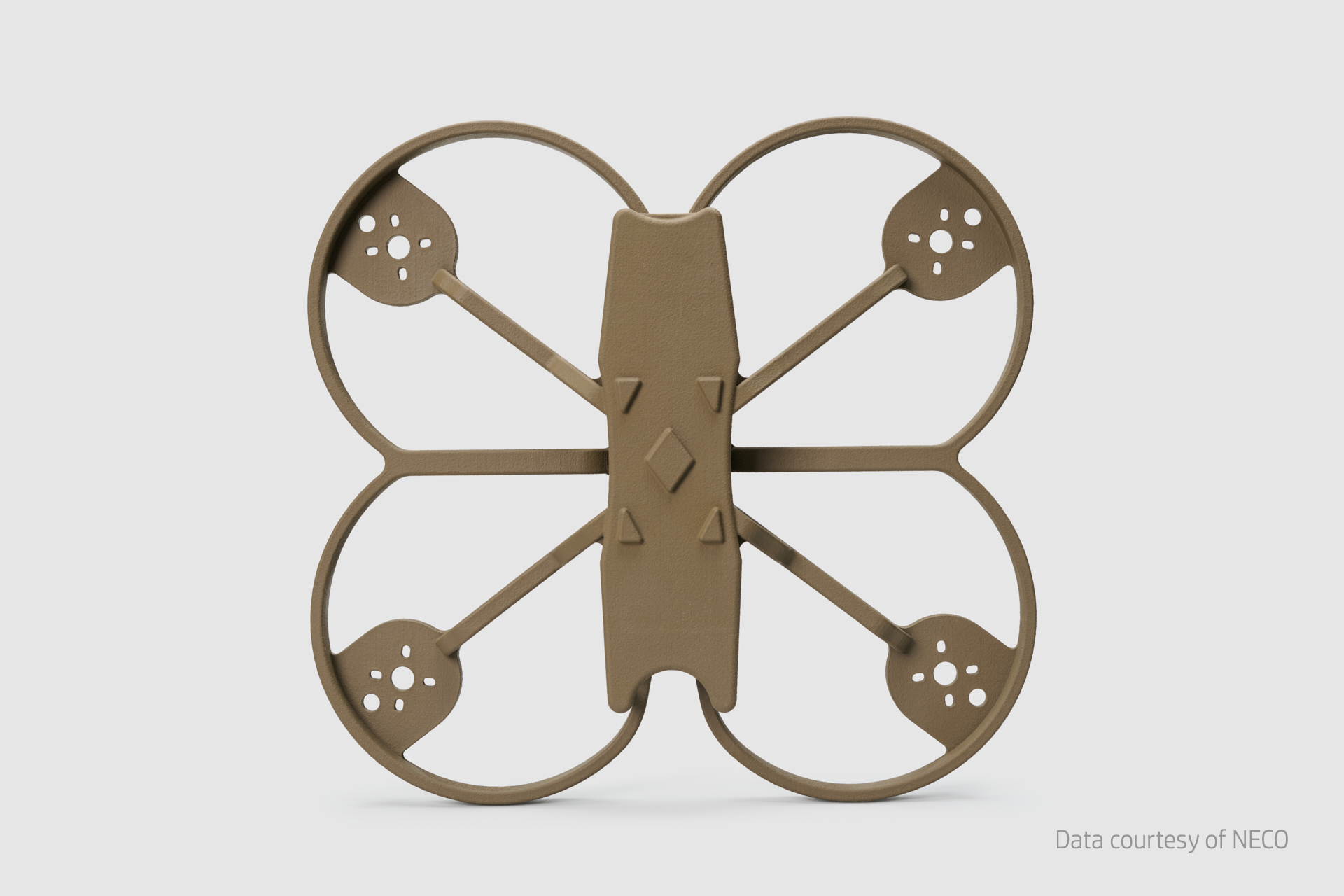
NECO’s 3D printed drone. Image courtesy of HP.
Scale and Quality at Volume
Since adopting additive manufacturing, NECO has produced over a million 3D printed parts, spanning both drone components and other industrial applications. The company’s ability to scale with consistent output has helped it serve a broader customer base — including startups seeking to bring products to market quickly, as well as established firms looking for agile manufacturing partners.
The flexibility of NECO’s workflow allows it to support two main approaches: reproducing customer-supplied parts and collaborating on new designs based on functional requirements. In both cases, the company uses its additive capabilities to reduce production bottlenecks and accelerate delivery.
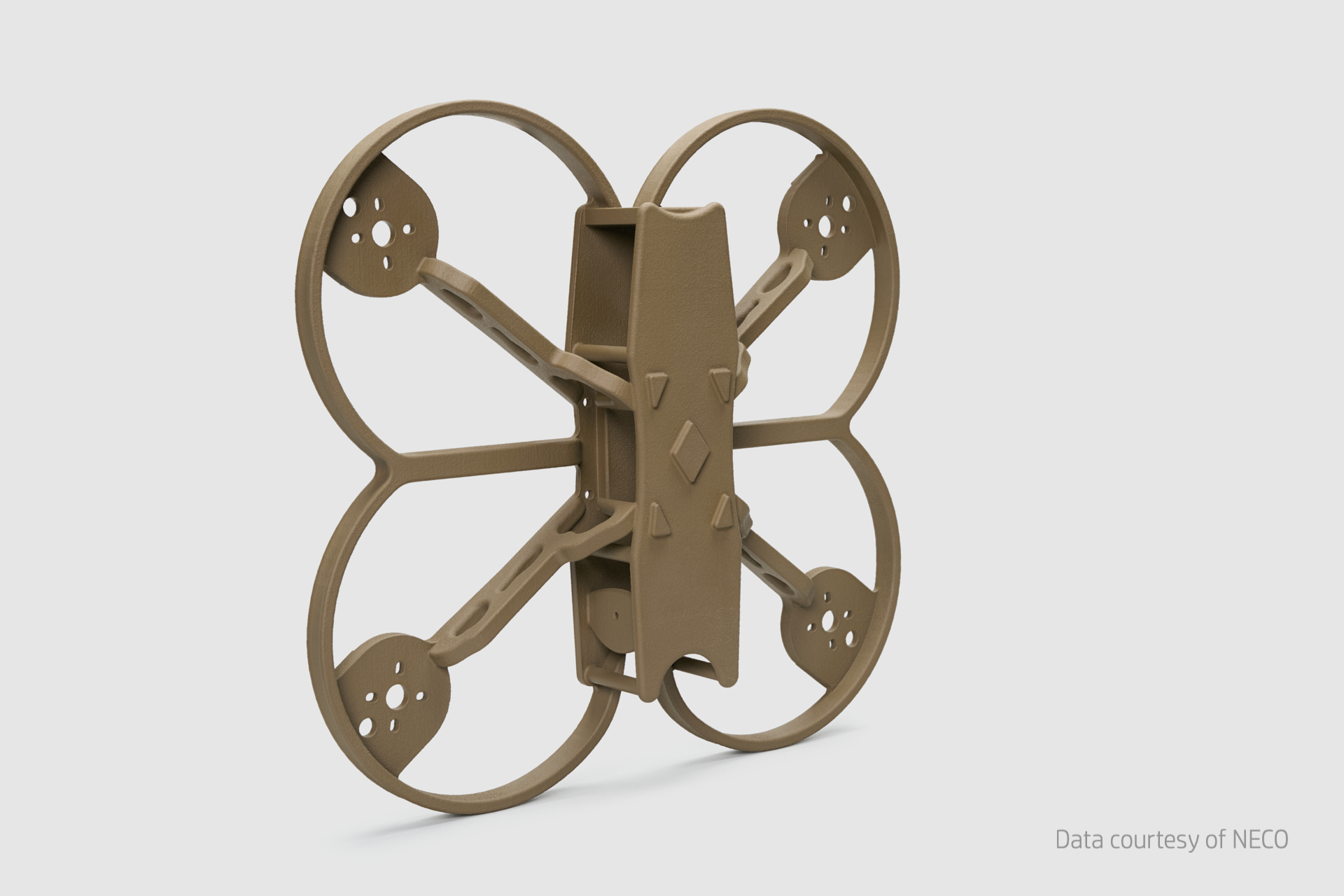
NECO’s 3D printed drone. Image courtesy of HP.
Evolving Role of Additive in Production
The collaboration between NECO, HP, and Autodesk reflects a broader trend in manufacturing: the shift from additive as a prototyping tool to a legitimate option for production-scale applications. For NECO, the integration of MJF and Fusion 360 has improved responsiveness, opened new design possibilities, and supported the production of high-performance drone parts on demand.
As drone systems become more complex and the need for rapid, flexible production increases, additive manufacturing is expected to play an even larger role. NECO’s model—focused on consistency, customization, and design freedom — highlights how manufacturers can modernize their operations without sacrificing quality.
Subscribe to Our Email Newsletter
Stay up-to-date on all the latest news from the 3D printing industry and receive information and offers from third party vendors.
Print Services
Upload your 3D Models and get them printed quickly and efficiently.













You May Also Like
Kickstarter is Testing the Next Wave of Desktop 3D Printing
3D printers are raising serious money again…on Kickstarter, that is. Over the last few months, a new group of 3D printer campaigns has attracted millions of dollars and thousands of...
Stratasys vs. Bambu Lab: What’s Really Behind the $27.6M Patent Verdict?
Editor’s note: This is Part 1 of a two-part series by Xu Fanglei examining the technology and patent issues behind the Stratasys-Bambu Lab dispute. Part 1 looks at the U.S....
Bambu Lab and SUSAN FANG 3D Print for London Fashion Week
At London Fashion Week, some of the more unusual pieces on the runway came from 3D printers. Chinese fashion designer SUSAN FANG presented her Spring/Summer 2027 Air-Illusion collection at the...
Stratasys Wins $27.6M in Patent Case Against Bambu Lab; Bambu Challenges Verdict
Update, September 21, 2026: This article has been updated with a statement from Bambu Lab responding to the verdict, along with additional information about the company’s ongoing patent challenges against...
























































