Mantle Boosts Feature Strength and Print Resolution for Tooling Applications

San Francisco-based Mantle reports an improvement in feature size and part strength. This should let its customers reduce EDM (electrical discharge machining) time, make more molds possible, and reduce sintering failures. Mantle’s machining-assisted paste binder jet process allows the firm to use harder materials with better finishes through binder jet. We’re fans of the firm that has specialized in the tooling market, using tool steels and catering to mold makers very specifically. By adopting a more focused go-to-market strategy, the company has specialized, learned deeply about its prospects, and shown growth through that approach.
Now the company can print feature sizes as thin as 0.2mm. The strength of these features has improved. This is specifically important in binder jetting, where many parts and features often collapse or break when a part is in its fragile green state. The improvement applies to ribs, pins, and edges. The improvements are not a new machine, but rather a software update. The company’s Automated Toolmaking System software has received an update, which it calls Top Definition.
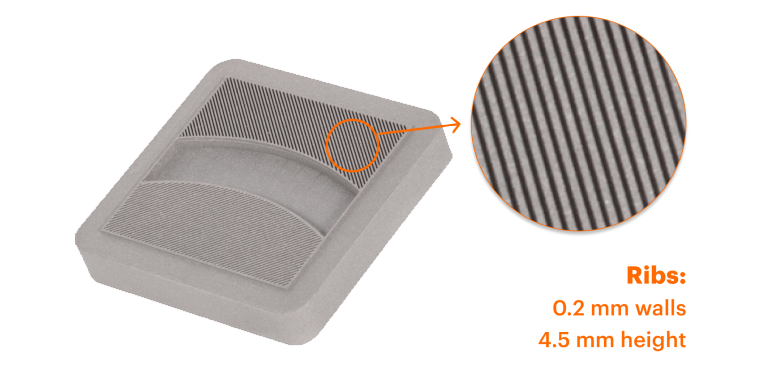
Ribs just 0.2 mm wide and 4.5 mm tall demonstrate Mantle’s ability to print ultra-fine features.
Top Definition changes the way the company prints,
“Instead of processing each layer individually, the new method prints a solid block of material at the top portion of the tool. This solid ‘top block’ is then machined from above in a top-down process, which encases and provides structural support for details much smaller than Mantle’s standard layer-by-layer print and machining can support.”
It’s great that Mantle’s architecture can support this and that the firm can offer software improvements like this to its installed base. At the same time, the company has disclosed that its bookings have doubled for the first half of the year when compared to a year earlier. One client, Conesys, has used multiple Mantle systems in making electrical connectors. Electrical connectors are a fast-growing segment in Additive. High-end connectors have a lot of SKUs, lead time challenges, and often want to make connectors close to customers. Generally, the firm believes its fortunes are being buoyed by reshoring and a renewed interest in manufacturing in the U.S., specifically for injection molding companies and mold makers.
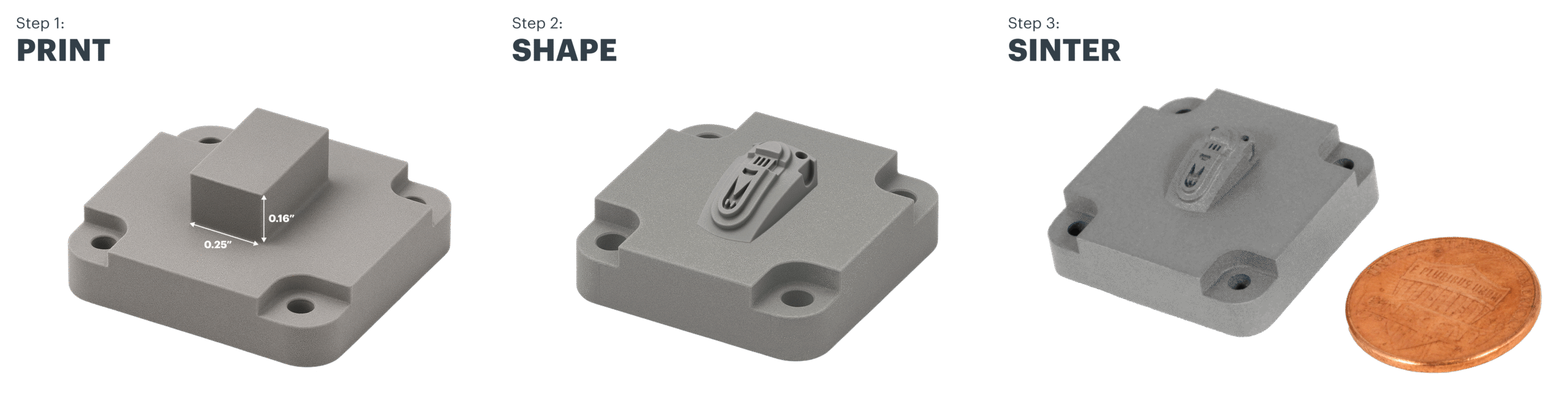
Mantle’s three-step process produces high-precision metal parts with minimal post-processing.
Conesys Chief Information Officer, Mark Edwards, stated,
“For more than 10 years, I’ve been searching for a 3D printing technology robust enough for production molds. After validating Mantle’s technology and experiencing its unmatched precision, we’ve integrated multiple Mantle printers into our operations. We’re now reducing the time and cost associated with producing new tooling, allowing us to respond to our customers more quickly and bring new products to market. The adoption of Mantle’s new Top Definition capabilities will further enhance precision, driving even greater efficiency and throughput within Conesys’s toolroom.”

Deep, 1.5 mm sharp features with 0.003″ radii highlight Mantle’s tooling-grade precision.
One interesting thing is that now Mantle primarily refers to itself as an “automated toolmaking system specifically for injection mold manufacturing,” reducing references to 3D printing in its press releases and copy when compared to before.
For the first decades, the 3D printing market focused on selling magic boxes. As long as you had the wherewithal and foresight to purchase a magic box, train your cadre of magicians, and learned to speak elvish, you too could harness the future of all the things. People who indeed needed magic persisted and, in some cases, were able to make things that were impossible to make by any other means. Many others struggled to get the incantations right until they gave up.
Now, on top of those boxes, we are building an application layer. We’re standing on the shoulders of those magicians and making products possible with Additive. No longer will we focus so much on selling you a Cisco server instead buy dogfood from Pets.com and watch movies online. The box buyers and magicians will now function as the CDNs (Content Delivery Network) and AWSs (Amazon Web Services) of the world. The future of 3D printing, therefore, will be uncommonly bright, easy to implement, and available in bite-sized portions. That will be good for us and application-specific trailblazers such as Mantle. For now, we will have to endure a world that no longer believes in our magic and combat this with results.
Images courtesy of Mantle
Subscribe to Our Email Newsletter
Stay up-to-date on all the latest news from the 3D printing industry and receive information and offers from third party vendors.
Print Services
Upload your 3D Models and get them printed quickly and efficiently.













You May Also Like
Stratasys Wins $27.6M in Patent Case Against Bambu Lab; Bambu Challenges Verdict
Update, September 21, 2026: This article has been updated with a statement from Bambu Lab responding to the verdict, along with additional information about the company’s ongoing patent challenges against...
3D Printing News Briefs, September 19, 2026: Process Validation, Orthotics, Energy Storage, & More
In this weekend’s 3D Printing News Briefs, Eplus3D and Young-Will Aerospace are working on LPBF process validation for a nickel-copper alloy. Meltio released a U.S.-made version of its Meltio Robot...
Printing Money Episode 42: Q2 2026 Public Markets 3D Printing Earnings Analysis with Troy Jensen, Cantor
Welcome to Printing Money Episode 42. Troy Jensen (Managing Director, Cantor) returns, joining Danny Piper (Managing Partner, NewCap) to review Q2 2026 publicly traded 3DP/AM company earnings reports. Troy’s quarterly...
3D Printing News Briefs, September 12, 2026: Rebranding, Cybersecurity, Project Call, & More
We’ve got a lot of business news from ATLIX to start off this weekend’s 3D Printing News Briefs, with a new identify for its additive manufacturing (AM) portfolio and some...