Boston’s Additive Edge: Inside RLP’s Gravity Free Revolution

Nestled in the historic neighborhood of Charlestown, one of Boston’s oldest waterfront enclaves, Rapid Liquid Print (RLP) is doing something extraordinary: rewriting the rules of 3D printing — without gravity.
This Boston-based startup has kept a low profile for years, building out its team, perfecting its process, and printing parts for industries ranging from healthcare to fashion. But with the unveiling of its first commercial printer, called Levity™, at RAPID + TCT this spring, RLP is stepping into the spotlight.
And not just the industrial one. Earlier this year, RLP’s work debuted on the Paris runway thanks to a collaboration with the fashion brand Coperni, which tapped the company to produce a series of glossy, lattice-structured silicone handbags. Going from the lab to the runway proved that RLP’s platform is production-ready.
“I never thought we’d be printing a handbag,” Schendy Kernizan, co-founder and CEO of RLP, explained during a tour of the company’s headquarters in June 2025. “But that’s what’s exciting about this work, you get these surprising requests that end up pushing the boundaries of what we can do.”
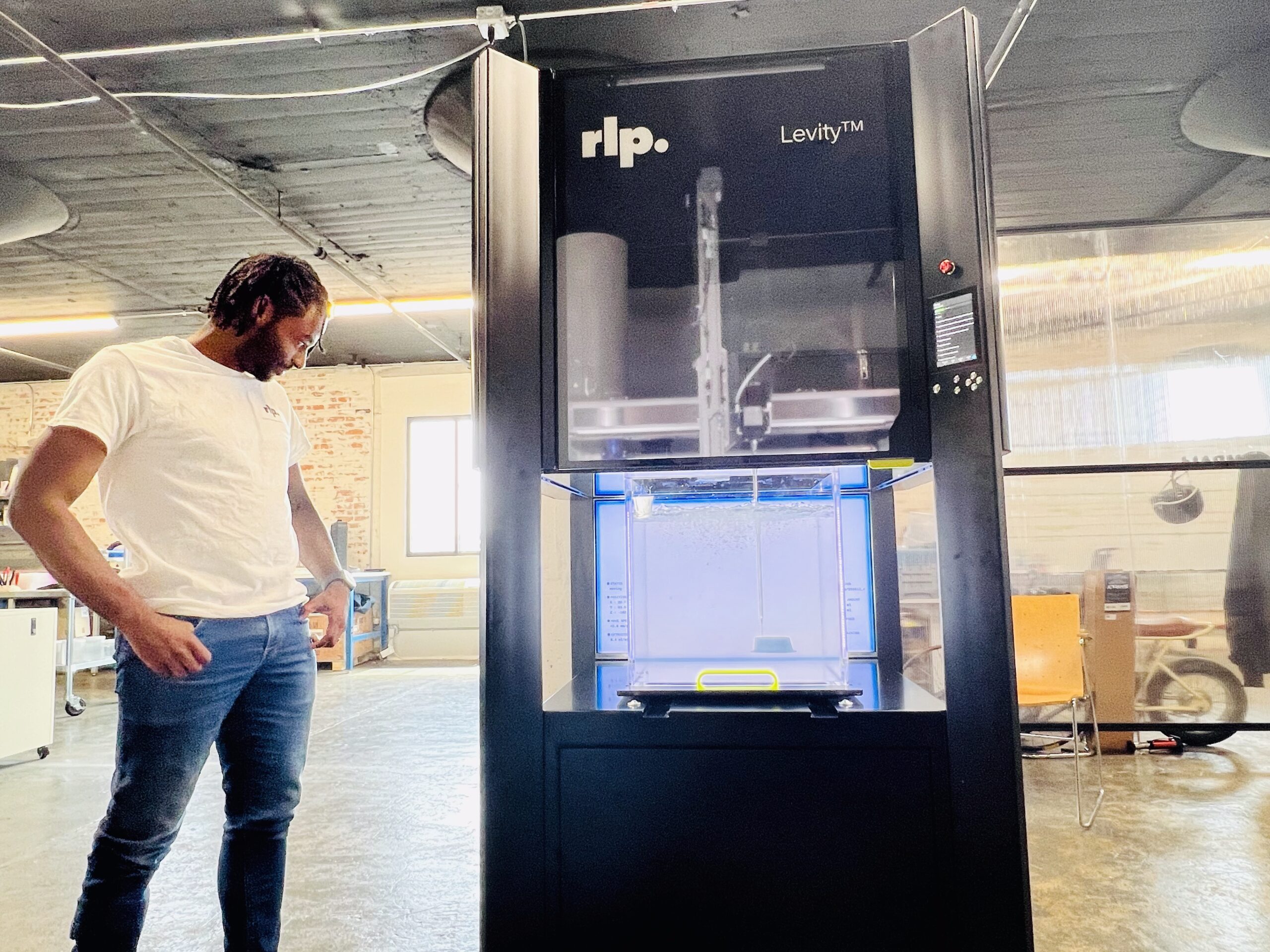
RLP Co-founder and CEO Schendy Kernizan next to Levity™.
From MIT Lab to Commercial Launch
RLP’s origins trace back to the MIT Self-Assembly Lab, where co-founders Kernizan and CTO Bjorn Sparrman were exploring new ways to manufacture soft, functional parts. Their big breakthrough was a process now known as Rapid Liquid Printing, which involves extruding materials inside a gel suspension. This medium holds the printed structure in place without the need for supports or layer-by-layer constraints, “effectively neutralizing gravity,” as the founders say.
“When you draw inside of a gel,” Kernizan said, “gravity doesn’t limit how you design, and it doesn’t limit how fast you can make that part. In fact, RLP’s proprietary process enables fast, large-scale, gravity free printing of industrial-grade silicone parts. That means no post-processing aside from a rinse and dry, no curing ovens, no sanding, no chemical waste.”
And thanks to the company’s decision to work with established industrial materials (like platinum-cure RTV silicones), the printed parts already come with known mechanical properties and safety profiles.
“We’re not changing the chemistry, we’re just changing how it flows. That means customers can trust the part they get is production-ready.”
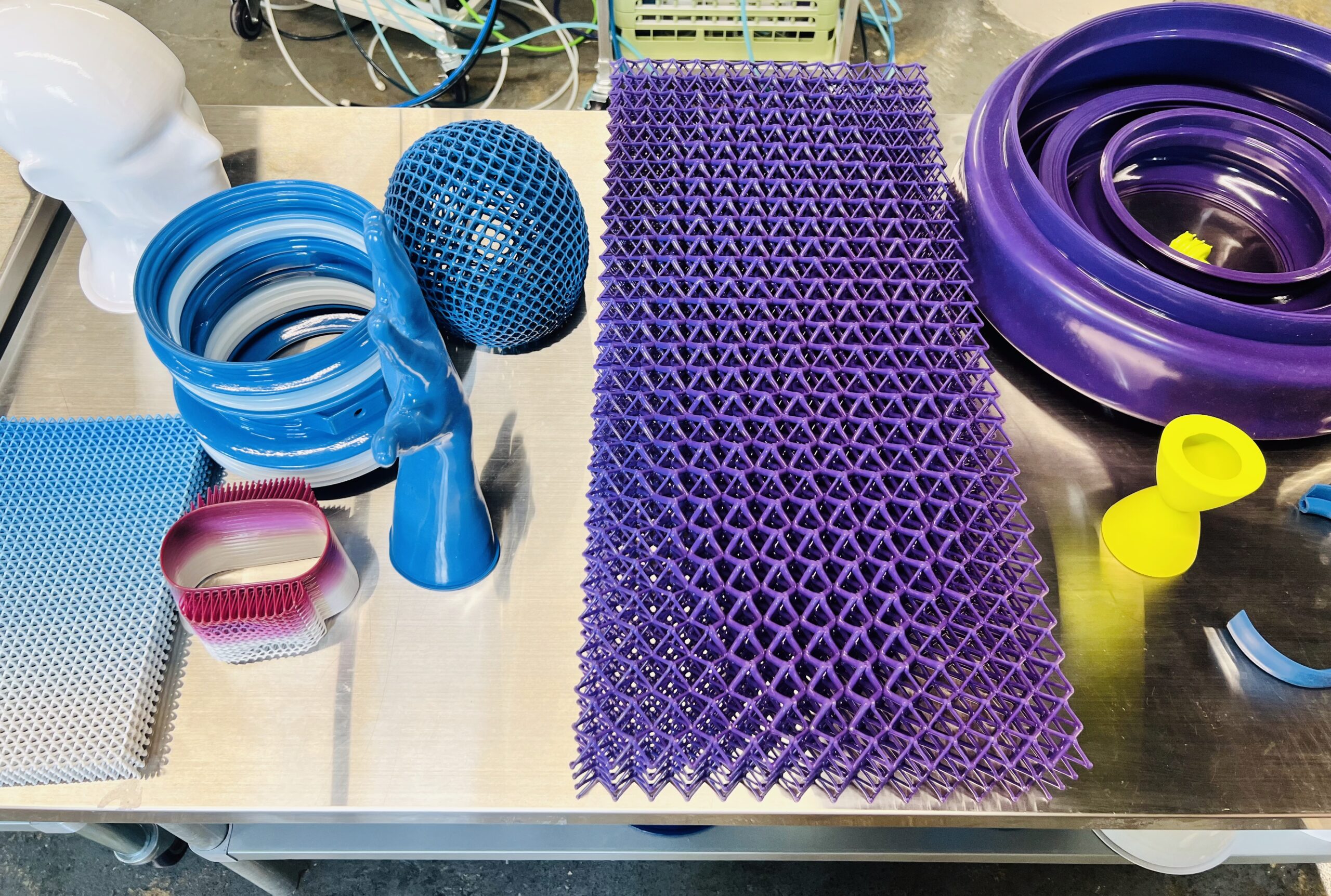
3D printed parts at RLP’s headquarters in Boston.
Introducing Levity™
The company’s new machine, Levity™, is RLP’s official entry into the commercial hardware market. With a 500 x 500 x 500 mm build volume, whisper-quiet operation, and a built-in lighting and monitoring system, Levity™ is designed for engineers and designers who want speed, precision, and ease of use without compromising on material performance.
“We’re opening shipments in 2026, but we already have early interest,” Kernizan said. “Some customers may even get even earlier access as early adopters.”
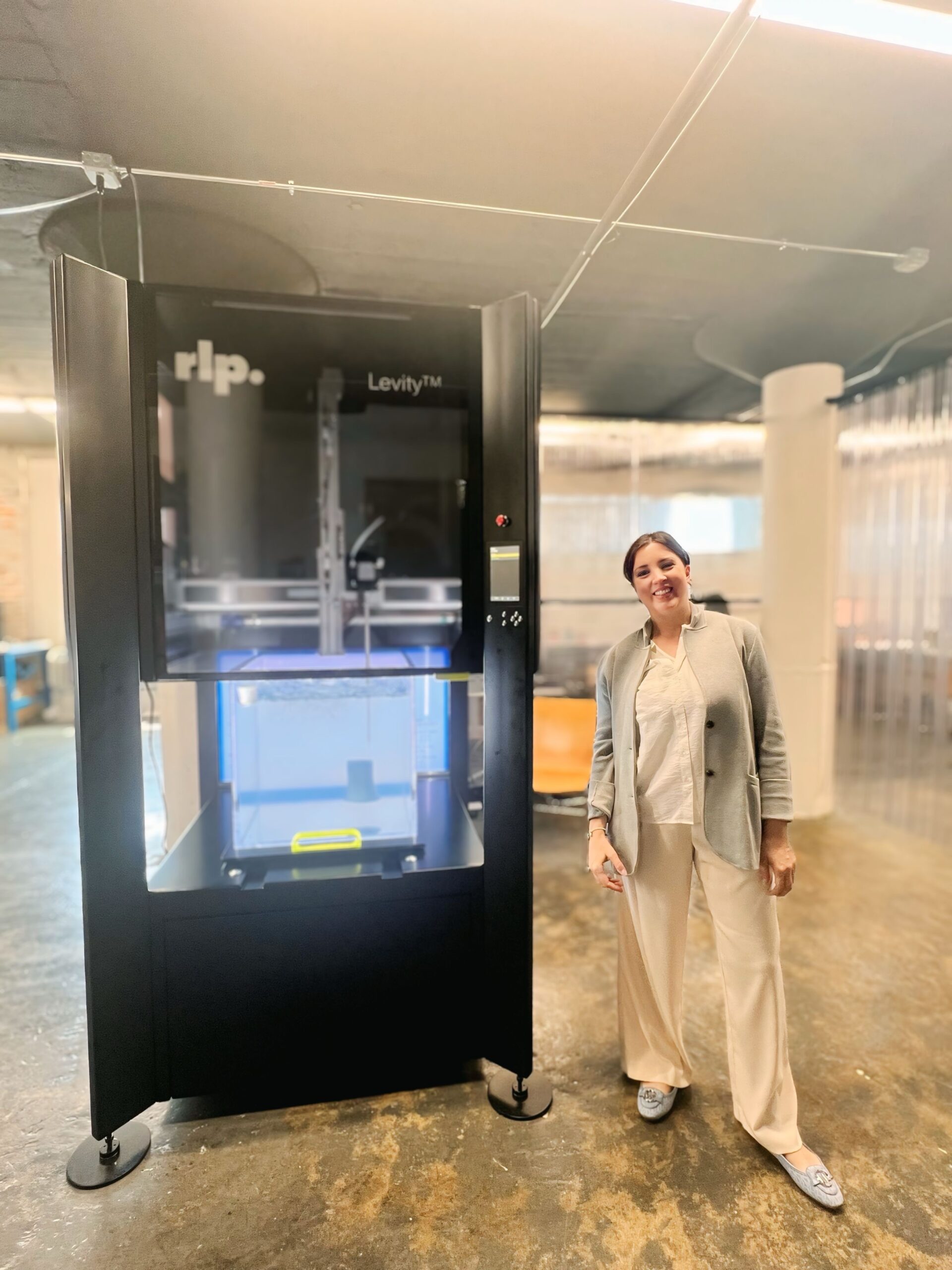
Vanesa Listek next to RLP’s Levity™.
RLP has spent the past few years operating as a service bureau, printing prosthetic liners, gaskets, and design prototypes for clients across the healthcare, footwear, automotive, and aerospace industries. This hands-on service model has given them the insights they need to evolve Levity™ into a machine built for both prototyping and production at scale.
“The goal has always been to bridge that gap,” said Kernizan. “A lot of people prototype with one material, then outsource for production. We wanted to offer a platform where you don’t have to make that switch.”
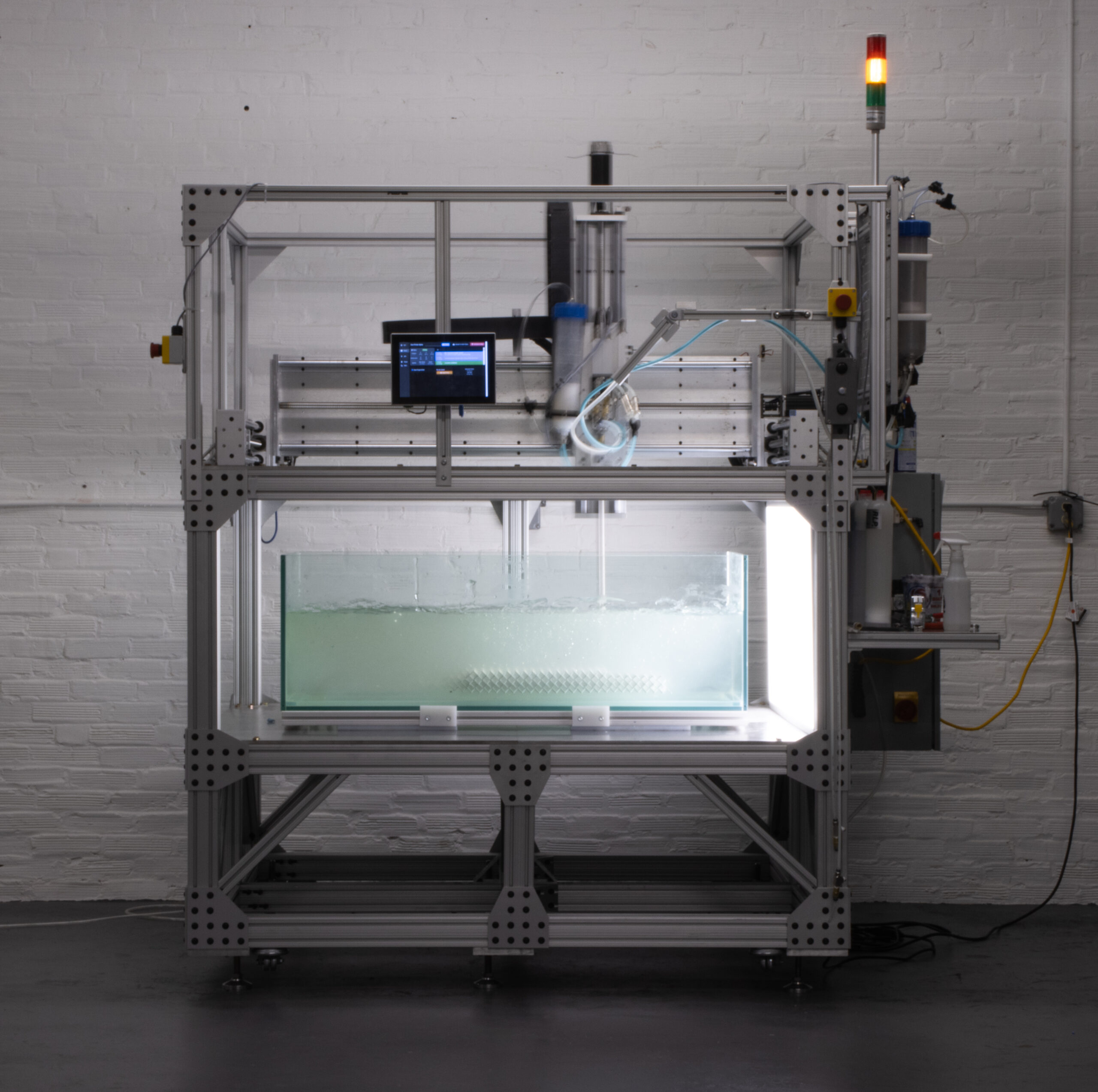
RLP’s prototype printer. Image courtesy of RLP.
The Coperni Crossover
Still, no single project has generated as much buzz for RLP as the collaboration with Coperni. The French fashion house, known for its tech-forward design, approached the RLP team about producing a limited line of handbags for their show. Although the bags were not designed with RLP’s process in mind, the team adapted the files and printed them in-house in Boston.
“It turned out to be a great opportunity — not just for visibility, but to actually produce something that people wanted,” said Kernizan. “We ended up printing parts for Coperni to sell, and now we’re talking about what else we can create together.”
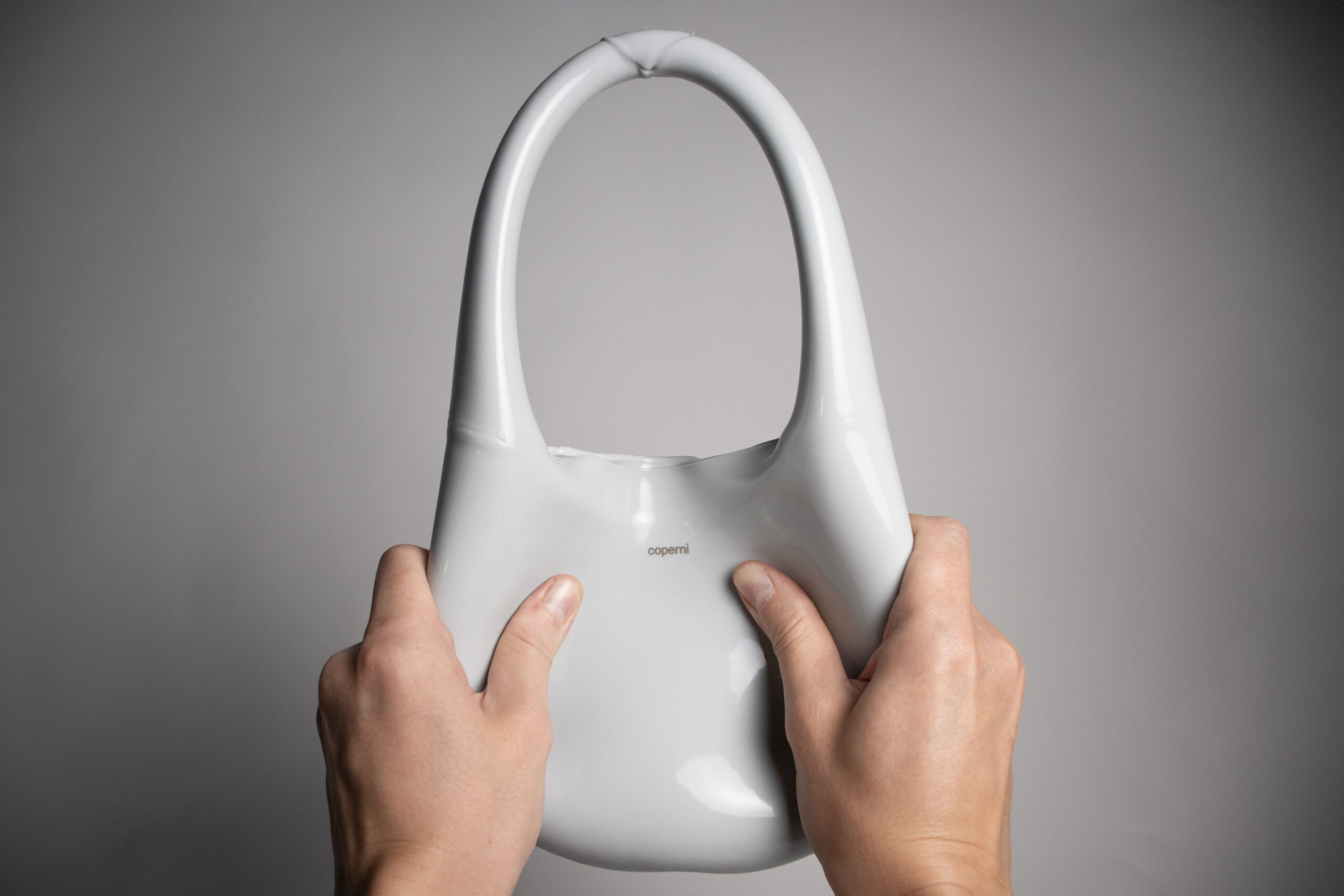
RLP’s Coperni bag. Image courtesy of RLP.
The collaboration resulted in two main commercial versions of the handbags: the sleek black Liquid Print Swipe Bag and an electric blue, limited-edition Disney × Coperni Liquid Print Swipe Bag, alongside a grey prototype that I spotted during my visit. The design draws inspiration from the iPhone’s “swipe to unlock” icon, giving the bag a clean, modern, futuristic, tech-inspired shape. Both colors are sold at $620.
Holding the bag in person was a great moment. It felt much cooler than any other 3D printed bag I’ve seen; it’s super smooth, tough, and innovative. I honestly didn’t expect it to feel that solid.
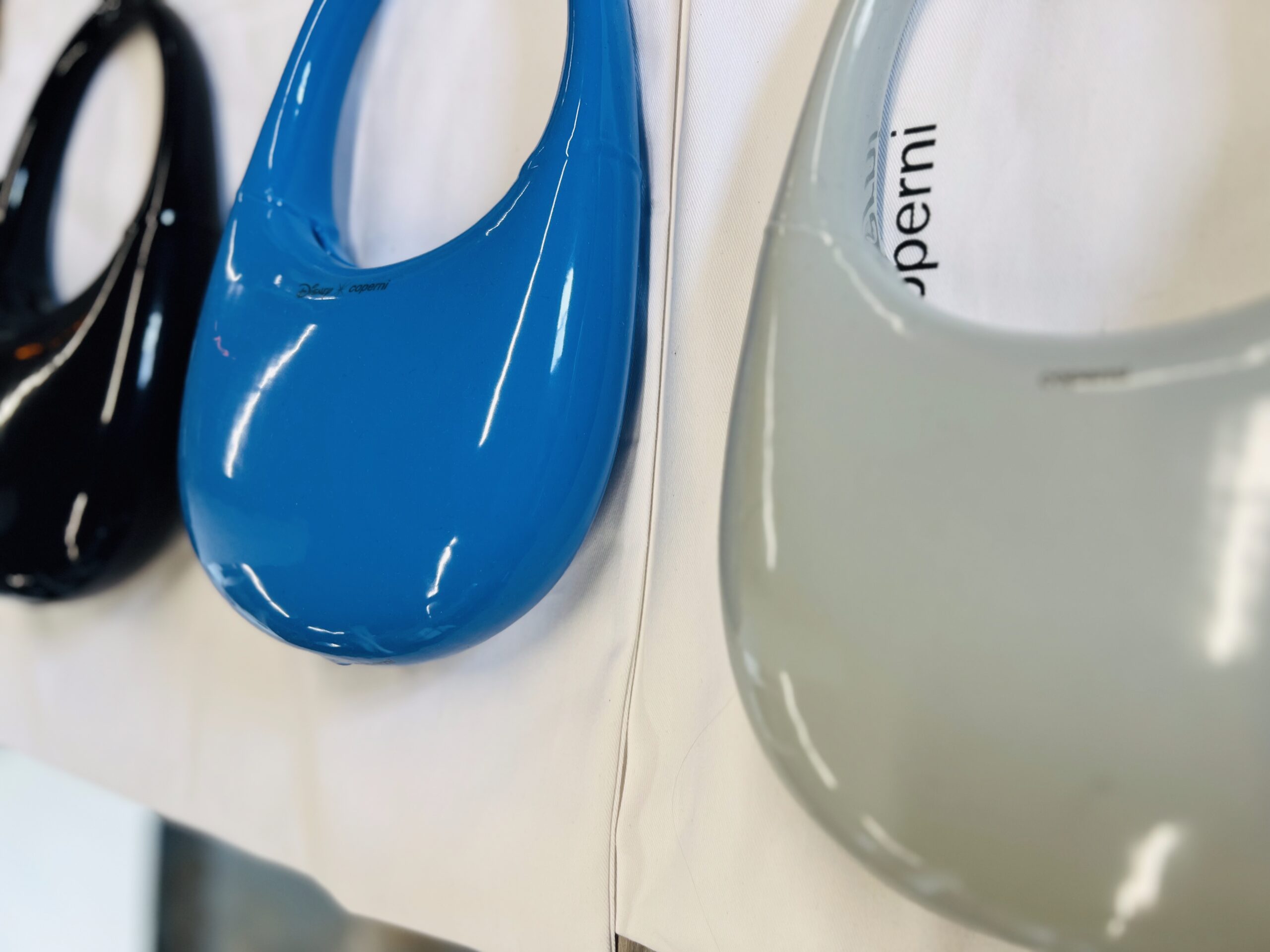
RLP’s Coperni bags on display at RLP headquarters in Boston.
What makes the bag stand out isn’t just the shape, it’s the material. RLP’s silicone print looks glossy and sleek.
After printing, the parts were laser-etched with logos, cleaned, and shipped overseas. The bags debuted in a Disneyland Paris runway show in October 2024, where the blue version, dubbed the “Ariel” Swipe Bag, was a perfect match for the theme of the evening.
“Fashion wasn’t something we expected to break into, but it is now one of the many capabilities we have,” Kernizan said. “We’d love to co-develop a design in the future that’s actually optimized for our process.”
The Bigger Picture
At its core, RLP isn’t just selling a printer; it’s pitching a new platform for digital manufacturing. Kernizan pointed out that they don’t even like to use the term “3D printing” anymore, because it comes with outdated assumptions.
“When you say 3D printing, people think of layers, supports, post-processing,” he said. “But this is something else. It’s more like drawing in space. That’s much more than just semantics. The absence of gravity in the process means parts can be printed faster, cleaner, and more sustainably. There’s no wasted support material, no need for molds, and no tooling to store or discard. You print what you need — and nothing more. That’s the future.”
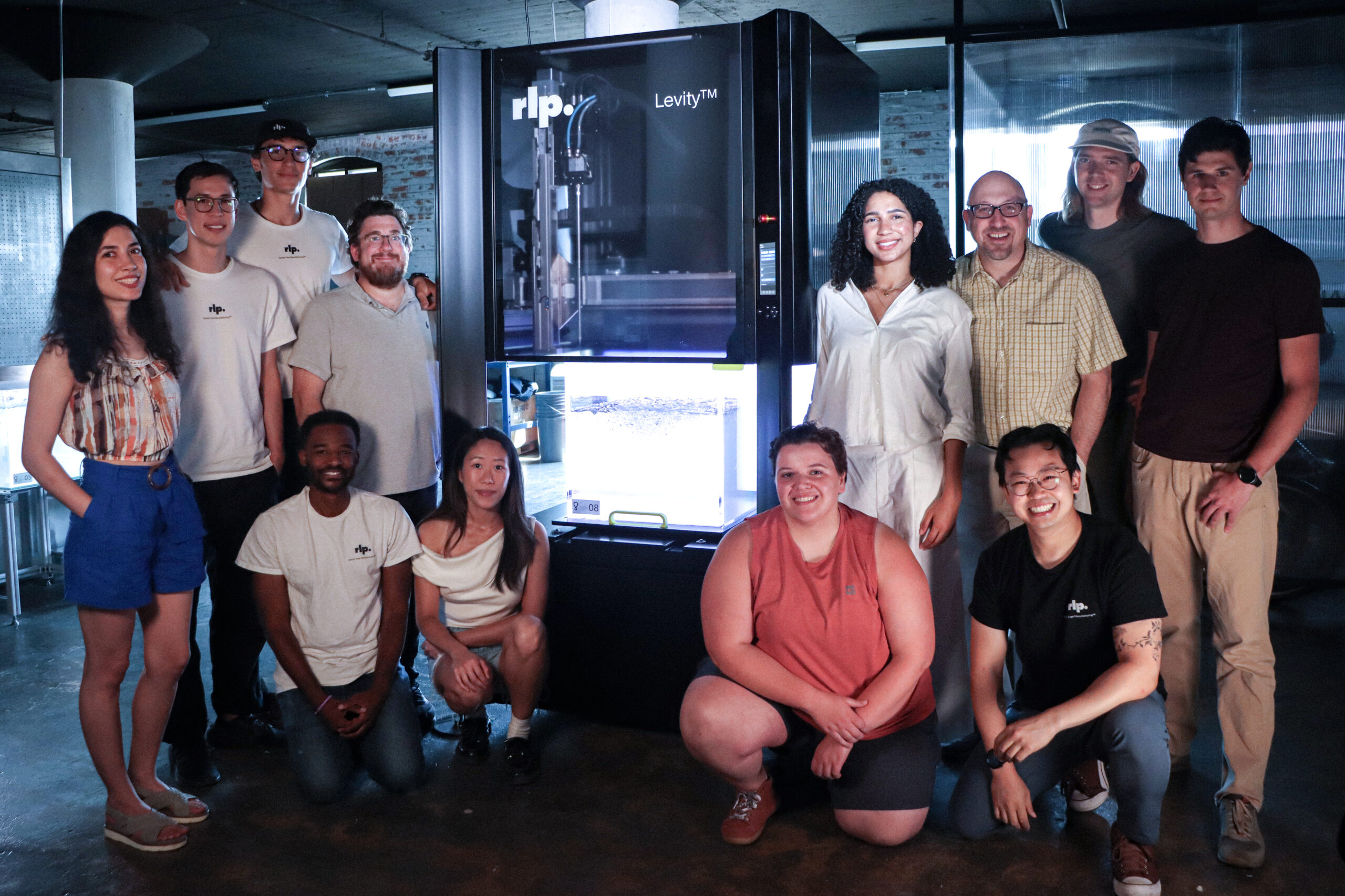
The RLP team. Image courtesy of RLP.
RLP’s ambitions go far beyond fashion. The team is currently exploring applications in other industries, including medical, industrial automation, high-performance sportswear, and transportation. At the same time, they’re expanding their IP portfolio, formulating new materials, and planning for Formnext 2025 in Frankfurt.
And while RLP’s story started with MIT, it’s now a venture all its own, one that is still relatively quiet, but undeniably powerful.
“People have followed us since the early days at MIT, but hadn’t seen the tech in person,” Kernizan concluded. “Some thought it wasn’t real. But now they’re seeing it, touching it. And they’re blown away.”
Images courtesy of 3DPrint.com unless otherwise noted
Subscribe to Our Email Newsletter
Stay up-to-date on all the latest news from the 3D printing industry and receive information and offers from third party vendors.
Print Services
Upload your 3D Models and get them printed quickly and efficiently.













You May Also Like
How Should Businesses Build New Business? Dirk Simon Weighs In — Part 1
Dirk Simon had deep experience in materials and chemistry before joining the 3D printing industry. Instrumental in BASF and Farsoon’s market introduction, Dirk has spent a lot of time thinking...
The Frankenservice Part 2: Have Your Cake and Eat it Too
This series of articles delves into a thought experiment. What if we let go of using a few machines very optimally, but instead use lots of different machines to meet...
The Additive Chicken Coop, Part IV: Lemmings
If we look at our past, we can see how making custom machines, incessantly watching ourselves, and our inability to rescope shaped our industry. We have also looked at the...
The Additive Chicken Coop, Part III: Bananas
A friend of mine, Ed Davis, once pointed out the level of strategic replication in additive. I wasn’t aware of it before and haven’t been able to unsee it since....