Continuum Powders’ Recycled Nickel Powders Reduce Carbon Footprint by 99.7 Percent


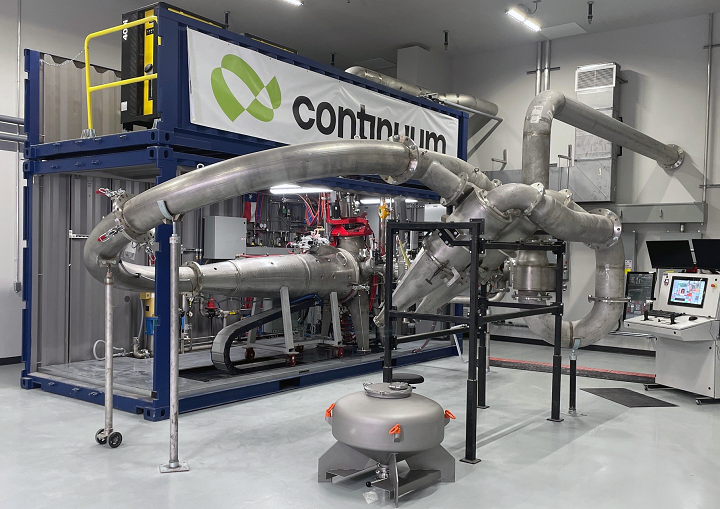
According to a new independent life cycle assessment (LCA) by the Industrial Sustainability Laboratory at Oregon State University (OSU), Continuum Powders’ recycling process for producing nickel powders from scrap lowers carbon emissions by 99.7 percent when compared to conventional processes. Continuum’s proprietary Greyhound Melt-to-Powder (M2P) technology eliminates the processing stages required when using virgin extracted nickel, with the mining process contributing to 96 percent of the carbon footprint associated with conventional nickel powder production.
The remaining reductions in carbon footprint result from the fact that Greyhound M2P avoids the need to convert mined powder into pre-alloyed ingots or wired feedstock. Continuum, based in Houston, has previously demonstrated the Greyhound M2P’s viability for recycling scrap oil and gas parts made from nickel-alloy Ni718 (Inconel) into metal powder for 3D printed parts, in partnership with contract manufacturer Knust-Godwin (also Houston-based).
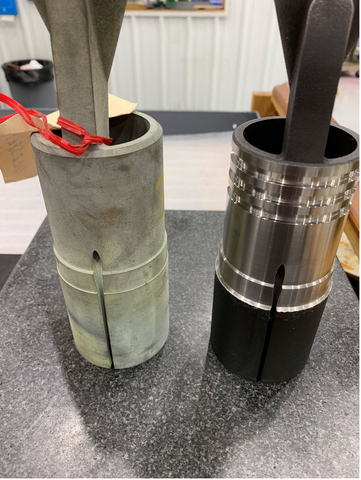
Scrap oil & gas part that Knust-Godwin turned into a printed part with Continuum metal powder
In December, 2024, Continuum Powders opened its global headquarters in Houston, featuring what the company claims is North America’s “largest” sustainable powder production site. Continuum also maintains an Asia-Pacific Production & Sales Center in Singapore, as well as a US Technology Center in California.
In a press release, Continuum’s CTO, Sunil Badwe, PhD, said, “This study confirms what we’ve known — sustainable metal powder production is not just an aspiration; it’s a reality. By transitioning from virgin to recycled metal feedstocks, we’re proving that sustainability and high-performance manufacturing can go hand in hand. The results of this LCA study validate our commitment to reducing emissions while delivering high-quality powder solutions. With 99.7% reduction in carbon emissions than the conventional gas atomizing, Continuum’s powder manufacturing is the most environmentally sustainable method available today, to our best knowledge.”
Co-author of the study, OSU professor of Advanced Manufacturing Karl Haapala, said, “Our findings demonstrate how focused and thoughtful development of advanced technologies and use of industry best practices can improve the sustainability profile of products we use every day. Availability of more sustainable metal powders will aid in the continued reduction of impacts of novel products produced using advanced additive manufacturing [AM] methods.”
As Continuum Powders CEO Rob Higby told 3DPrint.com in a December, 2024 interview, “If you just want a commodity metal, we’re probably not the company for you.” Instead, Higby explained, he sees the company’s business model as being most appealing to companies that are committed to a long-term vision of providing the highest-value products to their customers.
This aligns quite nicely with what Steven Camilleri, SPEE3D CTO, recently said about his vision for Make Stuff Here, an initiative aiming to build up Australia’s future industrial landscape by maximizing value density of manufactured exports with advanced manufacturing and high-grade materials. And this emerging philosophy does much to explain how manufacturing can be revitalized and sustained in the Western world in a way that’s not anachronistic, as the concept of reshoring often seems to its detractors.
In addition to oil and gas, Continuum, with its presence in a state that is one of the US’s hottest growth areas for data center activity, may be perfectly poised to capture what a recent AM Research report views as an “exponential” growth opportunity for AM over the next decade. Hardware for the AI boom is exactly the sort of product category that makes reshoring make sense, and the data center industry would seem to be an ideal fit for Continuum’s commitment to a long-term vision of maximizing quality and localizing production.
Images courtesy of Continuum Powders
Subscribe to Our Email Newsletter
Stay up-to-date on all the latest news from the 3D printing industry and receive information and offers from third party vendors.
Print Services
Upload your 3D Models and get them printed quickly and efficiently.













You May Also Like
Kalogon Wants to Patent Its Variable Density Wheelchair Cushion
Kalogon has brought the Verro to market. This is a 3D printed wheelchair cushion, made with vat polymerization technology. Using a variable density lattice, it hopes to give wheelchair users...
Pogačar & Fairlight Cycles Show Us Low Cost 3D Printed Components for Bikes
There has been a lot going on in 3D printing for bicycles over the years. The most successful implementation so far is in bicycle seats. Carbon 3D printed seats are...
3DPOD 295: From Product to Design at Carbon, with Kristi Eveland Smith
Kristi Eveland Smith started as a competitive soccer player before moving into consulting, operations, and 3D printing. She’s now Vice President, Design to Production at Carbon 3D and has been...
AMS 2026 in Photos: Snow, Songs, and Serious Conversations
AMS 2026 may have been altered by flight delays and snow-covered streets, but once you made it, the energy felt anything but frozen. This year’s Additive Manufacturing Strategies, which wrapped...