O’Neal Subsidiary UPM Buys Fabrisonic for Ultrasonic 3D Printing

UPM, a subsidiary of O’Neal Industries, is a U.S.-based specialty metals firm. The company refurbishes LPBF build plates, sells wire feedstock, and supplies LPBF powder. Additionally, UPM provides services such as deburring, heat treatment, and packaging. Its business model focuses on managing the entire metal value chain by taking over recurring, high-volume, non-core activities for metal manufacturers, executing them efficiently to generate cost savings for customers while ensuring profitability.
For its part, O’Neal is a $3.6 billion revenue metals service center company based in Birmingham, Alabama. With about 4,000 employees, O’Neal was listed by Forbes as the 171st largest private firm in the U.S. The company boasts 90 facilities across North America, Europe and Asia, focusing on supplying aluminum, alloy, hot-rolled, cold-finished, and stainless steel products to a range of customers, from job shops and OEMs to heavy industry and aerospace customers.
“I am proud of what our team has accomplished and am excited about the future, This acquisition opens up new opportunities for both Fabrisonic and our customers, and I look forward to seeing what we can achieve together moving forward,” said Henry Cialone, Fabrisonic Chairman of the Board and CEO of Edison Welding Institute.
“We are thrilled to welcome Fabrisonic to the United Performance Metals family. Their cutting-edge technology and expertise will significantly bolster our capabilities to create unique materials to support our innovative manufacturing customers,” contributed United Performance Metals CEO Peter Neuberger.
“This is a significant step forward for Fabrisonic. Joining the United Performance Metals family of companies will enable Fabrisonic to leverage greater resources and expanded capabilities. This will allow us to increase our market reach and continue to bring novel solutions to our customers. Kudos to our incredible team of engineers, both past and present, for getting us to this point. We have a bright future ahead and are excited for this next step,” added Fabrisonic General Manager Jason Riley.
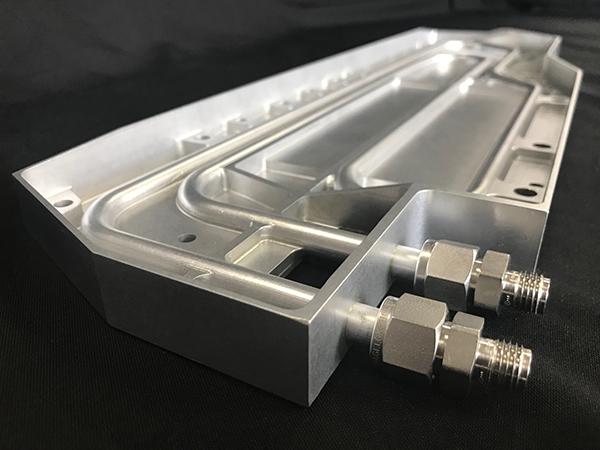
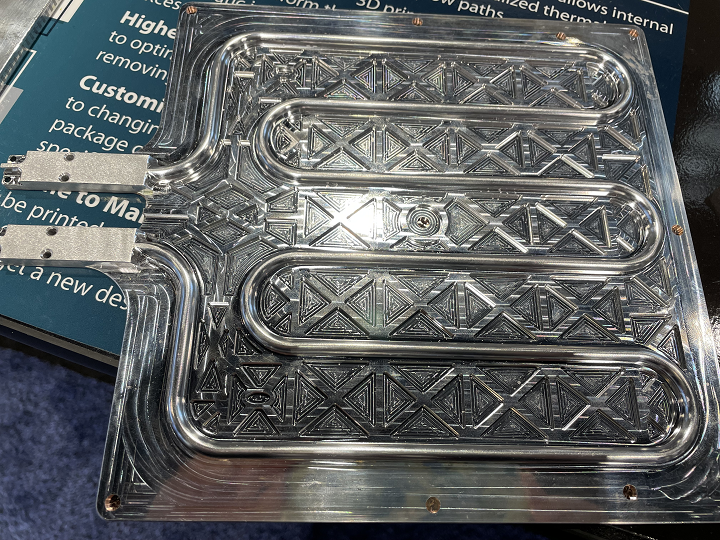
Ultrasonic welding techniques eliminated the need for thermal interfaces and hardware in this aluminum heat exchanger Fabrisonic made for the Jet Proulsion Laboratory. As a result, the heat exchanger weighs almost 30% less and performs 30% better than parts made through traditional methods. Image courtesy of Fabrisonic.
By transitioning from peripheral manufacturing services to direct part production and machine sales using 3D printing, UPM is making a strategically astute move. Expanding into LPBF part production or forming a reseller arrangement with a powder bed fusion firm could risk alienating partners or clients. However, Fabrisonic operates in a completely different space.
Ultrasonic additive manufacturing offers a unique set of advantages. As a solid-state process conducted at low temperatures, it avoids the extreme thermal conditions of other 3D printing technologies, resulting in distinct material properties and process benefits. The ability to integrate wiring and sensors directly into housings, as well as combine dissimilar materials like copper and aluminum within a single part, opens up novel engineering possibilities.
Applications such as oscillating heat pipes—highly efficient, micro-channel-based heat exchangers often used in defense—could prove particularly valuable. These components have the potential to enhance battery performance, RF systems, and avionics, where they may outperform existing alternatives. Defense applications, in general, present a broad range of opportunities for Fabrisonic’s technology.
UPM’s acquisition positions the company to establish highly specialized, high-value business lines in the future, making this a smart and forward-thinking investment.
Subscribe to Our Email Newsletter
Stay up-to-date on all the latest news from the 3D printing industry and receive information and offers from third party vendors.
Print Services
Upload your 3D Models and get them printed quickly and efficiently.













You May Also Like
UniFormation S10 Heads to Kickstarter with an Integrated Resin Printing and Post-Processing System
UniFormation will launch its S10 desktop resin 3D printer on Kickstarter on October 22, 2026, with pledges starting at $999. The S10 integrates printing, washing, and drying, allowing a print...
Creality Goes Pro with Sermoon P1S 3D Scanner
From making millions of value-engineered Prusa clones, Creality really has aggressively pivoted to more complex machines. The company has made strides forward in software, and the Ender’s of yore is...
Stratasys Showcases 3D Printed Automotive Applications & New Printer at IMTS 2026
Just ahead of last week’s International Manufacturing Technology Show (IMTS) in Chicago, Stratasys launched the F870, a new large-format, production-grade FDM 3D printing platform designed to drive industrial manufacturing at...
Creality Launches SPARKX i8 on Indiegogo, Bringing Fastest, No-Purge-Waste Printing
Creality announces the launch of the multi-color 3D printer SPARKX i8 on Indiegogo, at an early-bird price of $309 (MSRP $399) starting from Sept. 21. Designed for ultimate user experience,...